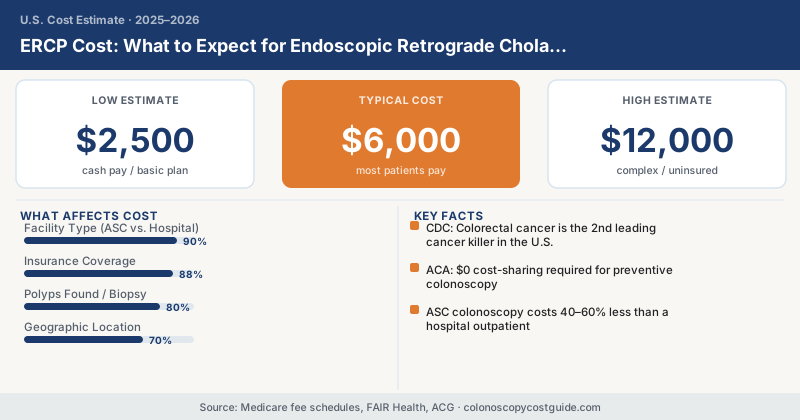
ERCP Cost: What to Expect for Endoscopic Retrograde Cholangiopancreatography
That $8,500 estimate your GI specialist handed you isn’t a mistake — ERCP is one of the most technically demanding outpatient procedures in gastroenterology, and the price tag reflects it.
ERCP (endoscopic retrograde cholangiopancreatography) threads a flexible scope through your mouth, past your stomach, into your small intestine — then uses X-ray guidance to treat blockages, stones, or strictures in the bile ducts or pancreatic duct. It’s both diagnostic and therapeutic, which means higher complexity billing. Here’s exactly what you’re paying for.
What Does ERCP Cost in 2025–2026?
Costs swing significantly based on whether you’re at a hospital outpatient department or a specialized ambulatory surgery center, and on what the procedure involves. A straightforward diagnostic ERCP is cheaper than one that includes stone removal, stent placement, or a sphincterotomy.
According to FAIR Health data, the national median charge for ERCP with stent placement (CPT 43264) at a hospital outpatient department is roughly $9,000 to $13,000 before insurance adjustments. The physician fee alone runs $1,200 to $3,500.
| Component | Typical Range |
|---|---|
| Facility fee (hospital outpatient) | $5,000 – $11,000 |
| Gastroenterologist / GI surgeon fee | $1,200 – $3,500 |
| Anesthesia (propofol, CRNA or MD) | $800 – $2,000 |
| Radiology / fluoroscopy interpretation | $200 – $600 |
| Pathology (if biopsy taken) | $150 – $500 |
| Total without insurance | $4,000 – $14,000+ |
Why ERCP Costs More Than a Standard Colonoscopy
Three things drive the higher price:
- Fluoroscopy: ERCP requires real-time X-ray imaging during the procedure — that’s extra equipment, a separate technician, and a radiology read fee.
- Specialized training: Not every gastroenterologist does ERCP. It requires advanced fellowship training, and those specialists bill at higher rates.
- Longer procedure time: A routine colonoscopy takes 20–45 minutes. An ERCP with stone extraction can take 60–90 minutes or more — anesthesia time alone adds cost.
The American Society for Gastrointestinal Endoscopy (ASGE) estimates roughly 500,000 ERCPs are performed annually in the United States. The vast majority are done to treat — not just diagnose — a biliary or pancreatic problem, so there’s almost always a therapeutic component adding to the bill.
Does Insurance Cover ERCP?
Yes — when it’s medically necessary. ERCP is diagnostic and therapeutic, which means standard insurance rules apply: you’ll typically pay your deductible first, then coinsurance (usually 10–30%) up to your out-of-pocket maximum. Unlike preventive colonoscopies, there’s no “free preventive” exemption for ERCP under the ACA.
Medicare coverage: Medicare Part B covers ERCP when it’s medically necessary. You’ll pay 20% of the Medicare-approved amount after your Part B deductible ($257 in 2025). A Medigap supplement can eliminate most of that cost-sharing.
What Affects Your ERCP Bill Most
- In-network vs. out-of-network status of both the facility AND the physician — they can differ
- What’s done during the procedure: stone removal (43264), stent placement (43264), sphincterotomy (43262) each carry different CPT codes and add cost
- Hospital vs. ASC: some academic medical centers and hospital systems are the only facilities in a region doing ERCP — meaning no ASC option
- Anesthesia type: deep sedation with propofol (standard for ERCP) costs more than moderate sedation
ERCP Cost With and Without Insurance
With insurance: Most patients who’ve met their deductible pay $500 to $2,500 out of pocket depending on coinsurance rate and plan maximums. Patients who haven’t touched their deductible could owe the full deductible amount — commonly $1,500 to $5,000.
Without insurance: Cash prices are negotiable but rarely cheap. Hospital-based ERCP without insurance typically runs $5,000 to $12,000 all-in. Ask the hospital financial counselor about charity care programs — ERCP patients are often hospitalized or referred from the ER, which strengthens eligibility.
| Scenario | Estimated Out-of-Pocket |
|---|---|
| Medicare (Part B, after deductible) | $300 – $900 |
| Private insurance, deductible met | $500 – $2,000 |
| Private insurance, deductible NOT met | $1,500 – $5,000 |
| No insurance, hospital cash price | $5,000 – $12,000 |
| No insurance, ASC (where available) | $3,500 – $7,500 |
Questions to Ask Before Your ERCP
Don’t walk in blind. A few calls ahead of time can save you thousands:
- Is the GI specialist in-network? Check your insurer’s portal — not the hospital’s.
- Is the radiologist who reads the fluoroscopy in-network? This is a separate physician bill you can easily overlook.
- What’s the anticipated CPT code? Ask the scheduler. Different codes = different cost estimates from your insurer.
- Does the hospital have a financial assistance program? If you’re uninsured or underinsured, ask for a financial counselor before the procedure.
The Bottom Line
ERCP is expensive, but it’s almost always done when there’s no simpler option. If you have bile duct stones, biliary obstruction, or a pancreatic duct problem, this is the least invasive way to fix it without open surgery. Budget for $4,000 to $14,000 without insurance, and call your insurer before scheduling to get a cost estimate in writing. If you’ve already met your annual deductible, the timing of your ERCP can make a real difference in what you pay.