Eosinophilic Esophagitis (EoE) Treatment Cost: Dupilumab, Diet, and Endoscopy
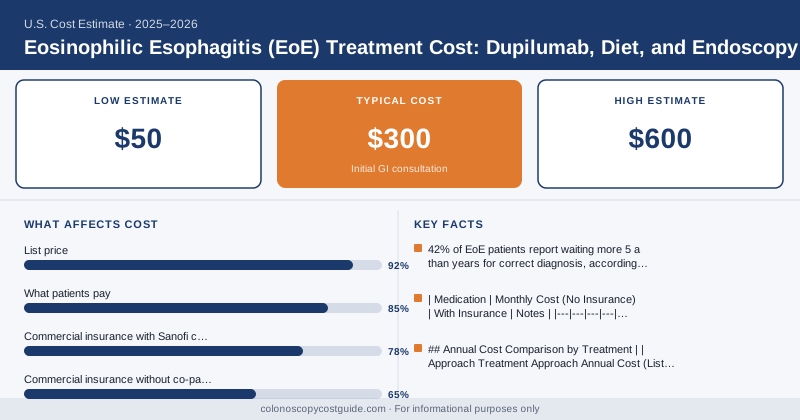
42% of EoE patients report waiting more than 5 years for a correct diagnosis, according to the American Partnership for Eosinophilic Disorders (APFED). During that time, they’re racking up costs for procedures, dietary consultations, and medications that treat the wrong condition. Once EoE is confirmed, you face a new cost reality: dupilumab (Dupixent) at $3,000–$4,500 per month at list price, or an elimination diet that’s free on paper but requires expensive allergy testing and ongoing dietitian support. Here’s the actual financial picture.
Eosinophilic esophagitis was barely recognized as a distinct disease before the 1990s. Today, the ACG estimates it affects approximately 1 in 2,000 Americans — about 160,000–180,000 people — with the diagnosis rate rising dramatically as awareness increases. It’s not rare anymore; it’s underdiagnosed.
Getting to Diagnosis: The Testing Costs
EoE requires endoscopic biopsy to confirm — you can’t diagnose it with symptoms or blood tests alone.
| Diagnostic Step | Cost Without Insurance | With Insurance (OOP) | Notes |
|---|---|---|---|
| Initial GI consultation | $300–$600 | $50–$200 | Often after primary care referral |
| Upper endoscopy (EGD) with biopsy | $2,500–$5,500 | $500–$2,500 | Multiple biopsies from different levels |
| Pathology reading | $300–$900 | $100–$400 | Biopsy interpretation |
| Allergy skin testing | $200–$800 | $100–$300 | Identifies food triggers |
| Food-specific IgE blood panel | $300–$700 | $100–$250 | 6-food or extended panels |
| pH-impedance testing | $1,500–$3,500 | $300–$800 | Rules out GERD overlap |
| Esophagram (barium swallow) | $800–$2,000 | $200–$600 | Evaluates structural narrowing |
The endoscopy with biopsy is the diagnostic cornerstone. Patients with EoE often need repeat endoscopies to assess treatment response — so the diagnosis cost isn’t one-time. For many patients, that first upper endoscopy starts a years-long cycle of procedures.
Treatment Option 1: Dupilumab (Dupixent) — The New Gold Standard
In 2022, dupilumab became the first FDA-approved medication specifically for EoE. It works by blocking IL-4 and IL-13 signaling — the same mechanism behind its approvals for asthma and atopic dermatitis. The clinical trial results were strong: histologic remission in ~50% of patients at week 24.
List price: $3,000–$4,500 per month (~$36,000–$54,000/year)
This is the WAC (Wholesale Acquisition Cost). Insurance-negotiated rates are lower — typically 20–35% below list.
What patients pay:
- Commercial insurance with Sanofi co-pay card: Eligible patients may pay as little as $0–$35 per month. Sanofi’s MyWay program offers this assistance for commercially insured patients.
- Commercial insurance without co-pay card assistance: Specialty tier copay ranges $200–$600/month, depending on plan.
- Medicare Part D: Dupilumab is an injectable administered at home, so it falls under Part D. The 2025–2026 IRA cap of $2,000/year on Part D out-of-pocket costs provides significant relief.
- Medicaid: Coverage varies by state; prior authorization required. Some states require step therapy (trying PPI or swallowed steroids first).
Dupilumab Administration: Self-Injection vs. In-Office
Unlike biologics for Crohn’s disease that require IV infusions, dupilumab is a subcutaneous injection you give yourself at home — typically every 2 weeks after an initial loading dose. This means:
- No infusion center fees
- No IV administration charges
- Covered under medical (Part B) or pharmacy (Part D) depending on your plan
Ask your insurer whether dupilumab is covered under medical or pharmacy benefits — the answer affects your cost-sharing significantly.
Treatment Option 2: Swallowed Corticosteroids
Before dupilumab, swallowed topical steroids (fluticasone inhaler swallowed rather than inhaled, or budesonide oral suspension) were the main pharmacological treatment. They’re far less expensive but less effective than dupilumab.
| Medication | Monthly Cost (No Insurance) | With Insurance | Notes |
|---|---|---|---|
| Swallowed fluticasone (off-label) | $50–$150 | $10–$50 | Using asthma inhaler off-label; inexpensive |
| Budesonide oral suspension (Eohilia) | $1,500–$2,500 | $200–$500 | FDA-approved for EoE (2024) |
| Budesonide capsule (Jorveza — EU) | Not available in US | N/A | Approved in Europe |
| Omeprazole (PPI — often tried first) | $15–$30 OTC | <$10 | Not curative; used for acid component |
Eohilia (budesonide 2 mg oral suspension, Ellodi Pharmaceuticals) received FDA approval in February 2024, the second FDA-approved EoE treatment. It’s specifically formulated to coat the esophagus. Prior to its approval, swallowed fluticasone from an asthma inhaler was an off-label but inexpensive option used by GI specialists for years.
Treatment Option 3: Dietary Elimination Therapy
The six-food elimination diet (6-FED) removes milk, wheat, eggs, soy, nuts/peanuts, and seafood — the most common EoE triggers. Response rates are 70–80% in children, 50–60% in adults. It’s potentially curative (you may identify your trigger and avoid it long-term) but requires intensive support and repeated endoscopies to test each food reintroduction.
Real costs of dietary therapy:
- Initial registered dietitian consultation: $150–$350 per visit; 4–6 visits during elimination phase
- Allergy testing (to narrow down triggers before starting): $200–$800
- Specialty foods (hypoallergenic alternatives to eliminated foods): $100–$300/month in additional grocery costs
- Repeat endoscopy after each food reintroduction: $2,500–$5,500 per procedure, $500–$2,500 with insurance
If you’re testing 6 food groups individually, that’s 6 rounds of dietary reintroduction over 12–18 months, each requiring an endoscopy. Total dietary therapy cost over 18 months including procedures: $15,000–$40,000 without insurance. With insurance and assuming you’ve hit your deductible: $3,000–$10,000.
Esophageal Dilation: When Strictures Form
Long-standing EoE often creates esophageal narrowing (strictures) from chronic eosinophilic inflammation. Patients with significant strictures may need dilation regardless of which treatment they choose.
| Procedure | Cost Without Insurance | With Insurance (OOP) | Notes |
|---|---|---|---|
| Esophageal dilation (endoscopic) | $2,000–$5,500 | $400–$2,000 | Done under sedation |
| Repeat dilation (3–6 months later) | $2,000–$5,500 | $400–$2,000 | Often needed 1–3 times initially |
| Ongoing maintenance dilation | $2,000–$5,500 | $400–$2,000 | Annually in some patients |
About 30–40% of adult EoE patients will need at least one dilation. Dilation treats the mechanical narrowing but doesn’t address the underlying eosinophilic inflammation — that requires medical or dietary treatment. It’s typically combined with, not substituted for, active EoE therapy.
Annual Cost Comparison by Treatment Approach
| Treatment Approach | Annual Cost (List/Uninsured) | With Insurance (Est.) |
|---|---|---|
| Dupilumab alone | $36,000–$54,000 | $0–$7,500 (co-pay card + OOP max) |
| Budesonide oral suspension | $18,000–$30,000 | $2,400–$6,000 |
| Swallowed fluticasone (off-label) | $600–$1,800 | $120–$600 |
| Dietary therapy (year of reintroductions) | $20,000–$45,000 | $4,000–$12,000 |
| Dietary therapy (maintenance after ID trigger) | $1,200–$3,600 | $200–$800 |
Swallowed fluticasone looks cheapest, but it has lower efficacy and isn’t FDA-approved for EoE. If it doesn’t work and you move to dupilumab later, you’ve spent 6–12 months on an ineffective treatment while disease continues.
Insurance Coverage and Prior Authorization
EoE is now well-established in clinical guidelines, but insurer behavior varies:
Dupilumab prior authorization: Most plans require documentation of EoE diagnosis via biopsy (eosinophil count ≥15 per high-power field), and often a trial of PPIs or swallowed steroids first (step therapy). Have your GI provide clinical notes supporting medical necessity.
Dietary therapy coverage: Allergen testing is typically covered under your medical benefit. Dietitian visits are covered under most ACA-compliant plans as preventive services or with a copay. Specialty foods are NOT covered by most insurance plans (some Medicaid states are exceptions).
Endoscopy for monitoring: Routine follow-up endoscopies for EoE monitoring are typically covered as diagnostic procedures — not as preventive colonoscopy under the ACA’s free preventive services provision.
For patients already navigating the GI healthcare system, understanding the full colonoscopy cost picture alongside EoE-specific endoscopy costs helps with annual budgeting.
Questions to Ask Your GI and Allergist
- Is my eosinophil count clearly above the ≥15/HPF diagnostic threshold?
- Should I try dietary therapy, medication, or both? What’s the evidence for my specific case?
- If I start dupilumab, will my plan cover it, and what step therapy is required?
- How many follow-up endoscopies should I expect in the first year?
- Is there an EoE patient support group or online community that can share real-world insurance navigation tips?
EoE is manageable — and costs are highly variable based on treatment path. Getting the diagnosis right and then picking the most cost-effective approach for your specific triggers and insurance situation makes an enormous difference.