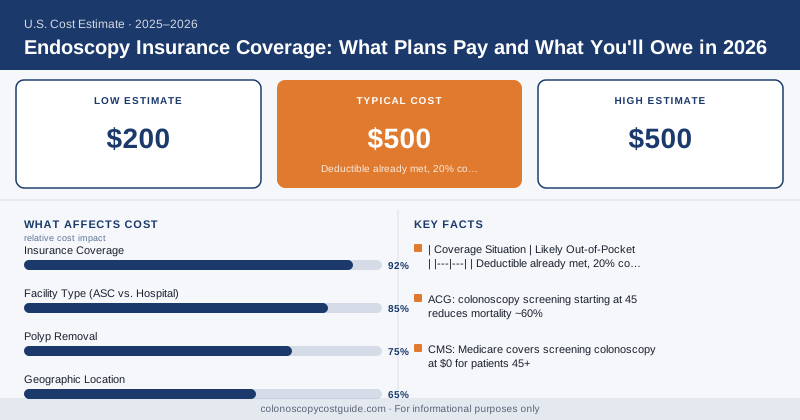
Endoscopy Insurance Coverage: What Plans Pay and What You'll Owe in 2026
{ if eq .Lang "zh" }{ else }{ end }Here’s a surprise that catches a lot of patients: your colonoscopy screening was free, so you assume your upper endoscopy will be too. It almost never is. The difference comes down to one word — preventive — and an endoscopy usually isn’t.
That single distinction is why you can walk out of a colonoscopy owing $0 and an endoscopy owing $900. Let’s unpack how insurance actually treats endoscopy.
Why Endoscopy Isn’t Free
A screening colonoscopy is covered at $0 because the ACA mandates preventive colorectal cancer screening. There’s no equivalent federal mandate for upper endoscopy (also called an EGD, esophagogastroduodenoscopy). An endoscopy is ordered to investigate symptoms — reflux, swallowing trouble, abdominal pain, suspected ulcers — which makes it diagnostic by definition. Diagnostic means cost-sharing applies. Our screening versus diagnostic guide explains the broader principle.
Key Takeaway
What You’ll Actually Owe
The total billed amount for an endoscopy often runs $1,500 to $3,000 before insurance, with the facility fee as the biggest line. Your out-of-pocket share depends on your plan and how much of your deductible you’ve met.
| Coverage Situation | Likely Out-of-Pocket |
|---|---|
| Deductible already met, 20% coinsurance | $200–$500 |
| Deductible partially met | $500–$1,200 |
| High-deductible plan, deductible unmet | Full negotiated rate $1,200–$2,000 |
| Medicare (Part B, after deductible) | ~20% coinsurance |
| Uninsured / self-pay | $1,500–$3,000 (negotiable) |
The cost structure mirrors a colonoscopy because the procedures are similar — same facility, same anesthesia, same pathology if biopsies are taken. If you want the colonoscopy comparison, our colonoscopy vs endoscopy cost overview lines them up.
The Multi-Provider Bill Problem
Like colonoscopies, endoscopies generate bills from multiple providers: the facility, the gastroenterologist, the anesthesiologist, and possibly a pathology lab. Each may have different network status, which is how surprise out-of-network bills happen. The No Surprises Act protects you here — if the facility was in-network but the anesthesiologist wasn’t, you generally owe only your in-network share. See our out-of-network anesthesia guide for how that protection works.
Prior Authorization and Medical Necessity
Many plans require prior authorization for endoscopy, especially for non-urgent cases. Because it’s diagnostic, your insurer wants documentation of the symptoms justifying it. If your gastroenterologist’s notes clearly establish medical necessity, authorization is usually straightforward. If they don’t, you risk a denial — and a denied claim means you owe the full negotiated rate. Roughly 20 million GI endoscopic procedures are performed in the U.S. each year according to gastroenterology society estimates, and medical necessity is the gating factor on coverage for nearly all of them.
If You’re Uninsured
Without insurance, you’ll pay the full self-pay rate, but it’s negotiable. Facilities often discount cash payments substantially, and you’re entitled to a good-faith estimate under the No Surprises Act. If the final bill exceeds that estimate by $400 or more, you can dispute it. Our colonoscopy cost without insurance and how to lower your colonoscopy bill guides apply directly to endoscopy too.
Bottom Line
Insurance covers a medically necessary endoscopy — but not for free. Because it’s diagnostic, not preventive, you’ll owe your deductible and coinsurance, typically $200 to $1,500. Confirm all four providers are in-network, make sure prior authorization is handled, and don’t expect the screening-colonoscopy free ride to carry over. If you’re uninsured, the cash rate is negotiable and the good-faith estimate is your leverage.
{ if eq .Lang "zh" }