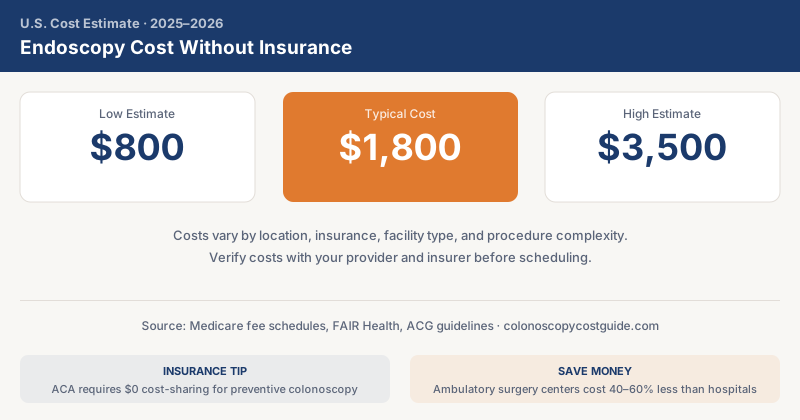
Endoscopy Cost Without Insurance: Cash Prices and Negotiation Tactics
{ if eq .Lang "zh" }{ else }{ end }James, 51, was uninsured and needed a diagnostic colonoscopy. The local hospital quoted him $4,200. The freestanding GI center three miles away quoted him $1,100 for the same procedure. Same surgeon. Different facility. $3,100 difference.
He booked the ASC, paid in full upfront, and got a 10% cash discount on top of the already lower rate. Final bill: $990.
This story isn’t unusual. The gap between hospital and ambulatory surgery center (ASC) pricing for GI endoscopy is one of the most dramatic price disparities in American outpatient medicine. If you’re uninsured, choosing the right facility is the single most powerful cost-reduction move available to you.
What GI Endoscopy Actually Costs Without Insurance
These are realistic cash-pay rates at freestanding endoscopy centers, confirmed by FAIR Health and CMS cost data. Hospital prices are included for comparison.
| Procedure | ASC / Freestanding Center | Hospital Outpatient |
|---|---|---|
| Diagnostic colonoscopy | $800 – $1,800 | $2,500 – $5,000 |
| Colonoscopy with polypectomy | $1,000 – $2,200 | $3,000 – $6,000 |
| Upper endoscopy (EGD) | $600 – $1,400 | $1,800 – $3,500 |
| Combined colonoscopy + EGD | $1,200 – $2,500 | $3,500 – $7,000 |
| Flexible sigmoidoscopy | $300 – $800 | $800 – $2,000 |
| Capsule endoscopy (small bowel) | $1,500 – $2,800 | $2,500 – $4,500 |
These ranges cover the facility fee only. Gastroenterologist and anesthesia fees are typically separate — add $400 to $1,200 total for the physician and anesthesia combined at most ASCs.
Why the Price Gap Exists
Hospitals have higher overhead. They staff 24-hour emergency departments, maintain more infrastructure, and have more complex billing departments. All of that cost gets built into procedure pricing.
Freestanding endoscopy centers do one thing: GI procedures. Lean operations mean lower prices. A 2020 RAND study found that hospital outpatient departments charged commercially-insured patients 247% of what Medicare pays for the same services, while ASCs charged closer to 150% of Medicare rates. Cash-pay patients generally negotiate to somewhere near or below Medicare rates at an ASC.
What Medicare Pays as Your Anchor Price
How to Negotiate Your Cash Price
This isn’t complicated, but it requires you to ask directly and be willing to call multiple providers. Here’s the process:
Step 1: Search for freestanding GI or endoscopy centers in your area. Use Google Maps searching “endoscopy center” or “gastroenterology ASC.” Not a hospital GI department — specifically freestanding centers.
Step 2: Call and ask one specific question. “What is your self-pay rate for a diagnostic colonoscopy, all-in, including facility, physician, and anesthesia?” Many centers have a bundled cash price they don’t advertise.
Step 3: Reference the Medicare rate. If their quote is significantly above Medicare rates, say: “I understand the Medicare facility rate for this procedure at an ASC is around $300. I’m a cash-pay patient — is there flexibility closer to that range?” Many schedulers have authority to discount.
Step 4: Offer to pay upfront. Cash upfront eliminates their billing risk and accounts receivable costs. Ask for an additional 5 to 15% discount in exchange for paying in full before the procedure.
Step 5: Get everything in writing. Ask for an itemized estimate before you sign anything. Make sure anesthesia is included or that you know exactly what the anesthesia provider will charge separately.
| Negotiation Tactic | Typical Savings |
|---|---|
| Choosing ASC vs. hospital | $1,500 – $3,500 |
| Asking for self-pay rate explicitly | 20–40% off list price |
| Paying upfront | Additional 5–15% |
| Referencing Medicare as anchor | Varies; often another 10–20% |
| Bundled procedure (combined colonoscopy + EGD) | $300–$700 vs. scheduling separately |
Community Health Centers: Sometimes Even Cheaper
If cost is a serious barrier, Federally Qualified Health Centers (FQHCs) offer GI services on a sliding-scale fee basis. Not all FQHCs have on-site endoscopy, but many have arrangements with local GI centers and can coordinate discounted rates for uninsured patients.
Find FQHCs near you at findahealthcenter.hrsa.gov. Income-based fees can reduce your out-of-pocket cost to as little as $0 to $100 for the physician component, with the facility fee negotiated separately.
The CDC reported in 2023 that about 7.9% of US adults under 65 are uninsured. GI centers know this — and many have infrastructure for cash-pay patients. Don’t assume the sticker price is fixed.
What About Hospital Charity Care?
If a hospital is your only realistic option, apply for charity care before your procedure, not after. Every nonprofit hospital is legally required to have a financial assistance program (the ACA requires it). Income thresholds vary, but patients earning below 200 to 300% of the federal poverty level often qualify for significant discounts or free care.
Call the hospital’s billing department or patient financial services office. Ask: “Do you have a financial assistance program, and can I apply before my procedure?” Getting approved before the procedure is far easier than negotiating after.
The Bottom Line for Uninsured GI Patients
You don’t have to pay hospital prices. The single best move for an uninsured patient needing a colonoscopy or upper endoscopy is to find a freestanding ASC, ask for the self-pay rate, and reference Medicare as an anchor. A diagnostic colonoscopy should cost you $800 to $1,400 at an ASC in most US markets. An upper endoscopy should cost $600 to $1,200. Combined procedures are often $1,200 to $2,000.
If that’s still out of reach, see whether an FQHC in your area can help coordinate care. Also explore colonoscopy financing options — CareCredit and similar programs can spread the cost over 12 to 24 months, sometimes at 0% interest.
{ if eq .Lang "zh" }