Endoscopy Biopsy Cost: Pathology Charges, CPT 88305, and H. pylori Add-Ons
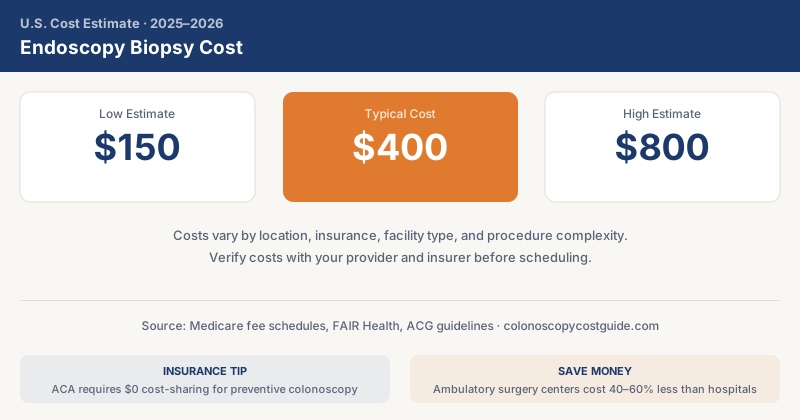
{ if eq .Lang "zh" }{ else }{ end }“They took a few biopsies.” Those four words can add $300 to $1,500 to your endoscopy bill. Here’s exactly how pathology charges work and what to expect on your EOB.
Most patients assume a colonoscopy or upper endoscopy is a single procedure with a single bill. It isn’t. When your gastroenterologist takes tissue samples during the procedure, those samples travel to a pathology laboratory — a completely separate entity from the GI facility — and that lab bills your insurance (and you) independently. Sometimes weeks later.
Understanding how biopsy charges work is the fastest way to avoid a bill you didn’t see coming.
How Pathology Is Billed
When a biopsy is taken during an endoscopy, the tissue sample goes to a pathologist who examines it under a microscope and produces a written report. The pathologist bills for this interpretation using CPT code 88305 — the most common pathology code in GI medicine.
The charge applies per specimen, not per procedure. A colonoscopy where your doctor takes three tissue samples from different locations can generate three separate CPT 88305 charges. An upper endoscopy with biopsies from two sites generates two.
| Biopsy Scenario | Estimated Pathology Charges |
|---|---|
| 1 specimen (single biopsy) | $150 – $300 |
| 2–3 specimens | $300 – $700 |
| 4–6 specimens | $500 – $1,200 |
| 7+ specimens (extensive sampling) | $800 – $2,000 |
| H. pylori rapid urease test (add-on) | $50 – $150 |
| H. pylori culture/sensitivity (additional) | $100 – $300 |
These charges reflect what the pathology lab bills — not necessarily what you’ll pay. Most insurers have contracted rates significantly below list price. Your actual cost-sharing depends on whether your deductible is met, your coinsurance rate, and whether the pathology lab is in-network with your plan.
The In-Network Trap for Pathology
Here’s a billing risk many patients don’t anticipate: the pathology lab that processes your biopsy may not be in the same network as your GI center or hospital.
Your gastroenterologist works at a facility with a contracted pathology lab. If that lab isn’t in your plan’s network, you could receive a surprise bill for out-of-network pathology services — even if your GI physician and facility were both in-network. The No Surprises Act (effective 2022) limits balance billing for emergency services, but its protections for scheduled outpatient procedures like elective colonoscopy are more limited.
Before your procedure, call your insurer and ask: “If biopsies are taken during my colonoscopy or endoscopy, which pathology labs are in-network?” Then confirm with the GI facility which lab they use.
Ask This Question Before Your Procedure
“Which pathology laboratory does this facility send biopsy specimens to, and is that lab in-network with my insurance plan?”
If the answer is that the lab is out-of-network, ask your insurer whether you can designate a specific in-network lab. Some plans allow this; others don’t. Getting this wrong can cost you hundreds of dollars in surprise pathology bills.
CPT 88305: What the Code Actually Covers
CPT 88305 is the billing code for “Level IV Surgical Pathology, Gross and Microscopic Examination.” It applies to a broad range of tissue specimens, including:
- Colorectal polyps (adenomatous, sessile serrated, hyperplastic)
- Gastric biopsies (for H. pylori, gastritis, dysplasia)
- Esophageal biopsies (Barrett’s surveillance, esophagitis)
- Duodenal biopsies (celiac disease)
The Medicare-approved amount for CPT 88305 nationally is approximately $60 to $90 per specimen. Private insurer rates are typically higher. Uninsured/cash-pay patients are often charged list price, which can be $150 to $350 per specimen before any negotiation.
H. pylori Testing: An Add-On Cost
If your gastroenterologist is evaluating for Helicobacter pylori infection during an upper endoscopy, there are two testing approaches:
Rapid urease test (CLO test): A direct test on the biopsy tissue at the time of the procedure. Results are available before you leave the endoscopy center. Billed separately from the standard pathology processing. Adds approximately $50 to $150 to your bill.
Histologic evaluation: The pathologist examines the biopsy tissue under the microscope specifically for H. pylori organisms. This is included within the standard CPT 88305 biopsy interpretation in most cases, though some labs bill an additional IHC (immunohistochemical) stain if needed.
According to the ACG 2022 clinical guidelines on H. pylori, testing is appropriate during upper endoscopy when there’s peptic ulcer disease, unexplained dyspepsia, or active gastric bleeding. If you’re getting an EGD for heartburn or reflux alone, your doctor may or may not test for H. pylori — ask before the procedure so you understand what you’re authorizing.
| Test During Endoscopy | Typical Additional Cost | Medicare-Approved Amount |
|---|---|---|
| Rapid urease test for H. pylori | $50 – $150 | ~$30–$50 |
| Pathology biopsy (CPT 88305) per specimen | $150 – $350 | ~$60–$90 |
| IHC stain (additional pathology) | $100 – $250 | ~$60–$80 |
| Polyp pathology (CPT 88305) | $150 – $350 | ~$60–$90 |
How Many Biopsies Is Normal?
During a colonoscopy with no visible polyps, most gastroenterologists don’t take biopsies unless there’s a specific concern. For upper endoscopy evaluating GERD, a standard protocol might include one or two esophageal biopsies for Barrett’s surveillance.
If your doctor is following the Sydney Protocol for H. pylori evaluation, they typically take five biopsies from specific stomach locations. That’s five separate CPT 88305 charges.
Patients with Barrett’s esophagus undergo Seattle Protocol biopsies — four-quadrant biopsies every 1 to 2 centimeters. A 4cm segment of Barrett’s can generate 8 to 12 specimens. That’s $400 to $1,500 in pathology alone.
The number of biopsies isn’t a choice you make during the procedure — it’s a clinical decision your gastroenterologist makes based on what they see. But you should know in advance what the billing implications are.
For a full picture of what your colonoscopy or upper endoscopy will cost including all components, see the colonoscopy cost breakdown.
{ if eq .Lang "zh" }