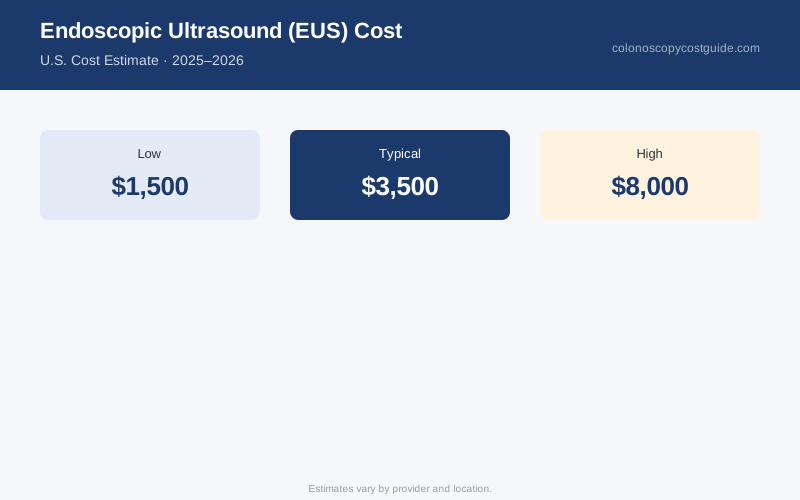
Endoscopic Ultrasound (EUS) Cost: What Patients Pay in 2025–2026
The GI specialist orders an EUS and suddenly you’re staring at a bill estimate that reads $4,200. That’s not a typo — and it’s not unusual. Endoscopic ultrasound combines the scope work of an upper endoscopy with real-time ultrasound imaging, which means more equipment, more expertise, and a higher price tag than a standard EGD.
Here’s what you’re actually paying for, and how to keep the cost as low as possible.
What Is EUS and Why Does It Cost More?
EUS (endoscopic ultrasound) threads a flexible endoscope with a miniature ultrasound transducer on its tip into your upper GI tract or, in some cases, the rectum. It creates detailed images of structures that a standard scope can’t see — pancreatic cysts, lymph nodes, submucosal tumors, and bile duct stones.
The American Society for Gastrointestinal Endoscopy (ASGE) notes that EUS is particularly valuable for staging cancers and evaluating pancreatic lesions, which is why it’s performed at specialized GI centers rather than every outpatient clinic. That specialization drives the cost.
EUS Cost Breakdown in 2025–2026
Costs vary most by whether the EUS is purely diagnostic or includes a fine-needle aspiration (FNA) biopsy — the latter adds pathology fees and technical complexity.
| Cost Component | Typical Range |
|---|---|
| Facility fee (hospital outpatient) | $2,000 – $5,500 |
| Facility fee (ambulatory surgery center) | $1,200 – $3,000 |
| Gastroenterologist / EUS specialist fee | $600 – $1,800 |
| Anesthesia (moderate sedation or propofol) | $400 – $1,200 |
| Fine-needle aspiration (FNA) — if performed | $300 – $900 |
| Pathology (cytology review of FNA sample) | $200 – $700 |
| Total (diagnostic only, ASC) | $1,500 – $4,000 |
| Total (with FNA, hospital) | $3,500 – $8,000+ |
Without insurance, most patients pay $2,000 to $5,500 for a straightforward diagnostic EUS. Add FNA biopsy and you’re looking at $4,000 to $8,000 or more at a hospital outpatient setting.
What Drives the Cost Up or Down?
Location matters — a lot. A 2023 FAIR Health analysis found that EUS charges at hospital outpatient departments run 40–60% higher than at freestanding ambulatory surgery centers for the same CPT codes. If your GI specialist has privileges at both, ask about the ASC option.
Diagnostic vs. therapeutic. Standard EUS is diagnostic. EUS-guided drainage of a pancreatic pseudocyst or EUS-guided celiac plexus neurolysis adds procedure codes — and fees.
Geographic variation. Urban centers in New York, San Francisco, and Boston average $1,000–$2,000 higher than comparable procedures in the Midwest or South.
Subspecialist premium. EUS requires advanced training beyond standard GI fellowship. Subspecialists who perform hundreds of cases per year charge more than general gastroenterologists — though they also tend to have lower complication rates.
Insurance Coverage for EUS
Most major insurers — including Medicare, Aetna, BCBS, and UnitedHealthcare — cover EUS when it’s medically necessary. Common covered indications include:
- Evaluation of known or suspected pancreatic cancer
- Staging of esophageal, gastric, or rectal cancer
- Assessment of submucosal lesions (e.g., GISTs, carcinoid tumors)
- Evaluation of bile duct stones not visible on ultrasound
- Evaluation of unexplained upper abdominal pain with abnormal imaging
Prior authorization is almost universal. EUS is rarely approved as a first-line test — insurers typically require documentation that less expensive imaging (CT, MRI, transabdominal ultrasound) was tried first or is insufficient.
Before You Schedule: Insurance Checklist
- Confirm your GI specialist and the facility are both in-network — EUS is often performed at specialized centers that may be out-of-network.
- Get prior authorization in writing before your procedure date.
- Ask specifically whether anesthesia is billed separately, and whether the anesthesiologist is also in-network.
- Request the CPT codes in advance: diagnostic EUS is typically 43237–43242; FNA is 43238 or 43242.
Medicare Coverage for EUS
Medicare Part B covers EUS under the same outpatient endoscopy benefit as upper endoscopy. You’ll pay the Part B deductible ($240 in 2025) plus 20% coinsurance after Medicare pays 80%. At an ambulatory surgery center, the facility fee is lower — expect total out-of-pocket of $400–$900 for a standard diagnostic EUS with Medicare.
Medicare Advantage plans may have different cost-sharing, so call your plan’s member services line before the procedure.
Uninsured Options
If you don’t have insurance, several options can reduce what you pay:
- Hospital charity care: Most nonprofit hospitals have financial assistance programs that can reduce your bill by 50–100% based on income.
- Negotiate before the procedure: Ask the billing department for the self-pay or cash-pay rate — it’s often 30–60% less than the chargemaster rate.
- University teaching hospitals: Academic medical centers with GI fellowship programs often perform EUS at lower self-pay rates than private hospitals, and their fellows are supervised by experienced attendings.
EUS vs. Other Imaging — Is It Worth the Cost?
According to a 2022 study in Gastrointestinal Endoscopy, EUS has a sensitivity of over 90% for detecting pancreatic lesions smaller than 2 cm — significantly higher than CT scan (roughly 77%) for lesions in that size range. When your GI doctor recommends EUS over CT or MRI, it’s usually because the diagnostic accuracy difference is clinically meaningful.
That said, if your physician orders EUS to evaluate an incidental finding that CT or MRI can adequately characterize, it’s worth asking whether a repeat or enhanced CT might be sufficient — and cheaper.
Frequently Asked Questions
Does EUS hurt? Most patients are under moderate sedation or propofol during EUS and feel nothing. Mild throat soreness is common afterward, similar to upper endoscopy.
How long does it take? A diagnostic EUS typically takes 30–60 minutes. EUS with FNA or therapeutic procedures can run 60–90 minutes.
Can I combine EUS with other procedures? Sometimes. Some GI specialists combine EUS with upper endoscopy (EGD) in a single session, which can be more cost-efficient than two separate procedures. Ask whether combined billing is possible.
What if the EUS finds something? If a suspicious lesion is found, your gastroenterologist may proceed directly to FNA biopsy in the same session — that adds to the day’s cost but avoids a second procedure and sedation event.
The bottom line: EUS is expensive because it’s genuinely specialized. But with prior auth, in-network confirmation, and an ASC setting where possible, most insured patients pay $200–$800 out of pocket — far less than the sticker price suggests.