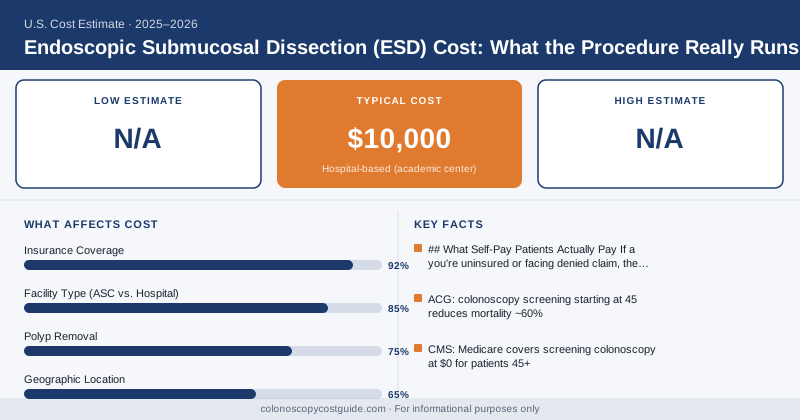
Endoscopic Submucosal Dissection (ESD) Cost: What the Procedure Really Runs
A $12,000 endoscopy that avoids $50,000 in surgery sounds like an obvious choice — and increasingly, it is. Endoscopic submucosal dissection (ESD) is an advanced GI procedure that removes large, flat lesions from the digestive tract without making a single incision. For years it was nearly impossible to get in the US. That’s changed, but the cost is still significant, and insurance decisions can go either way.
Here’s what ESD costs, who pays for it, and when it’s worth it.
What Is Endoscopic Submucosal Dissection?
ESD is a specialized endoscopic technique for removing large gastrointestinal lesions — typically those bigger than 2 cm — from the lining of the esophagus, stomach, or colon. The gastroenterologist injects fluid beneath the lesion to lift it away from the underlying muscle layer, then uses an electrosurgical knife to cut around and under it, removing it in one intact piece (called en-bloc resection).
That en-bloc removal is the key difference from the more common endoscopic mucosal resection (EMR). The ASGE notes that ESD achieves en-bloc resection of large GI lesions without surgery — something EMR can’t reliably do above a certain lesion size. En-bloc matters because it gives pathologists a clean specimen, which means a definitive diagnosis and accurate margin assessment. Piecemeal removal leaves uncertainty.
ESD requires a gastroenterologist with specialized training — often fellowship-trained at an advanced endoscopy center — and usually takes 1 to 4 hours depending on lesion size and location.
How Much Does ESD Cost?
| Setting | Facility Fee | Specialist Fee | Typical Total |
|---|---|---|---|
| Hospital-based (academic center) | $6,000 – $15,000 | $3,000 – $6,000 | $10,000 – $25,000 |
| Ambulatory surgery center (ASC) | $4,000 – $9,000 | $2,500 – $5,000 | $5,000 – $12,000 |
| Anesthesia (required for ESD) | $800 – $2,000 | — | Add to total |
| Pathology (specimen analysis) | $300 – $900 | — | Add to total |
Hospital-based academic medical centers are where most ESD in the US happens today, and their facility fees reflect that. If an ASC in your region has credentialed ESD specialists, you’ll pay noticeably less. Either way, plan for anesthesia and pathology bills to arrive separately from the main procedure bill.
For context, the surgical alternative — partial gastrectomy, esophagectomy, or colectomy depending on lesion location — runs $25,000 to $75,000 at minimum, with a multi-day hospital stay, longer recovery, and greater morbidity. When ESD is technically feasible, it’s almost always the financially and clinically preferred path.
Insurance Coverage: When Will Your Plan Pay?
Coverage for ESD is available but not automatic. Most major commercial insurers cover it as medically necessary when:
- The lesion is documented as a pre-cancerous polyp or early-stage cancer
- Imaging and prior biopsy results support the clinical indication
- A surgical alternative is documented as medically appropriate but ESD is less invasive
- The procedure is performed by a credentialed specialist at an accredited facility
Prior authorization is required by essentially every plan. Your GI team will need to submit documentation including the lesion size, location, biopsy results, and procedural plan. Denials do happen — usually when the insurer challenges the specialist’s credentials or claims the lesion could be removed by standard polypectomy. A peer-to-peer review between your doctor and the insurance medical director resolves many of these.
ESD vs. EMR: The Insurance Tipping Point
What Self-Pay Patients Actually Pay
If you’re uninsured or facing a denied claim, the numbers are steep but not always the sticker price:
| Payer Scenario | Estimated Out-of-Pocket |
|---|---|
| Commercial insurance (in-network, medically necessary) | $1,500 – $4,000 after deductible/coinsurance |
| Medicare (Part B, medically necessary) | 20% of approved amount + deductible |
| Self-pay at ASC | $5,000 – $12,000 |
| Self-pay at hospital | $10,000 – $25,000 |
| Denied claim / full patient responsibility | Full facility + specialist fees |
Most ASCs and academic centers have financial counselors who can negotiate cash-pay rates. The list price is a ceiling, not a floor. Ask explicitly for the self-pay discount before you schedule — a 30 to 50% reduction from listed rates is common for uninsured patients who pay up front.
Complications and Added Costs
ESD’s main risks are perforation (occurring in roughly 4 to 5% of cases) and post-procedural bleeding (around 5%). The good news: both complications are usually managed endoscopically — meaning clips, coagulation, or additional scope work, not emergency surgery. Still, if you’re in that small percentage, you’re looking at additional facility time, possible overnight observation, and added physician fees.
Perforation requiring surgical repair happens in fewer than 1% of cases with experienced operators, but it would significantly increase your total cost. Choosing a high-volume ESD center with experienced staff is the most effective way to reduce both clinical and financial risk.
Before You Agree to ESD
Get answers to these questions before scheduling:
- Has the specialist performed at least 30 to 50 ESD cases? (Volume matters for both outcomes and complication rates.)
- What is your insurer’s prior authorization process, and what documentation does the GI team need to submit?
- Are the facility, specialist, and anesthesiologist all in-network?
- What’s the pathology lab, and is it in-network?
- What’s the contingency plan if perforation occurs during the procedure?
ESD represents a genuine advance in GI care — a procedure that, according to ASGE data, can achieve curative resection for early GI cancers that would otherwise require major surgery. The cost is real, but for many patients it’s a fraction of what surgical resection would run, with a much faster recovery. The key is making sure your insurer agrees before you’re on the table.