Double-Balloon Enteroscopy Cost: Deep Small Bowel Scope Prices in 2026
{ if eq .Lang "zh" }{ else }{ end }You got a bill quoting $9,400 for a double-balloon enteroscopy and your stomach dropped harder than it did during the procedure prep. That figure is real, and it’s not even the top of the range. The good news? Almost nobody with insurance pays the sticker price.
Double-balloon enteroscopy (DBE) is the procedure doctors reach for when they need to see deep into your small intestine — the 20-plus feet a standard scope can’t reach. Two balloons inflate and deflate in sequence, pleating the bowel over the scope like an accordion. It’s slow, technical work, and the price reflects that.
What Double-Balloon Enteroscopy Costs
The total depends heavily on the approach. Antegrade (through the mouth) and retrograde (through the rectum) procedures carry slightly different times and risk profiles, and many patients need both to survey the whole small bowel.
| Cost Component | Hospital Outpatient | Ambulatory Surgery Center |
|---|---|---|
| Facility fee | $3,500 – $7,500 | $2,200 – $4,500 |
| Gastroenterologist fee | $800 – $2,000 | $800 – $1,800 |
| Anesthesia (deep sedation) | $600 – $1,800 | $500 – $1,200 |
| Pathology (if biopsies taken) | $250 – $900 | $250 – $900 |
| Total (uninsured estimate) | $5,200 – $12,000 | $3,800 – $8,400 |
DBE is less common than a standard colonoscopy, so fewer centers offer it. That scarcity nudges prices up, especially in regions where only an academic medical center performs it.
Why It’s So Expensive
This isn’t a 20-minute screening. A full antegrade DBE can run two to three hours, and that time tracks straight to the bill.
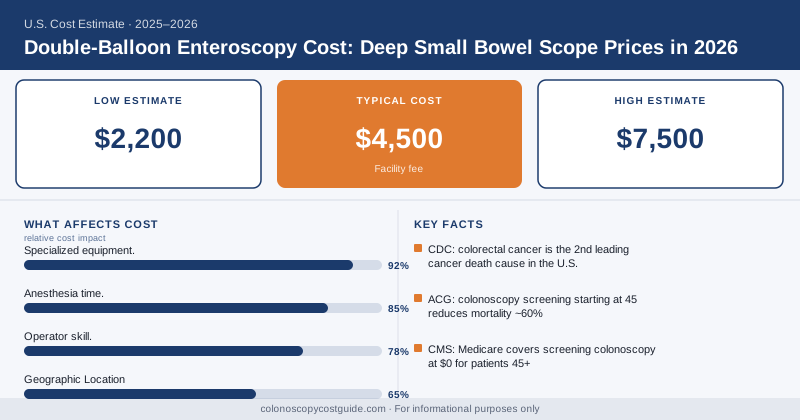
- Specialized equipment. The balloon overtube system and dedicated enteroscope cost far more than standard endoscopes, and centers amortize that into facility fees.
- Anesthesia time. Longer procedure, longer sedation, bigger anesthesia charge. The clock genuinely matters here.
- Operator skill. DBE has one of the steepest learning curves in endoscopy. Per the American Society for Gastrointestinal Endoscopy (ASGE), proficiency often requires dozens of supervised cases, so the physicians who do it command higher fees.
If you’ve read why is colonoscopy so expensive, the same drivers apply here — just amplified.
When You Actually Need It
Doctors don’t order DBE casually. The American College of Gastroenterology notes that obscure GI bleeding — bleeding with a normal colonoscopy and upper endoscopy — is the leading reason. Roughly 5% of GI bleeds originate in the small bowel that those standard scopes miss.
Other indications include suspected small bowel tumors, abnormal capsule endoscopy findings, complicated Crohn’s disease, and retrieving a stuck capsule. The CDC has tracked rising rates of inflammatory bowel disease in U.S. adults, which keeps demand steady for deep small bowel access.
Key Takeaway
Insurance and How to Lower the Bill
Because DBE is reserved for genuine medical problems, payers rarely fight it the way they sometimes contest elective tests. Coverage is the norm. Still, prior authorization is common — get it in writing before the date.
A few practical moves:
- Ask about the setting. A surgery center can be 30–40% cheaper than a hospital outpatient department for the identical procedure.
- Confirm the anesthesia provider is in-network. Out-of-network anesthesiologists are a classic surprise-bill source.
- Bundle the pathology question. If biopsies are likely, ask which lab the samples go to and whether it’s in-network.
How It Compares to Other Small Bowel Tests
If your doctor suspects a small bowel issue but isn’t sure where, a capsule endoscopy often comes first. It’s cheaper and noninvasive, but it can’t biopsy or treat anything. DBE and its cousin, endoscopic ultrasound, are the therapeutic step — you get diagnosis and treatment in one sitting. For bile-duct-related findings, ERCP may be the better tool entirely.
Bottom Line
Double-balloon enteroscopy is one of the pricier endoscopic procedures out there, with uninsured costs spanning $4,000 to $12,000. But it’s not a screening test you’d shop around for casually — it’s a targeted procedure for real problems, which is exactly why insurance tends to cover it. Get prior auth, ask about a surgery center, and verify everyone in the room is in-network. Do those three things and the scary sticker price usually shrinks to a manageable few hundred or couple thousand dollars.
{ if eq .Lang "zh" }