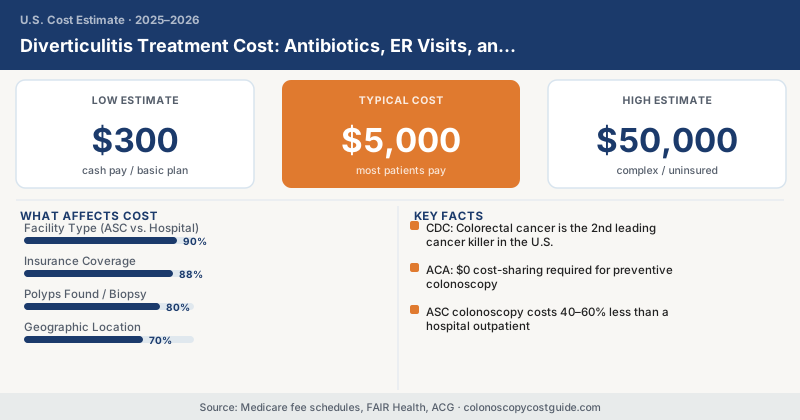
Diverticulitis Treatment Cost: Antibiotics, ER Visits, and Surgery Prices
What started as a low-grade ache in your lower left abdomen can turn into a five-figure hospital bill if it becomes complicated diverticulitis. The cost difference between a mild case and a severe one isn’t gradual — it’s a cliff.
Diverticulitis affects an estimated 200,000 hospitalizations per year in the United States, according to the CDC. It’s the most common GI cause of hospital admission in adults over 50. And the cost range is enormous: an outpatient antibiotic course for a mild case runs $200–$500. An emergency surgery for perforated diverticulitis can exceed $50,000 in hospital charges.
Here’s how to understand what you might face.
Uncomplicated Diverticulitis: Outpatient Treatment Cost
The majority of diverticulitis cases are mild and uncomplicated — treated at home with oral antibiotics and a liquid diet. If your doctor diagnoses you in the office or urgent care and sends you home, you’re looking at:
| Outpatient Component | Typical Cash Cost |
|---|---|
| Primary care or urgent care visit | $150 – $350 |
| Abdominal CT scan (confirms diagnosis) | $400 – $2,500 |
| Antibiotic course (ciprofloxacin + metronidazole, generic) | $30 – $80 |
| Follow-up office visit (2–4 weeks) | $100 – $250 |
| Follow-up colonoscopy (6–8 weeks post-episode) | $800 – $4,000 |
| Total (mild, outpatient) | $1,500 – $7,000 |
Note: the CT scan is the cost driver for outpatient cases. Diverticulitis is diagnosed by CT — a plain X-ray doesn’t cut it. At a hospital outpatient imaging center, a CT abdomen/pelvis with contrast can run $1,500–$3,500 in billed charges before insurance adjustments. At a freestanding radiology center, cash prices are often $400–$800.
A significant but often overlooked cost: the follow-up colonoscopy. The American College of Gastroenterology (ACG) recommends colonoscopy 6–8 weeks after an acute episode of complicated diverticulitis to rule out colon cancer, since tumors can occasionally present with diverticulitis-like symptoms. This adds $800–$4,000 depending on facility type and insurance status.
Moderate to Severe Diverticulitis: Hospitalization Costs
If you have fever, severe pain, inability to tolerate oral intake, or CT findings suggesting pericolic abscess, you’re headed for hospital admission with IV antibiotics — and costs jump dramatically.
| Hospitalization Scenario | Estimated Total Hospital Bill |
|---|---|
| 2–3 day admission, IV antibiotics, no surgery | $8,000 – $20,000 |
| Abscess requiring CT-guided drainage (percutaneous) | $15,000 – $35,000 |
| 5–7 day admission, IV antibiotics + observation | $18,000 – $40,000 |
| Emergency surgery (Hartmann procedure, colostomy) | $30,000 – $80,000+ |
| Elective laparoscopic colon resection (planned, not emergency) | $15,000 – $35,000 |
The nightmare scenario is a perforation — a diverticular hole in the colon leading to peritonitis. Hartmann’s procedure (removal of the perforated segment, temporary colostomy) is life-saving and expensive. You’re looking at $30,000–$80,000 in hospital charges, potentially more with ICU time.
Does Insurance Cover Diverticulitis Treatment?
Yes — all medically necessary treatment is covered. Here’s what you actually pay:
Outpatient (mild case):
- CT scan: deductible + coinsurance; typical patient cost $300–$800 with insurance
- Antibiotics: $10–$30 with insurance pharmacy benefit (generics are cheap)
- Office visits: normal specialist copay ($30–$75 per visit)
Inpatient (hospitalization):
- You pay your inpatient deductible (commonly $1,500–$4,000 per admission)
- Then coinsurance (often 20%) until out-of-pocket maximum
- Most plans hit their annual OOP maximum after a hospitalization
Medicare:
- Part A covers hospitalization after the Part A deductible ($1,676 in 2025)
- Part B covers outpatient visits, imaging, and colonoscopy at 80/20 split
Surgery for Diverticulitis: Elective vs. Emergency Cost Comparison
Surgery is either elective (planned, laparoscopic, scheduled weeks later) or emergency (open, urgent, unplanned). The cost difference is stark.
Elective laparoscopic sigmoid colectomy: Planned for patients with recurrent diverticulitis. Minimally invasive, shorter hospital stay (2–4 days), lower complication rates. Total hospital charges typically $15,000–$35,000; surgeon fee separately $3,000–$8,000. Insurance usually pays 80–90% after deductible.
Emergency open colectomy with Hartmann procedure: 5–10 day hospital stay, ICU admission common, higher complication rates. Total charges $40,000–$100,000+. Insurance covers it, but your OOP maximum will likely be reached.
Recurrent Diverticulitis: When Surgery Becomes a Serious Conversation
About 25–35% of patients with diverticulitis have a second episode, and recurrence risk increases with each attack, according to ACG 2021 guidelines. Two or more documented attacks, or a single complicated episode (abscess, perforation), is typically when surgeons recommend elective resection.
If you’re facing this decision, consider the cumulative costs: each acute episode with hospitalization runs $8,000–$40,000. An elective laparoscopic surgery, done once, eliminates future episodes in the affected segment of colon. Many patients find surgery is cost-effective after two or three hospitalizations.
Reducing Your Diverticulitis-Related Costs
- Catch it early: Mild cases treated outpatient cost 10–20x less than hospitalizations. Don’t wait out severe abdominal pain or fever.
- Use an urgent care or primary care CT order rather than the ER when symptoms are manageable — ER facility fees are 2–3x higher for the same CT scan.
- Get your colonoscopy at an ASC, not a hospital, for the follow-up exam — saves $500–$2,000 on the same procedure.
- Use your HSA/FSA to pre-tax all out-of-pocket costs for outpatient treatment and follow-up.
- Ask about financial assistance before any planned surgery — most hospital systems have income-based programs that can significantly reduce elective surgical costs.
Diverticulitis is unpredictable. But knowing where costs sit helps you make faster decisions about seeking care — and that speed itself can be the difference between a $600 antibiotic course and a $40,000 hospitalization.