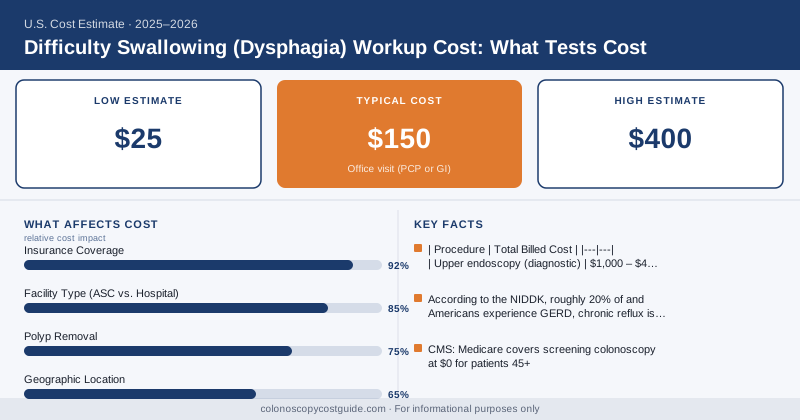
Difficulty Swallowing (Dysphagia) Workup Cost: What Tests Cost
{ if eq .Lang "zh" }{ else }{ end }Food sticking in your chest, a pill that won’t go down, the sense that swallowing takes effort — that’s dysphagia, and it’s a symptom doctors take seriously. The workup to find the cause runs anywhere from a few hundred dollars to around $6,000, depending on which tests you need and in what order.
Here’s the cost map, test by test.
Two Kinds of Trouble Swallowing
Doctors first sort dysphagia into two buckets, because each points to different tests. Oropharyngeal dysphagia means food gets stuck right at the start of the swallow, often from a neurological cause. Esophageal dysphagia means food sticks lower, in the food pipe itself — and that’s where GI tests come in.
| First-Line Test | Cash Cost | With Insurance |
|---|---|---|
| Office visit (PCP or GI) | $150 – $400 | $25 – $75 copay |
| Barium swallow (esophagram) | $300 – $1,500 | $50 – $400 |
| Modified barium swallow (with speech therapy) | $400 – $1,800 | $75 – $500 |
| Upper endoscopy (EGD) | $1,000 – $4,000 | deductible + coinsurance |
The barium swallow is the cheaper opening move — you drink a chalky contrast and an X-ray watches it travel down. But when there’s any worry about a stricture, ulcer, or tumor, doctors often go straight to an upper endoscopy because they can see and sample the tissue in one pass.
The Endoscopy Step
An upper endoscopy is the centerpiece of most esophageal dysphagia workups. It lets the doctor look directly at the lining, dilate a narrowing if one’s found, and take biopsies to check for eosinophilic esophagitis or cancer.
| Procedure | Total Billed Cost |
|---|---|
| Upper endoscopy (diagnostic) | $1,000 – $4,000 |
| Endoscopy with dilation of a stricture | $1,500 – $5,500 |
| Endoscopic biopsies | $200 – $800 |
| Esophageal manometry (motility study) | $1,000 – $3,500 |
If the scope and X-ray both look normal but you still can’t swallow well, the next test is esophageal manometry — a thin pressure-sensing tube that measures how the muscles squeeze. It’s how doctors diagnose motility disorders like achalasia. The biopsies taken during endoscopy add $200–$800 in pathology fees.
Key Takeaway
Reflux Is a Common Culprit
A huge share of esophageal dysphagia traces back to acid reflux that’s narrowed or inflamed the esophagus over time. According to the NIDDK, roughly 20% of Americans experience GERD, and chronic reflux is a leading cause of esophageal strictures. If that’s your diagnosis, the workup flows into GERD treatment, which carries its own costs.
What It All Costs
A simple case solved by a barium swallow might cost $300–$1,500. Add an upper endoscopy and you’re at $1,500–$5,000. Throw in manometry for a suspected motility disorder and the total can reach $6,000. Cash-pay patients should ask each facility for a written estimate, since outpatient endoscopy centers routinely undercut hospital prices by a wide margin.
The order of testing is where you can save. If a structural cause is likely, going to endoscopy first avoids paying for a barium swallow that just sends you back for the scope anyway.
{ if eq .Lang "zh" }