Crohn's Disease Surgery Cost: Bowel Resection and Colectomy Pricing
The average hospital charge for a bowel resection runs $75,000 to $120,000 — but what you actually pay depends on where it’s done, how complex it gets, and whether complications arise. For Crohn’s patients facing surgery, that gap between sticker price and out-of-pocket reality is enormous. Here’s what the numbers actually look like.
Crohn’s disease affects roughly 780,000 Americans, according to the Crohn’s & Colitis Foundation. About 70–75% of Crohn’s patients will require at least one surgical intervention over their lifetime, per data published in the journal Gastroenterology. Surgery doesn’t cure Crohn’s, but it can remove damaged bowel, drain abscesses, and restore quality of life when medications stop working.
Types of Surgery and Their Costs
The procedure type drives the price range more than almost any other factor.
| Procedure | Uninsured/Self-Pay | With Insurance (OOP) | Notes |
|---|---|---|---|
| Small bowel resection | $40,000–$85,000 | $3,000–$12,000 | Most common Crohn’s surgery |
| Ileocolic resection | $45,000–$95,000 | $3,500–$14,000 | Removes ileum + right colon |
| Partial colectomy | $50,000–$100,000 | $4,000–$15,000 | Removes diseased colon segment |
| Total colectomy | $70,000–$120,000 | $5,000–$18,000 | Full colon removal |
| Strictureplasty | $30,000–$60,000 | $2,500–$9,000 | Widens narrowed segments |
| Abscess drainage | $8,000–$25,000 | $1,500–$5,000 | Often done before major surgery |
| Fistula repair (surgical) | $20,000–$55,000 | $2,000–$10,000 | Depends on fistula complexity |
| Ileostomy (temporary) | $35,000–$80,000 | $3,000–$12,000 | May be reversed later |
| Ostomy reversal | $25,000–$60,000 | $2,000–$9,000 | Separate admission/surgery |
These figures reflect total facility + surgeon + anesthesia charges. Hospital outpatient rates are typically 30–50% lower than inpatient admission rates when the same procedure can be performed safely in a less intensive setting.
What Drives Cost the Most
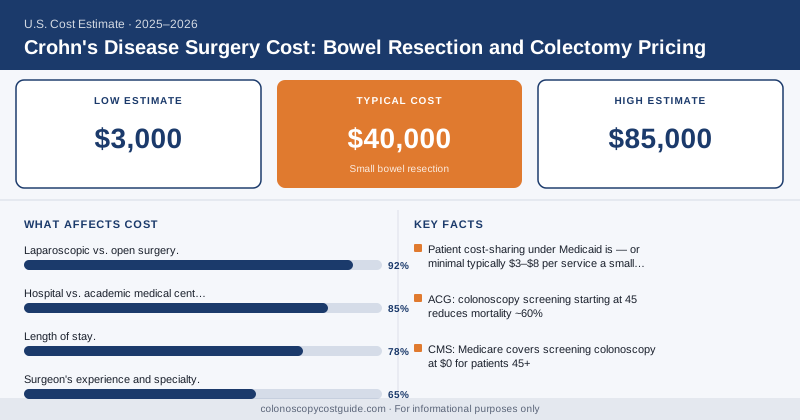
Laparoscopic vs. open surgery. Laparoscopic (minimally invasive) procedures typically reduce hospital stays by 2–4 days and cut total facility costs by 20–35% compared to open surgery. Most Crohn’s resections today are performed laparoscopically unless the disease is too complex or previous surgeries created extensive scar tissue.
Hospital vs. academic medical center. A community hospital might charge $45,000 for an ileocolic resection. The same procedure at a major academic medical center bills $85,000–$110,000. Academic centers often handle more complex cases but also have higher facility fees across the board.
Length of stay. The biggest variable in the final hospital bill. Standard uncomplicated bowel resection: 3–5 days, roughly $8,000–$15,000 per day in hospital charges. If you develop post-op complications (anastomotic leak, infection, ileus), every extra day adds to the bill — and a 10-day stay is not unusual after a complicated resection.
Surgeon’s experience and specialty. Colorectal surgeons who specialize in Crohn’s surgery may charge more, but their lower complication rates often mean shorter stays and fewer follow-up costs. The surgeon’s fee typically ranges $3,000–$8,000 for a bowel resection, independent of facility charges.
Geographic location. Urban centers in the Northeast and West Coast consistently run 40–60% higher than rural Midwest or Southern hospitals for the same DRG (diagnosis-related group) codes.
What Insurance Actually Pays: The Three Cost Components
Your total out-of-pocket for Crohn’s surgery under commercial insurance typically breaks into three pieces:
- Deductible — You pay first, often $1,500–$5,000 for individual plans
- Coinsurance — Usually 20–30% of allowed charges after the deductible
- Out-of-pocket maximum — Caps your total, typically $7,500–$9,000 for individual ACA-compliant plans in 2026
Most insured patients hit their out-of-pocket maximum with a surgery this size. If you haven’t hit it by surgery day, you almost certainly will afterward (due to anesthesia, pathology, and follow-up costs).
Pre-Surgical Costs That Add to the Bill
Don’t budget only for surgery day. These costs typically precede it:
- Colonoscopy to map disease location: $1,500–$3,500 (or $300–$1,200 with insurance)
- CT enterography or MRI enterography: $2,500–$6,000 (maps small bowel disease not visible on colonoscopy)
- Failed biologic therapy leading to surgery decision: Often $40,000–$150,000 in annual drug costs already spent
- Pre-surgical optimization (nutritional support, iron infusions): $500–$3,000
Post-Surgical Costs and Surveillance
Surgery for Crohn’s isn’t a one-time expense. Here’s what comes after:
| Post-Surgical Item | Typical Cost | Frequency |
|---|---|---|
| Surgical follow-up visits | $200–$450 each | 3–5 visits in year one |
| Colonoscopy at 6–12 months | $1,200–$3,500 | Standard post-resection surveillance |
| CT scan (check for recurrence) | $1,500–$4,000 | As clinically indicated |
| Biologic restart (post-surgery) | $6,000–$15,000/month (list) | Often restarted to prevent recurrence |
| Ostomy supplies (if applicable) | $200–$600/month | Ongoing if permanent ostomy |
| Dietitian consultations | $150–$350 per visit | 2–6 visits first year |
The Crohn’s & Colitis Foundation reports that post-surgical biologic therapy (particularly anti-TNF agents) reduces the risk of Crohn’s recurrence by approximately 50% at one year. Most surgeons recommend restarting biologics within 2–4 weeks of surgery recovery, which means ongoing medication costs resume quickly.
Medicaid, Medicare, and Government Coverage
Medicaid covers bowel resection surgery in all states. Crohn’s disease typically qualifies as a serious chronic condition, and prior authorization for surgery is generally straightforward. Patient cost-sharing under Medicaid is minimal — typically $3–$8 per service or a small percentage copay.
Medicare covers bowel resection under Part A (inpatient) and Part B (surgeon’s fee, if outpatient). For inpatient stays, the Part A deductible in 2026 is $1,632 for days 1–60, with daily coinsurance beginning at day 61.
Social Security Disability Insurance (SSDI) and Crohn’s: Severe Crohn’s disease may qualify as a disability. Approved SSDI recipients receive Medicare after 24 months. The Social Security Administration’s Blue Book includes Crohn’s under inflammatory bowel disease criteria — approval requires documented hospitalizations, weight loss, and functional limitations.
Financial Assistance Options
Hospital charity care. Most nonprofit hospitals are required to offer charity care to patients below 200–400% of the federal poverty level. For a $75,000 surgery, this can mean $0 out-of-pocket if you qualify. Apply before or immediately after admission — not six months later.
Crohn’s & Colitis Foundation assistance. The Foundation maintains a financial assistance program and a nurse-run helpline (1-888-694-8872) that can connect patients with local and national resources.
Negotiating self-pay rates. Uninsured patients can often negotiate hospital bills down to 40–60% of the original charge. Request the hospital’s “self-pay discount” or “prompt-pay discount” in writing before the procedure.
Payment plans. Nearly all major hospital systems offer 0% interest payment plans for balances up to $10,000–$25,000. Ask specifically — these are rarely advertised proactively.
For patients already on biologics, understanding the full Crohn’s disease biologic medication cost picture is critical to total disease-management budgeting alongside any surgical costs.
Questions to Ask Before Surgery
- Is this procedure laparoscopic or open — and why?
- What is the expected length of stay for an uncomplicated case?
- Is your surgeon in-network with your specific plan?
- Is the anesthesiologist in-network?
- Will pathology samples go to an in-network lab?
- What’s the post-surgical protocol for resuming biologics?
Knowing these answers upfront prevents the most common sources of surprise costs for Crohn’s surgical patients.