Colonoscopy vs. Cologuard: Which Is Better for You?
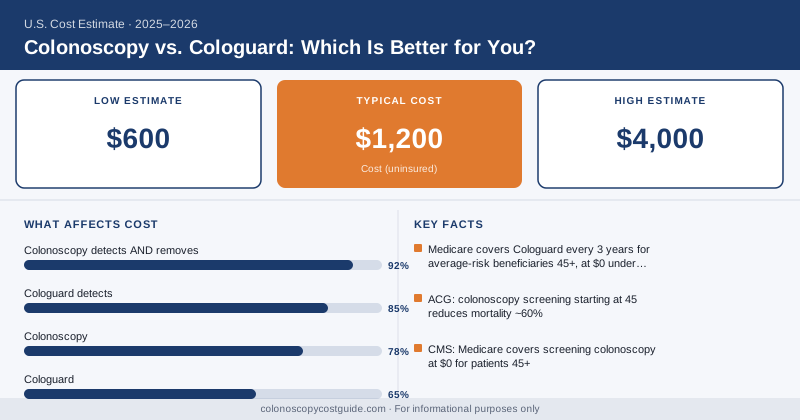
Cologuard costs $600–$900 and requires no prep, no sedation, and no day off work. A colonoscopy costs $1,500–$4,000 and requires all three. That difference gets people’s attention — but the accuracy tradeoff is real and consequential.
The American Cancer Society (ACS) endorses both as acceptable colorectal cancer screening options for average-risk adults aged 45+. But they serve different patients in different situations. Here’s the honest comparison.
The Core Difference: Detection vs. Removal
This is the most important concept in this comparison:
- Colonoscopy detects AND removes polyps in a single procedure
- Cologuard detects abnormalities — but if it comes back positive, you still need a colonoscopy
A colonoscopy is both the screening test and the treatment for precancerous polyps. Cologuard is just the screening test. If Cologuard finds something, you’re now doing both tests.
Accuracy: What the Numbers Actually Say
Colonoscopy sensitivity for detecting colorectal cancer: approximately 95%. For detecting adenomas ≥ 6mm: 75–93% depending on prep quality and physician adenoma detection rate.
Cologuard sensitivity for detecting colorectal cancer: 92% (per Imperiale et al., NEJM 2014, the pivotal trial). For detecting advanced adenomas: 42%.
That 42% number for advanced adenomas is the one to understand. Cologuard catches 9 in 10 colorectal cancers. But it misses more than half of the large precancerous polyps that, left untreated, could become cancer. Colonoscopy finds most of them and removes them in the same visit.
| Feature | Colonoscopy | Cologuard |
|---|---|---|
| Cost (uninsured) | $1,200 – $4,000 | $600 – $900 |
| Cost (insured, preventive) | $0 – $200 | $0 (ACA-covered, every 3 years) |
| Sensitivity (cancer) | ~95% | ~92% |
| Sensitivity (advanced adenomas) | 75–93% | ~42% |
| Prep required | Yes | No |
| Sedation required | Yes | No |
| Day off work | Yes (1–2 days) | No |
| Removes polyps | Yes | No |
| Frequency if normal | Every 10 years | Every 3 years |
| Positive result requires colonoscopy | N/A | Yes |
The Cost Reality of a Positive Cologuard
Cologuard has a 13% false-positive rate in average-risk adults (same NEJM trial). That means about 1 in 8 people who take Cologuard and don’t have cancer or polyps will test positive — and will then need a colonoscopy to confirm.
Here’s the cost scenario for a false-positive Cologuard:
- Cologuard: $600–$900
- Follow-up colonoscopy (now billed as diagnostic, not screening, because of a positive stool test): $1,500–$3,500 with full cost-sharing
Total: $2,100–$4,400 — potentially more than a colonoscopy alone would have cost.
And because the follow-up colonoscopy after a positive Cologuard is diagnostic (not screening), it may not be covered at $0 under your ACA preventive benefit. Your deductible applies.
The Real Cost Question to Ask
Before choosing Cologuard, calculate the expected cost over a 10-year cycle:
Colonoscopy path (10-year interval): ~$0–$200 per procedure = ~$0–$200 per cycle Cologuard path (3-year interval): $0 for Cologuard × 3 tests + ~30% chance of a positive requiring a $1,500+ diagnostic colonoscopy
The math depends heavily on your false-positive risk (higher as you get older, and with some GI conditions) and how your specific insurance prices the follow-up colonoscopy.
ACS Guidance: When to Choose Each
The American Cancer Society’s 2023 colorectal cancer screening guidelines describe a tiered preference:
First-tier options (preferred when accessible): Colonoscopy every 10 years, or CT colonography every 5 years.
Second-tier options (acceptable alternatives): Cologuard every 3 years, FIT test annually, or flexible sigmoidoscopy every 5 years.
The ACS language is direct: “If colonoscopy is available, affordable, and acceptable to the patient, it is the preferred option because it is both diagnostic and therapeutic.”
But the ACS also acknowledges that a screening test a patient will actually complete is better than a test they delay or avoid. If Cologuard gets a patient screened who would otherwise skip colonoscopy for years, it has enormous value.
Who Should Seriously Consider Cologuard
Cologuard makes the most clinical and financial sense for patients who:
- Can’t tolerate sedation due to medical conditions
- Take anticoagulants that make polypectomy higher-risk
- Have had prior significant anesthesia complications
- Are at very advanced age where colonoscopy risk outweighs benefit
- Have a prior normal colonoscopy and prefer a non-invasive interim check
Cologuard is NOT appropriate for:
- Patients with a personal history of colorectal cancer or adenomas
- Patients with IBD (ulcerative colitis, Crohn’s disease)
- Patients with symptoms (rectal bleeding, unexplained weight loss, change in bowel habits)
- High-risk patients (Lynch syndrome, FAP, strong family history)
Insurance Coverage: Both Are Now ACA-Covered
As of 2023, Cologuard (every 3 years) and colonoscopy (every 10 years) are both covered at $0 for average-risk adults aged 45–75 under ACA-compliant insurance plans. Medicare covers Cologuard every 3 years for average-risk beneficiaries 45+, at $0 under Part B.
The critical caveat: a diagnostic colonoscopy after a positive Cologuard is not the same ACA benefit as a screening colonoscopy. Cost-sharing applies.
The Bottom Line
For average-risk adults with no barriers to colonoscopy, colonoscopy remains the higher-sensitivity choice that removes polyps in a single visit. For patients who can’t or won’t do a colonoscopy for legitimate medical or practical reasons, Cologuard is a reasonable and ACS-endorsed alternative — as long as they understand the follow-up requirement.
For detailed Cologuard pricing, see Cologuard cost. For the full side-by-side cost comparison, see Cologuard vs colonoscopy cost.