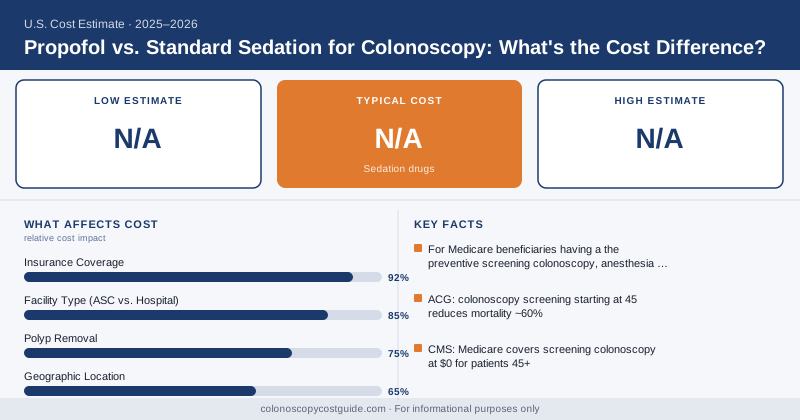
Propofol vs. Standard Sedation for Colonoscopy: What's the Cost Difference?
{ if eq .Lang "zh" }{ else }{ end }Same colonoscopy, $400 more if you choose deeper sedation — and that’s before you check whether the anesthesiologist is in-network.
That sentence summarizes what many patients discover on their Explanation of Benefits six weeks after their procedure. They didn’t know there were two sedation options. They didn’t know one required a separately billed anesthesia provider. They didn’t know that provider might be out-of-network even when the facility and GI doctor are in-network. And they definitely didn’t know to ask about any of this before they signed the consent forms.
Here’s what the two sedation types actually cost, how they’re billed, and the specific questions you should ask before your colonoscopy to avoid an unexpected anesthesia bill.
The Two Sedation Options
Standard Moderate Sedation (Conscious Sedation)
Standard moderate sedation — also called “twilight sedation” or “conscious sedation” — uses a combination of a benzodiazepine (most commonly midazolam, brand name Versed) and an opioid (most commonly fentanyl). You’re relaxed and drowsy. You may or may not remember the procedure. Most patients tolerate it comfortably, though some report awareness during the colonoscopy, especially if the procedure is long or difficult.
The key billing difference: the GI physician or a trained nurse (RN or LPN) administers and monitors moderate sedation. No separate anesthesia professional is required. The sedation drugs and monitoring are typically bundled into the facility fee or a modest add-on charge — they don’t generate a separate professional fee.
Cost impact of moderate sedation: $0–$150 beyond the base facility fee in most cases.
Propofol (Monitored Anesthesia Care / MAC)
Propofol produces deep sedation — you’re fully unconscious, remember nothing, and wake up when it’s over. Recovery is fast; most patients feel clear-headed within 30–45 minutes of a colonoscopy. Patient satisfaction scores consistently favor propofol over standard moderate sedation, which is why it became the dominant approach at US endoscopy centers over the past 15 years.
But propofol has one significant billing consequence: it must be administered and monitored by a qualified anesthesia provider — either an anesthesiologist (MD or DO) or a certified registered nurse anesthetist (CRNA). That person generates a separate professional bill — an anesthesia fee — that is billed independently from both the GI physician and the facility.
Cost impact of propofol (MAC): $200–$600 additional professional fee, billed separately.
| Cost Component | Standard Moderate Sedation | Propofol (MAC Anesthesia) |
|---|---|---|
| Sedation drugs | Included in facility fee | Included in anesthesia fee |
| Anesthesia professional fee | $0 (no separate provider) | $200–$600 (CRNA or MD) |
| Total sedation-related cost | ~$0–$150 added | ~$200–$600 added |
| Recovery time | 30–90 minutes | 20–45 minutes |
| Typical patient recall | Some awareness possible | None |
| Requires separate anesthesia consult | No | Sometimes yes |
Why the In-Network Question Is Critical
Here’s where patients often get blindsided. When you verify that your GI doctor and the ASC are in-network, you may have no idea whether the anesthesiologist (or CRNA) who shows up for your procedure is also in-network. At many facilities, anesthesia staffing is handled by a separate anesthesia group under its own contract — and that group may or may not participate in your insurance network.
If the anesthesia provider is out-of-network, the result before the No Surprises Act (NSA) took effect in 2022 would have been a balance bill — the anesthesiologist’s full charges minus what your insurer paid, which you owed in full. Under the NSA, you’re now protected from excessive balance bills for emergency services and for out-of-network providers at in-network facilities when you didn’t choose them. For scheduled colonoscopies, the NSA’s protection applies to the anesthesia provider you didn’t specifically choose — which is almost always the case.
That said, fighting a surprise bill under the NSA is still a process. Better to confirm in-network status upfront.
Three Questions to Ask Before Your Colonoscopy
“Will propofol or standard moderate sedation be used for my colonoscopy?” — This tells you whether there will be a separate anesthesia provider at all.
“If propofol is used, will there be a separate anesthesia provider? And can you confirm they are in-network with my plan?” — The scheduler may need to check with the anesthesia group; press for a definitive answer.
“If the anesthesiologist is not in-network, what are my options for sticking with in-network anesthesia?” — Some facilities can accommodate requests for moderate sedation as an alternative, or can direct you to an in-network anesthesia provider.
Does Insurance Cover Propofol?
Most insurance plans cover propofol anesthesia (MAC) for colonoscopy without requiring special preauthorization — it’s become the standard of care at most US endoscopy centers. Coverage, however, depends on two conditions:
- The anesthesia provider is in-network. If they are, your normal cost-sharing applies (typically 10–30% coinsurance after deductible).
- The plan doesn’t classify propofol as “not medically necessary” for routine colonoscopy. Some older or more restrictive plans do take this position, especially for screening colonoscopies in low-risk patients. This is less common now but still worth confirming.
Medicare covers MAC anesthesia for screening colonoscopy without separate preauthorization. For Medicare beneficiaries having a preventive screening colonoscopy, the anesthesia fee — like the procedure fee — should be covered at $0 cost-sharing if the anesthesiologist accepts Medicare assignment.
Can You Request Standard Sedation to Avoid the Extra Charge?
Yes — in most cases. If you’re an average-risk adult with no complex anatomy, no history of difficult prior colonoscopies, and no significant anxiety, you can often request standard moderate sedation. Tell your GI doctor at the pre-procedure consultation: “I’d prefer moderate sedation if it avoids a separate anesthesia fee.” Most gastroenterologists are comfortable administering moderate sedation and will accommodate the request.
There are situations where propofol is strongly recommended or required: very anxious patients, patients with obstructive sleep apnea or significant respiratory issues (who paradoxically may need even closer monitoring), lengthy procedures, or patients with a history of difficult prior colonoscopies. In these cases, the additional cost is clinically justified.
For the full picture on colonoscopy anesthesia billing, see colonoscopy anesthesia cost. For how sedation type interacts with whether your colonoscopy is classified preventive or diagnostic, see screening vs. diagnostic colonoscopy cost.
{ if eq .Lang "zh" }