Colonoscopy Sedation Cost: Propofol vs. Conscious Sedation and Anesthesia Fees
{ if eq .Lang "zh" }{ else }{ end }The anesthesia bill arrives separately. Most patients don’t expect it, and plenty don’t realize there’s a choice that affects both cost and comfort.
Here’s what each sedation option actually costs, what’s billable as a separate service, and how to have an informed conversation with your GI physician about what makes sense for you.
The Two Main Sedation Options
Propofol (Deep Sedation / “Twilight Anesthesia”)
Propofol is the sedative that knocks you out completely — you remember nothing, feel nothing, and wake up with the procedure over. It’s the preferred approach at most US endoscopy centers because it produces faster recovery and greater patient satisfaction than alternatives.
Propofol requires a qualified anesthesia provider: either an anesthesiologist (MD or DO) or a certified registered nurse anesthetist (CRNA). That person bills separately from your GI physician and the facility. Their fee is the anesthesia charge you see on your explanation of benefits.
Typical anesthesia fees for colonoscopy with propofol:
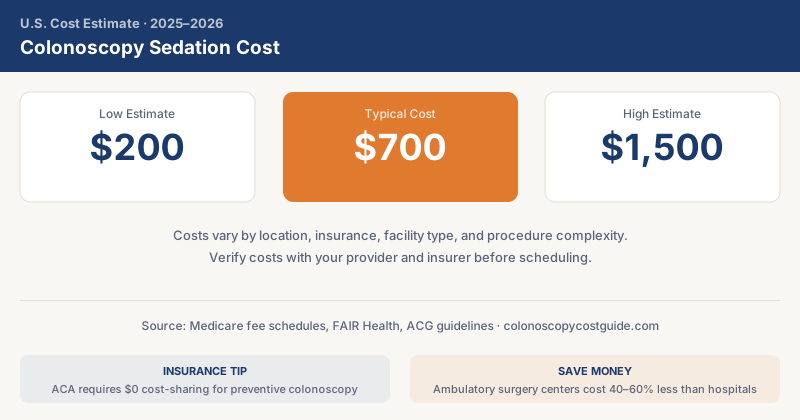
- Anesthesiologist (MD): $600 – $1,500
- CRNA: $400 – $900
These fees include pre-procedure assessment, sedation administration, monitoring throughout the procedure, and recovery room oversight until you’re stable.
Conscious Sedation (Moderate Sedation)
Conscious sedation uses medications like midazolam (Versed) and fentanyl — you’re relaxed and drowsy, you may drift in and out, and you might remember fragments of the procedure. It’s less complete than propofol but still effective for many patients.
The key billing difference: with conscious sedation, the GI nurse administers the sedative under the gastroenterologist’s supervision. There’s no separate anesthesiologist. No separate anesthesia bill. The sedation cost is bundled into the facility fee.
That’s a real cost saving — $400 to $1,500 off your total depending on what your anesthesiologist would have charged.
| Sedation Type | Who Administers | Separate Anesthesia Bill? | Approximate Added Cost |
|---|---|---|---|
| Propofol (anesthesiologist) | MD anesthesiologist | Yes | $600 – $1,500 |
| Propofol (CRNA) | Nurse anesthetist | Yes | $400 – $900 |
| Conscious sedation | GI nurse (under MD supervision) | No | $0 additional |
| Unsedated colonoscopy | N/A | No | $0 |
When Does Insurance Cover Anesthesia?
Most ACA-compliant commercial plans cover anesthesia for colonoscopy, but “cover” doesn’t mean “free.” Coverage depends on:
- Whether the colonoscopy is coded as screening or diagnostic
- Whether the anesthesiologist is in-network
- Whether your plan considers propofol sedation “medically necessary” vs. a comfort preference
Some insurers have tried to deny anesthesia for colonoscopy by arguing it’s not always medically necessary. The ACG (American College of Gastroenterology) has pushed back on this, noting that deep sedation improves adenoma detection rates — a direct quality metric — and reduces procedure complications from patient movement.
Medicare covers anesthesia for colonoscopy under Part B, but only when medical necessity is established. For routine screening colonoscopy on average-risk patients, Medicare has sometimes questioned anesthesia billing. Many gastroenterology practices have shifted to documenting medical necessity for anesthesia in every chart.
How to Check If Your Anesthesiologist Is In-Network
The anesthesiologist is chosen by the facility, not by you. You have limited control over who shows up. But you do have the right to ask:
- Call your GI office or the ASC: “Which anesthesiology group does your facility use?”
- Get that group’s NPI number and call your insurer to verify network status.
- If the group is out-of-network, ask whether an in-network anesthesiologist is available for your scheduled date.
The No Surprises Act limits out-of-network billing for anesthesia at in-network facilities in many situations, but navigating the protections requires knowing about the situation in advance.
CRNA vs. Anesthesiologist: Does It Matter?
Clinically, for a routine colonoscopy on a healthy patient, a CRNA and an anesthesiologist provide equivalent care. CRNAs are advanced practice nurses with 2–3 years of specialized anesthesia training on top of nursing education. They’re licensed to administer propofol independently in most states.
The cost difference is meaningful: a CRNA typically bills $100–$600 less than an MD anesthesiologist for the same colonoscopy. Some facilities use an “anesthesia care team” model where an MD anesthesiologist supervises multiple CRNAs performing procedures simultaneously — that’s billed at a blended rate somewhere in between.
If you’re cost-conscious and medically straightforward (no serious cardiac or pulmonary history), asking whether a CRNA is available is a legitimate question. It won’t affect the outcome of your procedure.
Can You Request Conscious Sedation to Avoid the Anesthesia Bill?
Yes — but with caveats. Ask your GI physician whether you’re a candidate for moderate conscious sedation. Some patients aren’t good candidates:
- Significant anxiety or previous difficult sedation experiences
- High BMI (airway management concerns)
- History of opioid use (may need higher doses to achieve adequate sedation)
- Complex or lengthy procedures expected
If you’re otherwise healthy, some GI practices will accommodate a preference for conscious sedation to avoid the separate anesthesia bill. You’d need to be comfortable with the possibility of being more aware during the procedure.
The Bottom Line on Sedation Costs
Propofol with a CRNA at an in-network ASC: $400–$900 added to your bill. Propofol with an MD anesthesiologist at a hospital: $600–$1,500 added. Conscious sedation: $0 added. The choice has clinical and financial dimensions. Talk to your doctor about what makes sense for your situation — and verify network status for whoever walks into that procedure room before your procedure date.
{ if eq .Lang "zh" }