Colonoscopy Recovery: What to Expect and What It Costs
{ if eq .Lang "zh" }{ else }{ end }The colonoscopy itself is behind you — but the bill story isn’t over yet.
Most patients focus entirely on the procedure cost and forget that colonoscopy recovery, while typically straightforward, comes with its own set of expenses that don’t always show up in the pre-procedure quote. Some are predictable and minor. A few can be significant. Here’s the full picture of what recovery actually involves and what each piece costs.
What Recovery Looks Like for Most Patients
For a routine colonoscopy without complications, the recovery arc is pretty uneventful:
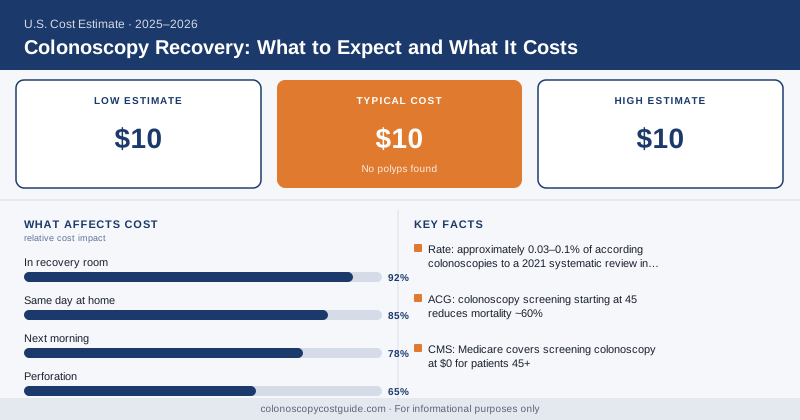
- In recovery room: 30–60 minutes post-procedure while sedation wears off. You’ll feel groggy, possibly bloated from the air pumped in during the scope. This is included in your procedure cost — no separate charge.
- Same day at home: Light activity, clear liquids transitioning to soft foods. Most people feel back to normal by evening.
- Next morning: The vast majority of patients feel completely fine and return to normal activities.
The more interesting question isn’t physical recovery — it’s financial recovery. Specifically, what additional bills are coming your way even after an “uncomplicated” procedure?
The Costs That Follow You Home
1. Pathology Lab Fees: $200–$800
If your doctor removed one or more polyps — which happens in roughly 40% of colonoscopies — the tissue is sent to a pathology laboratory for analysis. That lab bill arrives separately, typically 3–8 weeks after your procedure, from a company you’ve never heard of.
This is probably the single most common post-procedure financial surprise. The pathology lab often has different insurance network status than the facility where you had your procedure. Even if you had your colonoscopy at an in-network ASC, the lab may be out-of-network — and the bill may be higher than expected.
What to do: Ask your ASC or GI office which pathology lab they use. Verify that lab’s network status with your insurer before your procedure, not after.
2. Follow-Up Pathology Results Visit: $0–$300
When pathology comes back, your GI doctor typically contacts you with results — either by phone/MyChart message (no charge) or by scheduling an office visit. If an in-person follow-up is scheduled, that’s a specialist office visit with its own copay: typically $50–$150 with insurance, or $150–$300 cash-pay.
Ask in advance: “How do you communicate pathology results? Is it a phone call or do you schedule a visit?” If your doctor routinely schedules visits for normal polyp results, you may want to ask if phone notification is available.
3. Transportation: $20–$80
You can’t drive yourself after sedation. That’s not a suggestion — it’s a medical requirement, and the facility will not discharge you without a confirmed ride. Options:
- Rideshare (Uber/Lyft): $20–$60 depending on distance, or twice that if you need a round trip
- Designated driver: costs you a favor, but no dollar outlay
Budget for transportation if you’re planning to use rideshare. Some patients forget this entirely and end up scrambling the morning of their procedure.
Rideshare Drivers and Colonoscopy Pickup
4. Lost Work Time: Half a Day to a Full Day
The procedure itself takes 30–60 minutes, plus 30–60 minutes of recovery room time. But you also need someone to drive you, and you can’t drive back on your own. Most patients block out a half day for the procedure day itself.
The prep day before the colonoscopy is often overlooked. The bowel prep (laxative) typically starts the afternoon before and involves multiple bathroom trips throughout the evening and early morning. Most patients don’t feel comfortable leaving the house on prep day, which can mean another half-day or full day away from work.
Total time off: 1–2 work days is realistic for most patients. Depending on your job type and leave policy, this may or may not be compensated.
5. Post-Procedure Prescriptions: $15–$60
If biopsies were taken, your physician may prescribe a short course of antibiotics (though this is less common than it used to be for routine polypectomy). If you have inflammation noted on scope, a prescription medication may be started. These are typically inexpensive at a retail pharmacy — $15–$60 depending on the drug and your insurance.
If You Need a Follow-Up Colonoscopy
Polyp findings affect your next procedure timeline — and cost:
| Polyp Finding | Next Colonoscopy | Classification | Patient Cost |
|---|---|---|---|
| No polyps found | 10 years (average risk) | Preventive | $0 copay (insured) |
| 1–2 small tubular adenomas | 3–5 years | Surveillance (diagnostic) | Deductible + coinsurance |
| 3–4 adenomas or large adenoma | 3 years | Surveillance (diagnostic) | Deductible + coinsurance |
| High-grade dysplasia | 1 year | Surveillance (diagnostic) | Deductible + coinsurance |
| Colorectal cancer found | Per oncology plan | Diagnostic/therapeutic | Complex, varies |
Surveillance colonoscopies (the follow-ups after polyp findings) are typically classified as diagnostic, not preventive. That means they’re subject to your deductible and coinsurance — there’s no $0 cost-sharing. If you’re averaging-risk and had a clean scope, your next one in 10 years is free. If you had adenomas, plan to pay the same as a diagnostic procedure every 3–5 years.
The Rare but Serious Complication Costs
Colonoscopy is one of the safest procedures in medicine, but complications do occur. The most serious:
Perforation: A tear in the colon wall requiring emergency surgery. Rate: approximately 0.03–0.1% of colonoscopies according to a 2021 systematic review in Gastrointestinal Endoscopy. Cost if hospitalized: $30,000–$80,000 for surgical repair and hospital stay. Your insurance covers this like any emergency hospitalization — subject to your out-of-pocket maximum.
Post-polypectomy bleeding: More common than perforation (0.5–1% of colonoscopies involving polypectomy). Often resolves without intervention or with repeat endoscopy. Cost: $2,000–$15,000 depending on whether re-hospitalization is needed.
Reaction to sedation: Rare. Managed at the facility — typically no additional billing beyond standard procedure costs.
These complications are uncommon, but they’re why you’re having the procedure at a licensed, accredited facility rather than a bargain discount operation. Accredited ASCs and hospital GI units carry the equipment and trained staff to manage these scenarios.
Total Recovery Cost Budget
For most routine colonoscopies, the post-procedure cost is modest:
- No polyps: $0 additional (transportation aside)
- 1–2 polyps removed, in-network lab: $200–$400 pathology
- 1–2 polyps, follow-up visit: add $50–$150
- Multiple polyps, out-of-network lab: $400–$800 pathology
Budget $200–$500 as a realistic post-procedure buffer for a patient with average polyp risk. It’s not guaranteed, but it covers the most common scenarios without shocking you.
For a look at the lifetime cost picture across multiple colonoscopies, see the total cost of colonoscopy screenings over your lifetime. And if pathology came back showing a polyp requiring surveillance, colonoscopy vs. stool DNA test can help you think through future screening options.
{ if eq .Lang "zh" }