Low-Cost Colonoscopy Prep Alternatives: Affordable Options That Work
Your GI doctor writes a prescription for colonoscopy prep. You drop it at the pharmacy and get handed a branded kit with a $185 price tag — and your insurance either doesn’t cover it or hits it with a high-tier copay.
Most people don’t know they have options. The prep market has evolved, and the cheapest prep solution in your doctor’s prescription pad costs about $12 at Costco. Here’s what the alternatives actually cost, and how to get the most effective prep without overpaying.
Why Prep Costs Vary So Dramatically
There are six major colonoscopy prep categories, ranging from basic OTC mixtures to high-tech low-volume tablet systems. The price difference between the cheapest and most expensive is roughly 15x — without a meaningful difference in prep quality for most patients.
| Prep Solution | Approximate Cost | Volume Required |
|---|---|---|
| MiraLax + Gatorade split-dose (OTC) | $8 – $22 | 2 liters (split) |
| GoLYTELY / NuLYTELY (generic PEG 4L) | $20 – $45 | 4 liters |
| MoviPrep (PEG + ascorbic acid, 2L) | $60 – $120 | 2 liters |
| Clenpiq / Prepopik (sodium picosulfate, low volume) | $90 – $200 | ~1 liter |
| SUTAB (sodium sulfate tablets) | $100 – $250 | Tablets + 48 oz water |
| PLENVU (low-volume PEG, 1L) | $100 – $220 | 1 liter |
The newest prep products aren’t dramatically better at cleaning the colon — they’re better at getting patients through the process without quitting. That matters clinically, because an incomplete or poor-quality prep is one of the most common causes of a failed colonoscopy, leading to a repeat procedure and duplicate costs.
The MiraLax-Gatorade Option: The Cost Winner
The split-dose MiraLax-Gatorade regimen has been around for over 15 years and remains one of the most commonly used prep protocols in the US — not because it’s fancy, but because it works and costs almost nothing.
The protocol (confirm specifics with your GI doctor):
- Day before: clear liquid diet during the day
- Evening before: Mix 8.3 oz (238g) bottle of MiraLax into 64 oz of Gatorade (not red or purple). Drink half (32 oz) over 1–2 hours.
- Morning of procedure: Drink remaining 32 oz, finishing at least 2 hours before your procedure time.
Total cost: $8–$22 depending on where you buy MiraLax and Gatorade.
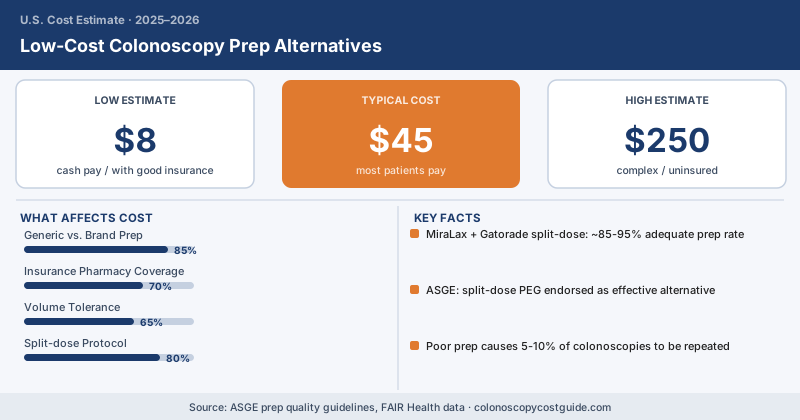
The American Society for Gastrointestinal Endoscopy (ASGE) has endorsed split-dose PEG-based prep protocols as effective and acceptable alternatives to full-volume PEG in their prep quality guidelines. Multiple studies show adequate bowel preparation rates of 85–95% with the MiraLax-Gatorade approach.
Ask Your GI Office for the MiraLax Protocol Before Filling a Prescription
When to Consider a Premium Prep
Low-volume and tablet-based preps genuinely improve tolerability for certain patients. They’re worth the extra cost if:
- You’ve had a previous colonoscopy and couldn’t finish the prep due to nausea or volume intolerance
- You have gastroparesis or other conditions that make drinking large volumes difficult
- You have kidney issues that require specific low-phosphate or low-sulfate formulas
- Your doctor specifically recommends a certain formula for a clinical reason
In these cases, the branded prep is a medical decision — and your insurance should cover it as a prescription at your applicable copay tier. The process:
- Your GI doctor writes a prescription for the specific prep
- You check your insurance formulary or call pharmacy benefits to verify coverage
- If not covered, ask your doctor to submit a prior authorization with the medical justification
Insurance coverage for prescription preps varies. Most are covered on formulary as generic or brand-name drugs at Tier 2 or Tier 3 copay levels ($30–$60 for generic, $50–$120 for branded).
The Hidden Costs of a Bad Prep
A cancelled colonoscopy due to inadequate prep isn’t just inconvenient — it’s expensive:
- Rescheduled colonoscopy: another facility fee, physician fee, anesthesia fee — the full procedure cost again ($1,200–$4,500)
- Another day off work
- Another diet day and prep experience
FAIR Health data shows that approximately 5–10% of colonoscopies are categorized as incomplete or inadequate quality due to preparation failures. Compliance failures — patients who quit the prep halfway through because they couldn’t tolerate it — are a major driver. A prep you can actually finish is the prep that saves money.
Dietary Prep: The Day Before
Regardless of which solution you use, the day-before dietary restrictions add minor costs:
- Clear broth, gelatin (not red or purple), clear juices, popsicles
- Estimated food cost for a clear liquid day: $10–$30
- Some GI offices now allow a low-residue diet the day before rather than strict clears — this is more comfortable and doesn’t change prep quality significantly per recent ASGE guidance
Ask your GI office specifically whether your prep protocol allows low-residue foods the day before. The updated ACG and ASGE guidance (2023) allows low-residue diets for most patients before split-dose prep, which makes the prep process more tolerable and less expensive (you can eat real food at dinner).
The OTC Additions Your GI May Recommend
Some GI practices add OTC medications to the standard prep protocol:
| Optional OTC Add-On | Purpose | Cost |
|---|---|---|
| Simethicone (Gas-X) | Reduce gas bubbles that obscure the colon view | $5 – $12 |
| Dulcolax (bisacodyl) tablets | Speed onset for split-dose protocol | $8 – $15 |
| Anti-nausea medication (Zofran generic) | Prescription required; helps with nausea | $10 – $40 |
These additions are optional and your GI office should specify whether they want you to use them. Don’t add them on your own without asking.
HSA and FSA Coverage for Prep Costs
All prescription colonoscopy prep solutions qualify as HSA/FSA-eligible expenses. OTC MiraLax — since it requires a prescription from a physician for this specific medical purpose — can also be covered when accompanied by a Letter of Medical Necessity (LMN). If cost is a concern, using pre-tax HSA/FSA dollars for prep reduces the effective cost by your marginal tax rate (typically 22–32% for most working adults).