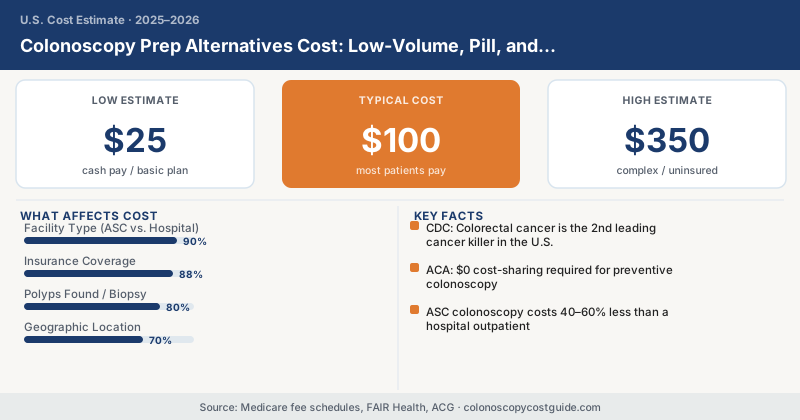
Colonoscopy Prep Alternatives Cost: Low-Volume, Pill, and Reduced-Prep Options
“I’ll do the colonoscopy — I just can’t stomach the prep.” Sound familiar? It’s one of the most common reasons patients delay colon cancer screening. The good news: the gallon-jug prep of the 1990s isn’t your only option. Lower-volume, better-tasting, and pill-based alternatives exist. The bad news? Some of them cost significantly more.
The CDC estimates that only 72.8% of adults aged 50–75 are up to date on colorectal cancer screening as of 2023 — and patient-reported barriers consistently cite the prep as a top deterrent. Understanding your prep alternatives (and their real costs) might be what gets you through the door.
Standard vs. Alternative Preps: A Side-by-Side Cost Comparison
| Prep Option | Volume | Cash Price | With Insurance |
|---|---|---|---|
| GoLYTELY (standard 4L PEG) | 4 liters | $15 – $40 | $0 – $20 copay |
| MoviPrep (2L PEG + ascorbic acid) | 2 liters | $40 – $90 | $10 – $40 copay |
| Prepopik / Clenpiq (sodium picosulfate) | 2 small drinks | $80 – $180 | $20 – $60 copay |
| SuTab (sodium sulfate tablets) | 12 tablets + water | $100 – $200 | $30 – $80 copay |
| Plenvu (1L PEG-based) | 1 liter | $60 – $150 | $20 – $60 copay |
| SUTAB (brand) | 24 tablets | $150 – $350 | $40 – $120 copay |
| MiraLAX + Gatorade (off-label, split-dose) | ~2 liters | $25 – $45 | Out-of-pocket (often not covered as prescription) |
| Low-residue diet prep only (no cathartic) | N/A | $30 – $80 (food cost) | Not a drug — no coverage |
The Cheapest Option: Standard GoLYTELY
The original large-volume polyethylene glycol (PEG) prep isn’t glamorous, but it’s cheap. Generic GoLYTELY (PEG 3350 + electrolytes) runs $15–$40 at most pharmacies. It’s universally covered by insurance — essentially every plan carries it at Tier 1.
The downside is volume — four liters of moderately salty, slightly sweet solution consumed over 2–4 hours. Most patients manage it. If you’ve tried it and genuinely can’t complete it, alternatives are clinically valid.
Low-Volume Preps: Meaningful Improvement, Moderate Cost Increase
MoviPrep and Plenvu cut volume in half while maintaining efficacy comparable to 4L preps per American Society for Gastrointestinal Endoscopy (ASGE) data. They cost $40–$150 without insurance, and most commercial insurance plans cover them at Tier 2 or Tier 3.
Clenpiq (sodium picosulfate + magnesium citrate) is a split-dose liquid prep — just two 6-oz drinks taken the evening before and morning of the procedure. It works differently from PEG-based preps (stimulant laxative mechanism), has fewer electrolyte shifts, and is often better tolerated in older adults. Cash price: $80–$180. Insurance coverage is common but check your formulary.
Split-Dose Scheduling: What It Is and Why It Matters
“Split-dose” means you take half the prep the night before and half the morning of your procedure (usually 4–6 hours before the start time). ASGE and ACG both recommend split-dose for all patients — it improves colon cleansing quality by 20–30% compared to taking all the prep the night before.
All the preps listed above can be prescribed as split-dose. If your prescription says “take the night before,” ask your GI nurse or physician about converting to split-dose. Better prep quality = fewer incomplete colonoscopies = one less procedure you’ll need (and pay for).
Pill-Based Prep: Maximum Convenience, Higher Cost
SuTab and SUTAB (oral sulfate tablets) let you take a series of pills with water instead of drinking a liquid prep. Patients with severe nausea, swallowing difficulty with large volumes, or extreme prep aversion find this option much more manageable.
Cost: $100–$350 without insurance depending on whether you get the generic or brand-name version. Insurance coverage is mixed — many plans cover SuTab but classify it Tier 3 (non-preferred brand), meaning higher copays ($50–$120).
Efficacy is comparable to standard PEG preps. The pill prep still requires drinking the required amount of water (approximately 1.5 liters with pills), so it’s not truly no-liquid.
The MiraLAX + Gatorade Option
Many GI practices prescribe an “off-label” prep: over-the-counter MiraLAX (polyethylene glycol 3350) mixed into 64 oz of Gatorade. Total cost: $25–$45 at any pharmacy, no prescription required.
Efficacy: comparable to GoLYTELY in multiple studies. The ACG notes it as an acceptable option. The ASGE doesn’t formally endorse it because it lacks FDA approval for bowel prep specifically, but many gastroenterologists continue to prescribe it — especially for patients who prefer to avoid medications or can’t afford branded options.
Insurance doesn’t cover MiraLAX as a colonoscopy prep since it’s purchased OTC. But you’re paying $30 instead of $150. For uninsured patients especially, this is often the most practical choice.
Does Insurance Cover Colonoscopy Prep?
Most insurance plans, including Medicare Part D, cover at least one bowel prep option as a prescription drug. Coverage varies by:
- Formulary tier: Generic PEG preps are almost always Tier 1 ($0–$15 copay). Branded options like Clenpiq or SUTAB may be Tier 2 or Tier 3 ($30–$120 copay).
- Step therapy: Some plans require you to try GoLYTELY first before they’ll cover an alternative prep.
- Medicare Part D: Covers FDA-approved preps at your plan’s drug benefit level — but Part D formularies vary by plan. Check your specific Part D plan formulary before your GI office calls in a prescription.
The ACA preventive coverage rule: Under the ACA, a preventive colonoscopy (at the recommended age/frequency) must be covered at no cost — but this coverage applies to the procedure, not the prep. The prep is still billed as a prescription drug through your pharmacy benefit.
Reduced-Prep and Low-Residue Diet Options
Some GI practices offer a low-residue diet colonoscopy prep — a restricted diet for 2–3 days before the procedure, with a reduced-dose laxative rather than a full bowel prep. Studies show adenoma detection rates comparable to full prep in selected patients.
This isn’t universally available — it depends on your GI doctor’s protocol and your clinical situation (body habitus, prior prep quality). But if you’re a candidate, your total prep cost is just the food modification plus a small laxative dose. No $150 prescription required.
Tips for Managing Prep Costs
- Ask your GI office which prep is on your formulary before they send the prescription — a quick call to your pharmacy with the drug names prevents an unexpected bill.
- Use GoodRx for preps not covered by insurance: GoodRx has coupons for MoviPrep, Clenpiq, and SuTab that can reduce cash prices 30–60%.
- Ask about the MiraLAX option if cost is a barrier — many GI practices will prescribe it when patients ask.
- Check manufacturer patient assistance: Some branded prep makers offer coupon programs (Clenpiq’s manufacturer has offered up to $100 off with a patient card).
- Plan around your deductible year: If you’ve already met your annual deductible, your Tier 3 prep costs less out of pocket than if you haven’t.
The right prep is the one you’ll actually complete. A half-finished prep is a failed prep — meaning a repeat colonoscopy and another full cost cycle. If the standard option is making you delay the procedure, that’s the conversation to have with your GI doctor.