Colon Capsule Endoscopy Cost: The Swallowable Camera Pill Explained
“You swallow a camera the size of a large vitamin, it photographs your entire colon over 10 hours, and you don’t need sedation.” If that sounds appealing compared to a traditional colonoscopy, you’re not alone. Colon capsule endoscopy — most commonly the PillCam Colon (Given Imaging / Medtronic) — is a real alternative for patients who can’t or won’t undergo conventional colonoscopy. But it costs more, insurance coverage is limited, and its role is narrower than many patients assume.
The FDA cleared the PillCam Colon 2 in 2014 for patients with incomplete conventional colonoscopy. The American College of Gastroenterology’s 2021 colorectal cancer screening guidelines acknowledge capsule endoscopy as an alternative but note that evidence for its use as a primary screening tool in average-risk patients is still developing.
What Colon Capsule Endoscopy Costs
| Setting / Scenario | Typical Billed Charge | Patient Out-of-Pocket (Insured) | Self-Pay |
|---|---|---|---|
| Gastroenterologist office / reading fee | $300–$700 | $100–$300 | $300–$700 |
| Capsule device cost (passed to patient) | $500–$800 | Varies | $500–$800 |
| Facility fee (outpatient GI clinic) | $700–$2,500 | $200–$600 | $500–$1,000 |
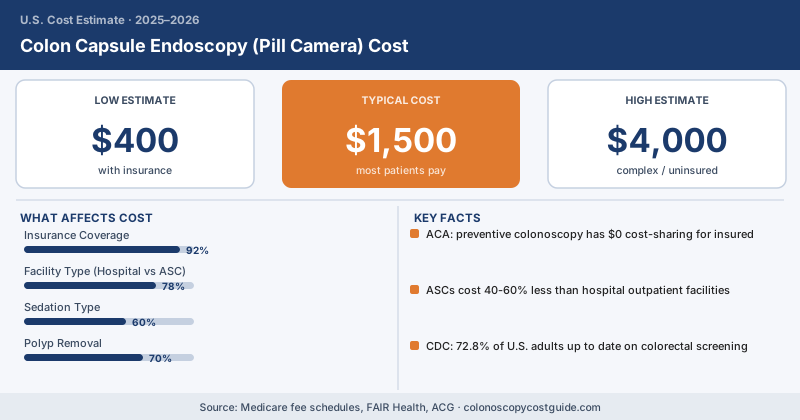
| Total (GI clinic, in-network) | $1,500–$4,000 | $400–$1,200 | $1,300–$2,500 |
| Hospital-based GI lab | $2,500–$5,500 | $600–$2,000 | $1,800–$3,500 |
Note that the capsule device itself — a single-use disposable camera — is often billed as a supply item separate from the professional and facility fees. Some facilities bundle it; others itemize it. Ask specifically when you’re getting a cost estimate.
What CPT Code Is Used?
Colon capsule endoscopy is billed under CPT 91113 (gastrointestinal tract imaging, intraluminal, with interpretation and report, colon). This is different from the small bowel capsule endoscopy code (CPT 91110/91111), which is more commonly covered by insurance for small bowel disease evaluation.
The distinction matters for coverage. Small bowel capsule endoscopy (used to evaluate unexplained bleeding, Crohn’s disease, or celiac disease) has been covered by Medicare and most commercial insurers for years. Colon capsule endoscopy has much more limited coverage.
Insurance Coverage for Colon Capsule Endoscopy
Here’s the honest picture: coverage is inconsistent and often requires prior authorization.
Medicare: Medicare covered colon capsule endoscopy for patients with incomplete conventional colonoscopy starting in 2022 under specific clinical criteria. Coverage is limited — the patient must have had a technically incomplete colonoscopy (due to anatomic reasons or failed bowel preparation), not simply a preference to avoid the traditional procedure. Medicare pays approximately $500 to $800 for the procedure at approved facilities; patient coinsurance applies.
Commercial insurance: Coverage varies widely. Some plans (particularly BCBS plans and some UnitedHealthcare commercial plans) cover it for the incomplete colonoscopy indication. Many plans have a non-coverage policy for colon capsule endoscopy entirely, meaning it’s not a covered benefit under any circumstances. Always verify with your specific plan before scheduling.
Self-pay / uninsured: The full cash price of $1,500 to $3,500 is accessible at some GI practices. Compare this to the capsule endoscopy cost detailed in the capsule endoscopy cost article, which also covers small bowel capsule pricing for context.
The Right Candidate for Colon Capsule Endoscopy
Colon capsule endoscopy is currently best suited for patients who:
- Had an incomplete conventional colonoscopy (couldn’t reach the cecum due to anatomy or prep failure)
- Have contraindications to sedation that make conventional colonoscopy impractical
- Decline conventional colonoscopy entirely after being informed of all options
It is not currently recommended as a first-line screening alternative for average-risk adults who simply prefer to avoid sedation. For those patients, virtual colonoscopy (CT colonography) is a better-established, often cheaper alternative with clearer insurance coverage.
What the Capsule Does (and Doesn’t Do)
The PillCam Colon 2 takes approximately 35,000 images over 10 hours as it travels through the colon. The images are transmitted wirelessly to a recorder worn on a belt. A gastroenterologist reviews the footage afterward.
Advantages over conventional colonoscopy:
- No sedation required
- No recovery time (you can drive yourself and go back to work the same day)
- No risk of perforation from the scope
- Images the entire colon including potentially areas that can be difficult to access with a colonoscope
Limitations:
- Still requires full bowel prep (often more extensive than conventional colonoscopy prep)
- Cannot perform biopsies or remove polyps — any findings require a follow-up conventional colonoscopy
- Slightly lower sensitivity for flat lesions than conventional colonoscopy
- If a polyp is found, you need a conventional colonoscopy anyway — doubling the cost
The inability to take biopsies or remove polyps is the single most important limitation. If colon capsule endoscopy finds a polyp, you haven’t avoided a traditional colonoscopy — you’ve added a step and a cost before it.
| Feature | Conventional Colonoscopy | Colon Capsule Endoscopy |
|---|---|---|
| Sedation required | Yes (typically) | No |
| Bowel prep required | Yes | Yes (extensive) |
| Can remove polyps | Yes | No |
| Can biopsy tissue | Yes | No |
| Cost (self-pay) | $900–$2,500 | $1,300–$3,500 |
| Insurance coverage | Broad | Limited |
| Recovery time | 1 day | None |
Colon Capsule Endoscopy vs. Cologuard vs. CT Colonography
Patients who want a non-invasive screening alternative have three main options:
- Cologuard (stool DNA test): ~$700 (often $0 with insurance as preventive screening). No prep, no capsule. Covered by most insurance including Medicare. Sensitivity for colorectal cancer ~92%. But positive result still requires colonoscopy. See the Cologuard cost article.
- CT colonography (virtual colonoscopy): $400–$1,500 self-pay; Medicare coverage for high-risk patients only as of 2025. Requires bowel prep. More established coverage than capsule endoscopy. See virtual colonoscopy cost.
- Colon capsule endoscopy: $1,300–$3,500 self-pay; limited insurance coverage. Best for incomplete conventional colonoscopy indication.
For most average-risk patients who want to avoid conventional colonoscopy, Cologuard is the most cost-effective, most widely covered alternative. Colon capsule endoscopy fills a niche role for specific clinical situations.