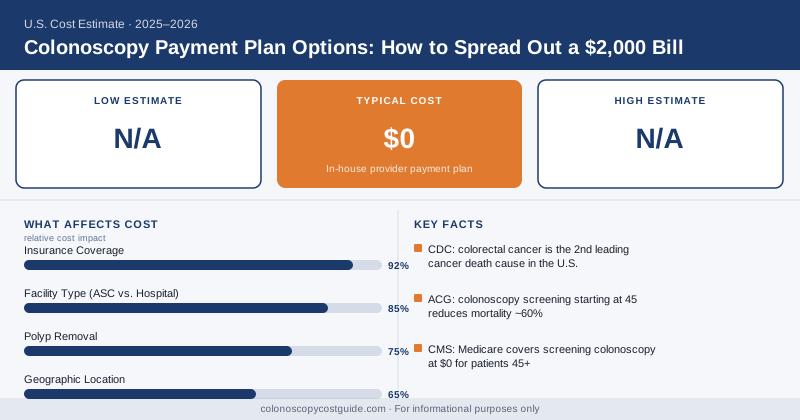
Colonoscopy Payment Plan Options: How to Spread Out a $2,000 Bill
{ if eq .Lang "zh" }{ else }{ end }A $2,000 colonoscopy bill doesn’t have to be a $2,000 hit all at once. Spread the right way, it’s about $170 a month with zero interest — but choose the wrong financing and that same bill balloons with 26% interest you never saw coming.
Plenty of patients can’t write a four-figure check on demand, and that’s exactly why payment plans exist. The trick is knowing which options are genuinely cheap and which ones quietly cost you. Here’s the rundown.
Your Main Options, Ranked by Cost
| Option | Typical Interest | Best For |
|---|---|---|
| In-house provider payment plan | 0% (usually) | Most patients; split over 6–24 months |
| Hospital financial assistance | N/A (discount/waiver) | Lower-income, uninsured |
| Medical credit card (e.g. CareCredit) | 0% promo, then 25%+ | Larger bills needing longer terms |
| HSA / FSA funds | 0% (pre-tax) | Anyone with a funded account |
| Personal loan / 0% credit card | Varies | Those with good credit |
The cheapest path is almost always the provider’s own interest-free payment plan. Split that $2,000 over 12 months and you’re looking at roughly $167 a month with nothing added. Our colonoscopy financing carecredit guide digs into the medical-credit-card option specifically.
Key Takeaway
Start With Financial Assistance, Not Financing
Before you finance anything, ask whether you qualify for help that reduces the bill itself. Nonprofit hospitals are required to maintain financial assistance policies, and many will discount or waive charges for patients under certain income thresholds. KFF research has documented that a large share of hospital bills are eligible for some form of assistance that patients simply never ask about. A reduced bill beats a financed full bill every time.
If you’re uninsured, also ask for the self-pay or cash discount before setting up a plan — our colonoscopy cost without insurance guide explains how to get it.
The Deferred-Interest Trap
Medical credit cards advertise “0% interest for 12 months,” and that sounds great. The danger is deferred interest. If you don’t pay the full balance by the promotional deadline, many cards charge interest retroactively on the entire original balance, often at 25% or higher. A $2,000 bill you mostly paid off can suddenly sprout hundreds in back-interest. Only use these if you’re confident you’ll clear the balance in time.
Use Tax-Advantaged Money If You Have It
HSA and FSA accounts let you pay with pre-tax dollars, effectively discounting the bill by your tax rate. If you have a funded HSA, that’s often the smartest money to spend on a colonoscopy — it’s like a built-in 20-to-30% discount depending on your bracket. The CDC continues to report that on-time colorectal screening saves lives, so spending tax-advantaged dollars on it is a doubly good use of those funds.
A Simple Game Plan
- Ask about financial assistance and self-pay discounts first — shrink the bill before financing it.
- Request the provider’s interest-free payment plan — usually the cheapest way to spread it out.
- Tap HSA/FSA funds if available, for the pre-tax savings.
- Use medical credit only as a last resort, and only if you can beat the promo deadline.
- Negotiate the underlying charges using our how to lower your colonoscopy bill guide.
The Bottom Line
You rarely need to pay a colonoscopy bill in one lump. An interest-free in-house plan turns a $2,000 charge into manageable monthly payments around $167, and financial assistance may cut the total before you ever finance it. Steer clear of deferred-interest cards unless you’re sure you’ll pay them off in time. To understand the bill you’re financing in the first place, start with our colonoscopy cost breakdown.
{ if eq .Lang "zh" }