Gastroenterologist vs. Surgeon for Colonoscopy: Is There a Cost Difference?
{ if eq .Lang "zh" }{ else }{ end }Your primary care doctor handed you two referral slips: one to a gastroenterologist at an outpatient endoscopy center, one to a colorectal surgeon at a hospital. You’re getting a colonoscopy either way. Does it change your bill?
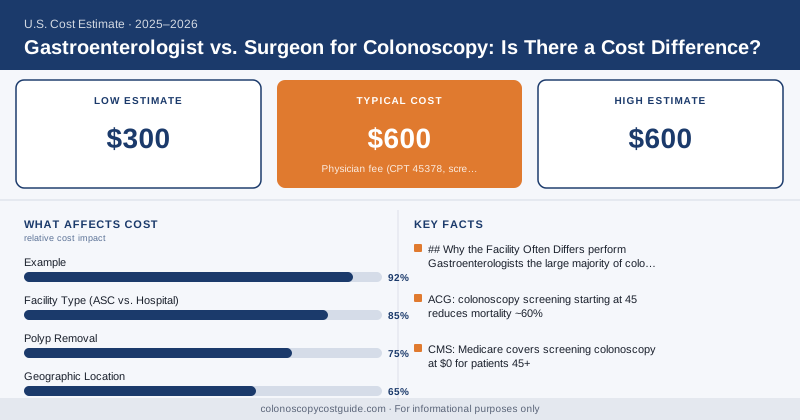
The short answer: the physician fees are nearly identical. The facility setting — which often differs between the two specialties — can change your total bill by $1,000 or more.
How Colonoscopy Billing Works for Both Specialties
Both gastroenterologists (GI doctors) and colorectal surgeons perform colonoscopies using the same CPT (procedure billing) codes. The base screening colonoscopy code (CPT 45378) doesn’t care who’s holding the scope. Biopsy or polyp removal adds additional codes (45380, 45385), but again, those codes are the same regardless of specialty.
What that means: the professional fee — what the doctor bills for their time and skill — is essentially equivalent for a GI doctor and a colorectal surgeon performing the same procedure. Both bill under Medicare’s Physician Fee Schedule at the same rate for the same CPT code. Commercial insurers negotiate facility- and specialty-specific rates, but for colonoscopy specifically, the rates are very similar across these two specialties.
| Cost Component | Gastroenterologist | Colorectal Surgeon | Difference |
|---|---|---|---|
| Physician fee (CPT 45378, screening) | $300–$600 | $300–$600 | Negligible |
| With biopsy (CPT 45380) | $350–$700 | $350–$700 | Negligible |
| With polypectomy (CPT 45385) | $400–$800 | $400–$800 | Negligible |
| Facility fee (ASC setting) | $800–$1,800 | $800–$1,800 | Same if same facility |
| Facility fee (hospital outpatient) | $2,500–$5,000 | $2,500–$5,500 | Comparable |
The physician fee is a wash. The facility is where the cost story actually lives.
Why the Facility Often Differs
Gastroenterologists perform the large majority of colonoscopies in the US — approximately 80–85% of all screening and diagnostic colonoscopies, according to data from the American Society for Gastrointestinal Endoscopy. Many GI physicians work primarily or exclusively at freestanding ambulatory surgery centers (ASCs), which have lower overhead and generate significantly lower facility fees than hospital outpatient departments.
Colorectal surgeons, by contrast, are surgical specialists whose practice base is the hospital. They operate on colon cancers, perform bowel resections, treat rectal prolapse — procedures that require a hospital operating room. When a colorectal surgeon performs a colonoscopy, it’s more often in that hospital surgical environment, either in the OR or in the hospital’s outpatient endoscopy suite.
That setting difference — not the specialty itself — is what drives a cost gap when one exists.
Example:
- GI doctor at freestanding ASC: facility fee $900–$1,500 + physician fee $300–$500 = total billed $1,200–$2,000
- Colorectal surgeon at hospital outpatient department: facility fee $2,500–$4,500 + physician fee $350–$600 = total billed $2,850–$5,100
Same colonoscopy. Same quality. Nearly $3,000 difference in billed charges — driven entirely by the facility, not the specialty.
When You’d See a Colorectal Surgeon Instead of a GI Doctor
For average-risk screening colonoscopy, there’s no clinical reason to prefer a colorectal surgeon over a gastroenterologist. GI doctors are colonoscopy specialists; it’s the central procedure in their training and daily practice. Their colonoscopy completion rates, adenoma detection rates, and complication rates are equivalent to or better than those of surgeons for routine screening.
You’d typically see a colorectal surgeon for colonoscopy in these situations:
- Rectal bleeding with suspected surgical lesion: If your PCP or GI doctor thinks the bleeding may require surgical evaluation and possible intervention, the surgeon’s comprehensive perspective is appropriate.
- Pre-operative bowel evaluation: Before colorectal surgery, a surgeon may perform the colonoscopy themselves to assess the anatomy they’ll be working on.
- Complex anatomy following prior abdominal surgery: Patients with significant prior pelvic or abdominal surgery may have altered anatomy better managed by a surgeon who can handle complications if they arise.
- Known or suspected colorectal cancer: If imaging or prior biopsy already suggests cancer, care will be coordinated through surgical oncology, and the surgeon may perform the staging colonoscopy.
- Failed colonoscopy by GI physician: Occasionally, a technically difficult colonoscopy at a GI ASC is referred to a surgical center for repeat attempt under more controlled conditions.
Does Your Insurance Treat Them Differently?
For most commercial insurance plans, gastroenterologists and colorectal surgeons are categorized similarly — both are physician specialists, and colonoscopy performed by either specialty is covered the same way. You’ll pay the same specialist copay whether you see a GI doctor or a colorectal surgeon.
The distinction that matters more is whether the facility is in-network, and whether it’s a hospital outpatient department or an ASC. Confirm both of those before you schedule — the specialty of the physician is almost never the cost variable that matters.
The Practical Recommendation
For routine preventive screening colonoscopy (average-risk adult, 45–75, no symptoms, no complex history): ask your PCP for a referral to a GI doctor who performs procedures at a freestanding ASC. This combination — GI specialist at an ASC — is almost always the lowest-cost and most efficient pathway for routine screening.
For diagnostic colonoscopy due to symptoms, prior abnormal findings, or complex history: the GI specialist at an ASC is still often appropriate. Your GI doctor will refer you to a colorectal surgeon if the clinical picture warrants surgical evaluation.
For patients already in surgical care for a colorectal issue: the colorectal surgeon’s colonoscopy is part of integrated care and shouldn’t be separated out for cost optimization.
For more on how facility type drives colonoscopy cost, see ambulatory surgery center vs. hospital colonoscopy cost. For how physician fees compare across different billing scenarios, see colonoscopy cost breakdown.
{ if eq .Lang "zh" }