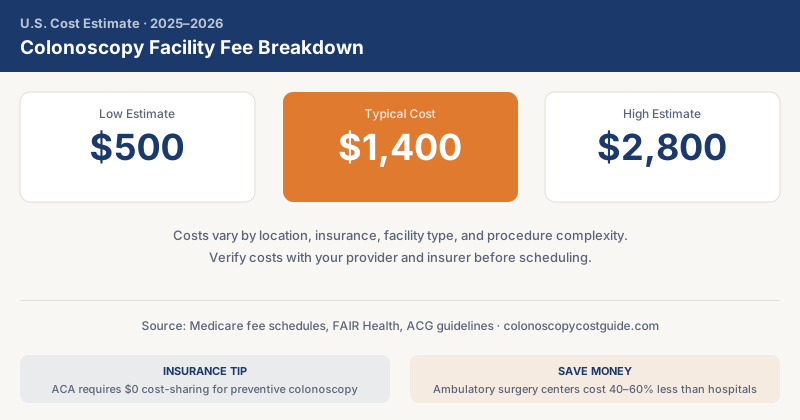
Colonoscopy Facility Fee Breakdown: What You're Paying For and Why
{ if eq .Lang "zh" }{ else }{ end }The $1,800 charge from “Regional Endoscopy Center” on your EOB — that’s the facility fee. It’s usually the biggest number on your bill. It’s also the least understood.
Most patients think they’re paying one doctor to do one procedure. In reality, the facility and the physician bill independently. Your GI doctor’s fee is a separate, smaller charge. The facility fee is what the place itself charges for keeping the lights on, the equipment sterile, and the nurses present.
What the Facility Fee Covers
The facility fee is the ASC or hospital outpatient department’s charge for everything that isn’t the physician’s service. That includes:
- Nursing staff: Pre-procedure assessment, medication administration, intraoperative monitoring, and post-anesthesia recovery
- Procedure room: The room itself, cleaning and turnover between patients, and room-specific equipment
- Endoscopic equipment: The colonoscope, biopsy forceps, snare devices, electrosurgical equipment (if used), and all disposables
- Medications: IV fluids, reversal agents, supplemental oxygen, emergency medications on standby
- Recovery area: The bay where you wake up from sedation, staffed until you’re cleared for discharge
- Administrative costs: Scheduling, medical records, billing
None of this is itemized on your EOB. It shows up as one number under the facility name.
Facility Fee by CPT Code
The CPT code for your procedure determines the base facility fee. When additional procedures are performed, additional codes are added — and the facility fee increases accordingly.
| CPT Code | Procedure Description | Typical Facility Fee (ASC) | Typical Facility Fee (Hospital) |
|---|---|---|---|
| 45378 | Colonoscopy, diagnostic/screening | $500 – $1,400 | $1,000 – $2,800 |
| 45380 | Colonoscopy with biopsy | $700 – $1,600 | $1,300 – $3,200 |
| 45384 | Colonoscopy with polyp removal (forceps) | $750 – $1,700 | $1,400 – $3,200 |
| 45385 | Colonoscopy with polypectomy (snare) | $900 – $1,900 | $1,500 – $3,500 |
| 45388 | Colonoscopy with ablation | $1,000 – $2,200 | $1,800 – $4,000 |
For a procedure with multiple polyps removed, the facility bills the primary code (45385) plus modifier codes for the additional procedures. The total facility fee can increase by $300–$700 per additional polyp removed.
Professional Fees: The Separate Physician Charge
Your gastroenterologist’s fee is billed under the same CPT codes — but as a “professional component” rather than a “facility component.” Both claims go to your insurer separately.
The physician fee is typically 15–25% of the total bill. On a $2,000 facility fee, expect a $300–$550 physician fee from the GI physician. These are processed and paid separately by your insurer, and your cost-sharing applies to each independently (up to your out-of-pocket maximum).
| Component | Who Bills It | Typical Amount |
|---|---|---|
| Facility fee | ASC or hospital | $500 – $2,800 |
| GI physician fee | Gastroenterologist | $250 – $600 |
| Anesthesia fee | Anesthesiologist or CRNA | $400 – $1,500 |
| Pathology fee | Reference lab | $100 – $600 |
| Total (no polyps) | Multiple billers | $1,150 – $5,500 |
Hospital-Owned ASCs: The Facility Fee Trap
Not all facilities that look like ambulatory surgery centers bill as ambulatory surgery centers. Hospital-owned ASCs — those owned by or affiliated with a hospital system — often bill under the hospital’s CMS provider number, which means they’re classified as hospital outpatient departments (HOPDs) for billing purposes.
The practical difference is enormous. CMS pays roughly twice as much to HOPDs as to freestanding ASCs for the same procedure. Commercial insurers typically follow a similar premium. A facility fee that costs $900 at a freestanding ASC can cost $2,200 at a hospital-owned ASC billing as an HOPD.
How to check:
- Ask the facility directly: “Are you a freestanding ASC, or are you billed under a hospital’s Medicare provider number?”
- Verify the facility type with your insurer by NPI number
- Check the facility’s CMS certification type at cms.gov
What Drives Facility Fee Variation Within the Same Setting
Even among freestanding ASCs, facility fees vary. Factors that push them higher:
- Geographic market: ASC rates in Manhattan are 2x rural Ohio for the same reasons hospital rates are
- Negotiated insurer rates: Larger ASC networks negotiate higher rates; independent facilities may be lower
- Equipment type: ASCs with newer high-definition colonoscopes or specialized equipment may have higher overhead baked into their rates
- Procedure complexity: Longer or more complex procedures (extensive diverticular disease, prior abdominal surgery) may be billed at higher complexity codes
Understanding Your Facility Fee EOB
Your Explanation of Benefits will show:
- Billed charge: What the facility submitted (often inflated; no one pays this)
- Allowed amount: What your insurer’s contract permits the facility to receive (this is what matters)
- Plan paid: What your insurer pays
- Your responsibility: What you owe
The “billed charge” can be 3–5x the “allowed amount.” Only the allowed amount matters for calculating your cost-sharing. If you’re uninsured and paying cash, negotiate based on the allowed amount from a comparable insurer — or use FAIR Health’s free cost estimator — not the billed chargemaster price.
Understanding the facility fee structure is the foundation for any cost negotiation. If you can identify the setting, confirm the CPT codes, and know the in-network allowed amount — you know your real cost before anyone sends you a bill.
{ if eq .Lang "zh" }