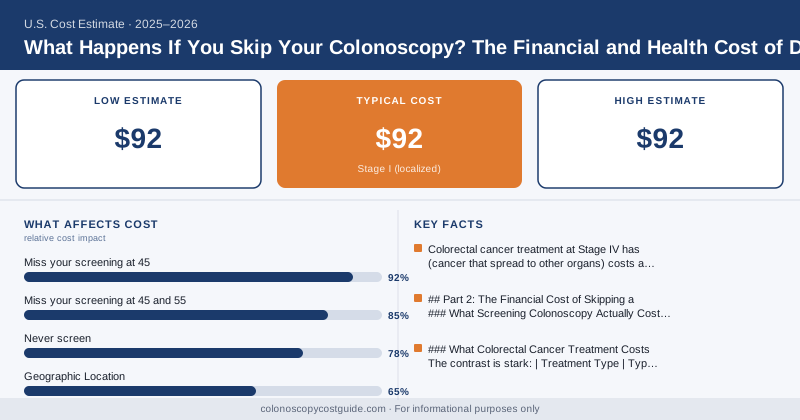
What Happens If You Skip Your Colonoscopy? The Financial and Health Cost of Delay
{ if eq .Lang "zh" }{ else }{ end }A $0 screening colonoscopy or a $180,000 cancer treatment — the stakes of skipping aren’t subtle.
That’s not hyperbole. Colorectal cancer treatment at Stage IV (cancer that has spread to other organs) costs an average of $120,000–$180,000 or more over the course of treatment, based on CMS claims data analysis. A preventive screening colonoscopy for an insured adult costs $0. For an uninsured adult at a freestanding surgery center, it costs $500–$1,200 all-in. The financial gap between catching colon cancer early and missing it entirely is one of the largest in American medicine.
This article lays out both sides of that equation — the health risk of delaying and the financial cost of delay — so you can make an informed decision about whether “I’ll get to it eventually” is actually a reasonable plan.
Part 1: The Health Cost of Skipping
How Colon Cancer Develops (And Why the Window Matters)
Most colorectal cancers start as polyps — small growths on the inner lining of the colon that are benign when they form. The progression from a normal polyp to invasive cancer typically takes 10–15 years. That timeline is your opportunity: colonoscopy allows a GI doctor to find and remove polyps before they ever become cancerous.
But that window isn’t infinite, and it’s not the same for everyone. Certain polyp types (sessile serrated lesions, villous adenomas) carry higher malignant potential and progress faster. Patients with inflammatory bowel disease face an accelerated cancer risk. And some colorectal cancers develop through a faster pathway — sometimes within 3–5 years.
The take-home: a 10-year screening interval is designed around the average-risk polyp timeline. If you miss one decade-long interval, you may catch a cancer that’s still early-stage. Miss two intervals — meaning you go 20+ years without screening — and you’re taking a real gamble.
Survival Rates by Stage
Here’s the data that makes the colonoscopy case more compellingly than any public health campaign:
| Stage at Diagnosis | 5-Year Relative Survival Rate | Notes |
|---|---|---|
| Stage I (localized) | ~92% | Caught early, usually surgical cure |
| Stage II (regional, no lymph nodes) | ~72–85% | Surgery often curative |
| Stage III (lymph node involvement) | ~53–89% | Depends on nodes involved |
| Stage IV (distant metastasis) | ~13–15% | Chemotherapy, targeted therapy |
Source: National Cancer Institute SEER database, 5-year survival rates for colorectal cancer, 2013–2019 data.
That is a collapse in survival odds from 92% to 13–15%. The National Cancer Institute’s SEER data shows that approximately 37% of colorectal cancers are still diagnosed at a localized stage — meaning the majority are diagnosed after the cancer has already spread. Screening colonoscopy is specifically designed to prevent that late-stage discovery.
The Polyp-to-Cancer Clock
A useful way to think about screening delay:
- Miss your screening at 45: You now have a 10-year window where polyps could be growing undetected. Risk is moderate.
- Miss your screening at 45 and 55: 20 years of undetected growth. A polyp that formed at 46 could be Stage II or III cancer by the time you finally get screened at 65.
- Never screen: The ACS estimates that colorectal cancer is the second-leading cause of cancer death in the US when men and women are combined — a statistic driven largely by late-stage diagnoses in unscreened populations.
Part 2: The Financial Cost of Skipping
What a Screening Colonoscopy Actually Costs You
Let’s establish the baseline:
- Employer-insured adult (preventive): $0 out of pocket
- ACA marketplace plan (preventive): $0 out of pocket
- Medicare (preventive): $0 out of pocket
- Uninsured, ASC cash rate: $500–$1,200 all-in for a basic screening colonoscopy
- Uninsured, free program eligibility: $0 (Colon Cancer Alliance, FQHCs for income-qualifying patients)
For most Americans, the cost of the screening itself is a non-issue. The barrier is time, discomfort with the prep, and — most commonly — procrastination.
What Colorectal Cancer Treatment Costs
The contrast is stark:
| Treatment Type | Typical Cost Range | Notes |
|---|---|---|
| Colon resection surgery | $35,000–$95,000 | Hospital stay 3–7 days, anesthesia, surgeon fee |
| Laparoscopic colectomy | $28,000–$75,000 | Minimally invasive, shorter stay |
| Chemotherapy (6-month course, Stage III) | $30,000–$100,000 | Varies by regimen |
| Targeted therapy (bevacizumab, cetuximab, Stage IV) | $10,000–$30,000/month | Ongoing treatment |
| Radiation therapy | $25,000–$65,000 | Common in rectal cancer |
| Total Stage IV treatment (2–4 years) | $120,000–$250,000+ | Per CMS claims analysis |
For insured patients, these costs are partially covered — but not fully. After deductibles, coinsurance, and out-of-pocket maximums reset each year over a multi-year treatment course, total patient out-of-pocket for Stage IV colon cancer treatment can reach $25,000–$75,000 even with good insurance.
For uninsured patients, the financial devastation is near-total. Medical bankruptcy is strongly associated with cancer diagnosis in the US, and colorectal cancer is one of the diagnoses most likely to produce catastrophic medical debt.
The Insurance Complexity Factor
Beyond raw cost, late-stage cancer diagnosis creates insurance complications that early-stage disease doesn’t:
- Prior authorization battles: Targeted therapies and immunotherapy agents require insurer pre-approval. Denials, appeals, and step-therapy requirements add weeks of delay and administrative burden.
- Annual out-of-pocket maximums reset: If treatment spans multiple calendar years — common with Stage III and IV — your deductible and out-of-pocket max reset each January, adding thousands in new cost-sharing each year.
- Income disruption: Cancer treatment often forces patients to reduce work hours or stop working entirely, creating a compounding financial crisis on top of direct medical costs.
The Comparison That Puts It in Perspective
A colonoscopy prep kit costs about $15 at a pharmacy. The procedure itself costs most insured patients $0. The lost work day for the procedure and prep costs the average American worker $200–$300 in wages. The total real cost of getting your colonoscopy done: roughly $300 for most employed, insured adults — mostly in lost time.
The cost of colorectal cancer caught at Stage IV: potentially your life, plus $120,000–$250,000 in medical bills.
The math strongly favors the screening.
The Uninsured Patient’s Calculus
Uninsured adults who skip colonoscopy because they can’t afford it face a particularly tragic version of this calculation. The Colon Cancer Alliance’s Never Too Busy program and many FQHCs offer free or very low-cost screening colonoscopies for income-qualifying adults. An uninsured 52-year-old who skips screening because they assume it’ll cost $2,000 — when they could actually get it free — and later develops Stage III colorectal cancer is in a nearly impossible financial and medical situation.
If cost is your reason for delay, please investigate free programs before concluding you can’t afford it. See colonoscopy cost without insurance for a full list of resources.