Does Insurance Cover a Colonoscopy Before Age 45?
The free screening colonoscopy everyone talks about? It starts at 45. If you’re 38 and your doctor wants you to get one, you’re in a different billing world — and the difference can be thousands of dollars.
That doesn’t mean insurance won’t pay. It means the rules change. Whether your colonoscopy before 45 costs $0 or $2,500 comes down to one question: is it screening, or is there a medical reason behind it?
The 45 Cutoff Comes From One Specific Rule
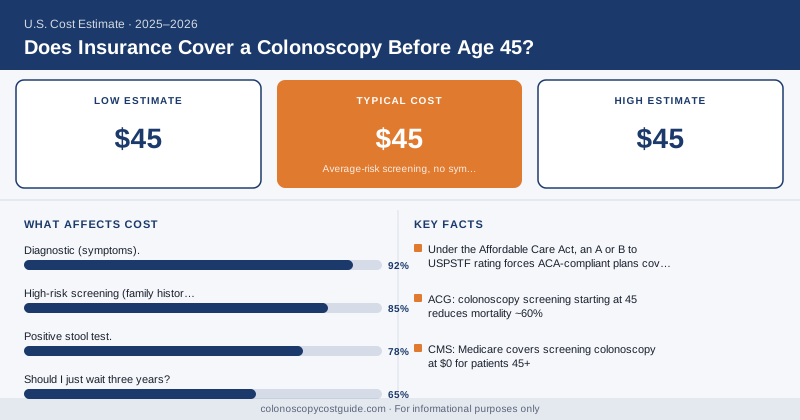
In 2021, the U.S. Preventive Services Task Force lowered its colorectal cancer screening recommendation from 50 to 45, giving ages 45–49 a Grade B rating. Under the Affordable Care Act, an A or B USPSTF rating forces ACA-compliant plans to cover that service at $0 — no copay, no deductible.
That’s the entire reason 45 is the magic number. Below 45, there’s no average-risk screening recommendation, so there’s no $0 mandate. The American Cancer Society actually recommends screening from 45 too, which reinforces the cutoff.
Average Risk vs. Higher Risk — This Decides Everything
You’re “average risk” if you have no symptoms, no personal history of polyps or colorectal cancer, no inflammatory bowel disease, and no significant family history. Average-risk people get the $0 benefit only at 45+.
You’re “higher risk” — and may qualify for covered screening earlier — if you have a first-degree relative with colorectal cancer, a genetic syndrome like Lynch, or a condition like Crohn’s or ulcerative colitis.
When a Colonoscopy IS Covered Before 45
There are three solid paths to coverage before 45. Two of them just don’t come with the $0 price tag.
| Reason Before 45 | Covered? | Typical Out-of-Pocket |
|---|---|---|
| Average-risk screening, no symptoms | Usually not until 45 | Full cost if you proceed |
| Symptoms (bleeding, pain, anemia) — diagnostic | Yes, diagnostic | Deductible + coinsurance ($1,000–$3,000) |
| Family history / high risk — screening | Usually yes | $0 to coinsurance (varies by plan) |
| Positive stool test follow-up | Yes, diagnostic | Deductible + coinsurance |
Diagnostic (symptoms). If you have rectal bleeding, unexplained anemia, persistent abdominal pain, or a change in bowel habits, the colonoscopy is medically necessary at any age. Insurance covers it as a diagnostic procedure — meaning your deductible and coinsurance apply.
High-risk screening (family history). Most guidelines say to begin screening at 40, or 10 years before the age your relative was diagnosed, whichever comes first. If your dad had colon cancer at 46, you start at 36. Insurance generally covers high-risk screening, though some plans still apply cost-sharing — get the coverage confirmed in writing first. Our colonoscopy at age 45 guide covers how the screening benefit works once you reach the cutoff.
Positive stool test. A positive FIT or Cologuard result makes the follow-up colonoscopy diagnostic and covered — but as diagnostic, not as a $0 screening.
What It Actually Costs If You Pay
If you’re under 45, average risk, and choose to proceed anyway — or if it’s diagnostic and your deductible hasn’t been met — you’re looking at real money. On a typical commercial plan, expect $1,000–$3,000 out of pocket. The full billed amount usually runs $2,000–$5,000 depending on facility and whether a polyp is removed.
Frequently Asked Questions
My doctor recommended one at 42 but I feel fine — is that covered? If it’s truly average-risk screening with no symptoms and no family history, your plan probably won’t apply the $0 benefit until 45. Ask your doctor whether there’s a documented medical reason. If there is, the coding changes and coverage usually follows.
Should I just wait three years? Only if you’re average risk with zero symptoms. If you have a family history or any symptom, waiting is genuinely risky and a covered diagnostic colonoscopy is the right call now.
Will the polyp finding change my bill? Yes — if a polyp is removed during a pre-45 diagnostic colonoscopy, expect a higher facility fee plus a pathology charge. See what happens if polyps are found for the specifics.
The short version: before 45, “covered” and “free” aren’t the same thing. Diagnostic and high-risk colonoscopies get covered, but you usually share the cost. The $0 average-risk benefit waits for your 45th birthday.