Colonoscopy Cost Without Insurance: Cash Prices and How to Negotiate
{ if eq .Lang "zh" }{ else }{ end }What does a colonoscopy actually cost if you’re uninsured?
The honest answer: it depends more on where you call than on where you live. The same procedure that runs $3,200 at a hospital outpatient department can cost $900 at a freestanding ambulatory surgery center two miles away. Knowing that gap — and knowing how to ask for the lower number — changes everything.
Cash Prices Vary Wildly
FAIR Health’s consumer cost lookup shows that cash-pay colonoscopy prices (CPT 45378) vary by factor of 3x or more within the same metro area. A procedure billed at $3,500 at a hospital-affiliated outpatient facility might be listed at $1,100 at a freestanding ASC. Neither number is regulated. Both are negotiable.
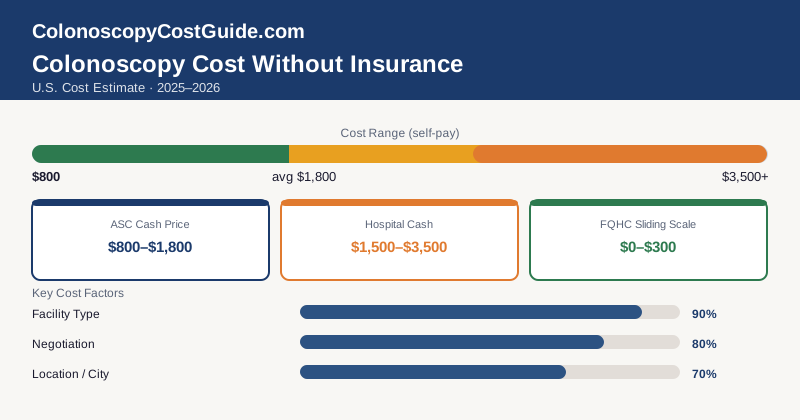
National cash-pay ranges for a basic diagnostic colonoscopy:
| Setting | Cash Price Range |
|---|---|
| Freestanding ASC (low-cost market) | $800 – $1,500 |
| Freestanding ASC (high-cost market) | $1,200 – $2,200 |
| Hospital outpatient department | $1,800 – $3,500 |
| Academic medical center | $2,500 – $4,800 |
| FQHC / community health center | $0 – $300 (sliding fee) |
The prep medication is a separate cost. See the colonoscopy prep cost guide for GoodRx pricing and OTC alternatives.
The Fastest Way to Cut Your Bill: Choose an ASC
Ambulatory surgery centers charge dramatically less than hospitals for colonoscopy. The procedure itself is identical — same physician, same sedation, same equipment. The facility cost is just lower because ASCs don’t carry the overhead of a full hospital.
A 2023 analysis of Medicare claims data found ASC facility fees averaging roughly 40–55% less than hospital outpatient department rates for colonoscopy (CPT 45378). That gap holds for cash-pay patients too.
How to find a freestanding ASC near you:
- Search the CMS ASC Locator at cms.gov
- Call your GI physician’s office and ask if they perform procedures at an affiliated ASC
- Ask explicitly: “Is this facility freestanding or hospital-owned?” — hospital-owned ASCs often bill at hospital rates
How to Negotiate a Cash-Pay Price
Call the ASC’s billing department — not the front desk, not the scheduling line — and say this:
“I’m a self-pay patient. I don’t have insurance and I’m paying cash on the day of service. What is your self-pay discount rate for CPT 45378?”
Most ASCs have a self-pay or prompt-pay discount already built in. It’s rarely advertised. The discount can be 20–40% off the listed charge. Some facilities will match a competitor’s price if you have a written quote.
Get the agreed price in writing before your procedure date. Ask for a “financial agreement” or “self-pay contract” that specifies:
- The total billed amount
- The self-pay discount
- Your total out-of-pocket
- What happens if polyps are removed (polypectomy adds cost — ask about that rate too)
What to Say If They Quote You the Rack Rate
Regional Price Variation: Where Costs Run High vs. Low
Geographic location matters. CMS fee schedules include geographic adjustment factors, and private-pay markets follow similar patterns.
| Region | Approximate ASC Cash Range |
|---|---|
| Northeast (NY, MA, CT) | $1,400 – $2,800 |
| West Coast (CA, WA, OR) | $1,200 – $2,400 |
| Southeast (FL, GA, TN, AL) | $900 – $1,800 |
| Midwest (OH, IN, MI, MO) | $800 – $1,600 |
| Southwest (TX, AZ, NV) | $900 – $1,900 |
Rural areas vary independently. Some rural hospitals have lower rates due to lower overhead; others are the only facility within 60 miles and price accordingly.
Using GoodRx for Prep Medication
Colonoscopy prep prescriptions can run $50 to $250 at retail price. GoodRx consistently brings that down for generic options:
- GoLYTELY (polyethylene glycol) — retail ~$40–$80, GoodRx as low as $18–$30 at major pharmacies
- Suprep (sulfate-based) — generic available now, retail ~$80–$120, GoodRx ~$45–$70
- Clenpiq — brand only, $250–$300 retail; minimal GoodRx discount; look for manufacturer coupon
The Miralax + Gatorade split-dose OTC approach costs about $25 total and is approved by the ACG as an effective prep for many patients. Ask your GI physician if that option is appropriate for you.
Community Health Centers: The Option Most People Skip
Federally Qualified Health Centers (FQHCs) offer colonoscopy on a sliding fee scale based on income. Under federal rules, no FQHC patient is turned away for inability to pay. Some FQHCs perform colonoscopy on-site; others refer to a partner ASC at a negotiated low rate.
To find an FQHC near you, use the finder at findahealthcenter.hrsa.gov. Income limits typically follow 200% of the federal poverty level for the lowest fee tier, but many FQHCs extend sliding fees up to 300–400% FPL.
The Actual Minimum You Can Pay
If you call an FQHC and qualify for their lowest sliding-fee tier, your colonoscopy could cost $0 to $50. If you use a freestanding ASC with a negotiated cash rate, use GoodRx for prep, and have a clean procedure (no polyps), you’re looking at $800 to $1,200 total in most U.S. markets.
That’s the floor. The $3,500 hospital quote is the ceiling. The difference is just a few phone calls.
For a complete picture of colonoscopy cost components, or to understand the free and low-cost colonoscopy programs available through CDC and state cancer screening funds, follow those guides before you schedule.
{ if eq .Lang "zh" }