Colonoscopy Cost With Insurance: What You'll Owe After Coverage
{ if eq .Lang "zh" }{ else }{ end }Most people assume colonoscopy is always free under insurance. It’s not — and the reasons why are buried in billing codes your insurer uses, not in your policy documents.
Whether you pay $0 or $800 out of pocket depends on three things: how the procedure is coded, whether you’ve met your deductible, and whether every single provider in that room is in your network. Get all three right and you genuinely pay nothing. Get one wrong and the bill lands anyway.
How Insurance Processes a Colonoscopy Bill
Your insurer doesn’t pay one lump sum. It processes separate claims from each provider who billed for your procedure — facility, gastroenterologist, anesthesiologist, and pathology lab. Each goes through the same steps:
- The provider submits a claim with a CPT code and diagnosis code.
- Your insurer applies its contract rate (the “allowed amount”).
- It checks whether the service is preventive or diagnostic.
- It applies your deductible, then your copay or coinsurance.
- You get an Explanation of Benefits (EOB) showing what you owe.
The step that trips people up is step 3. Under the ACA, a preventive colonoscopy must be covered at zero cost-sharing by most plans. A diagnostic colonoscopy is treated like any other specialist procedure — subject to your deductible and coinsurance.
The Coverage Trigger: Screening vs. Diagnostic
The USPSTF updated its colorectal cancer screening recommendation in 2021 to include average-risk adults starting at age 45. Under the ACA, health plans must cover USPSTF-recommended preventive services at no cost-sharing — no deductible, no copay, no coinsurance.
That means a routine screening colonoscopy should cost you $0 if:
- You’re average-risk (no symptoms, no personal or strong family history of colorectal cancer)
- Your plan is ACA-compliant (most employer and marketplace plans are)
- You use an in-network facility and in-network providers for everything
But here’s what changes the math: if your doctor finds and removes a polyp during that screening, some insurers recode the whole visit as diagnostic. You can walk in for a “free” screening and walk out owing $400. This is the single most common billing complaint in GI care. The screening vs. diagnostic colonoscopy cost article covers the legal and billing mechanics in detail.
What You’ll Actually Owe: Common Scenarios
| Scenario | Likely Out-of-Pocket |
|---|---|
| Screening, no polyps, in-network, ACA plan | $0 |
| Screening, polyp removed, insurer recodes as diagnostic | $150 – $600 |
| Diagnostic colonoscopy, deductible met | $150 – $400 (coinsurance) |
| Diagnostic colonoscopy, deductible not met | $500 – $2,000+ |
| Any colonoscopy, out-of-network facility | $800 – $3,500+ |
| Anesthesiologist out-of-network | $200 – $1,200 additional |
In-Network vs. Out-of-Network: The Biggest Cost Variable
In-network means your insurer has a contract with that provider. The contract sets a maximum “allowed amount” — and limits your cost-sharing to a percentage of that amount. Out-of-network means no contract exists, so there’s no negotiated rate protecting you.
The No Surprises Act (effective 2022) protects patients from surprise out-of-network bills for emergency services and certain non-emergency services at in-network facilities. But it doesn’t cover every situation. If you voluntarily choose an out-of-network GI physician or knowingly use an out-of-network facility, you can still be responsible for the difference.
The most common in-network trap: your hospital and your GI doctor are in-network, but the anesthesiologist they use that day is not. Verify every provider individually before your procedure. Call your insurer with the provider’s NPI number — not their name — to confirm network status.
Deductible vs. Copay vs. Coinsurance
These three terms work together, and confusing them leads to budget surprises:
- Deductible: The amount you pay before insurance pays anything for non-preventive services. Common amounts are $500 to $3,000 for individual plans.
- Copay: A flat fee per visit (e.g., $50 for a specialist visit). Most colonoscopies don’t use copays — they use coinsurance.
- Coinsurance: Your percentage share after the deductible. If your plan has 20% coinsurance and the allowed amount is $1,800, you owe $360 — but only after your deductible is met.
For a diagnostic colonoscopy where your deductible hasn’t been met, you could owe the full allowed amount until you hit that threshold. That’s why procedure timing matters. See the colonoscopy cost with a high-deductible plan guide for the math on timing your procedure strategically.
Steps to Know Your Exact Cost Before Scheduling
- Call your insurer and ask for the allowed amount for CPT 45378 at the specific facility (use the facility’s NPI).
- Ask your current deductible balance — how much have you met year-to-date.
- Ask explicitly: “How does your plan handle a screening colonoscopy that becomes diagnostic if polyps are removed?”
- Verify the anesthesiologist is in-network by their NPI number.
- Request a good-faith estimate from the facility in writing — federal law requires this for scheduled services.
The Pathology Bill Arrives Later
If any tissue was removed or biopsied, expect a pathology bill 3–6 weeks after the procedure. Pathology is billed by a separate lab, not your GI physician or the facility. That lab may or may not be in your network — and if it isn’t, you could owe more than expected.
FAIR Health data shows pathology charges for colonoscopy specimens running $200 to $600 per specimen when billed at out-of-network rates. In-network rates are typically much lower. Ask your GI office in advance which pathology lab they use and verify that lab is in your network.
The Bottom Line on Insured Costs
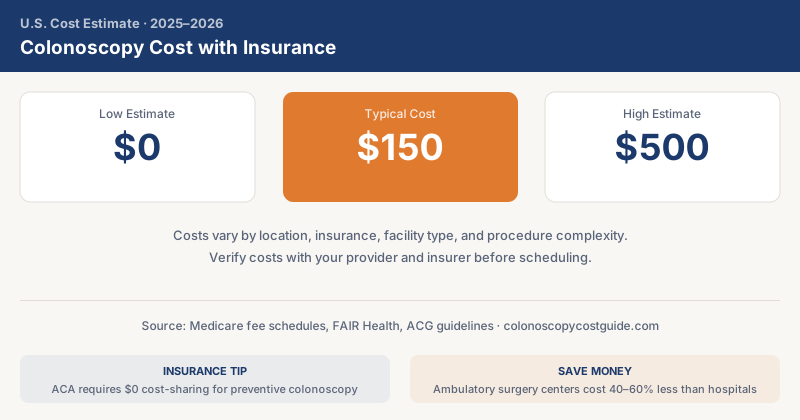
A clean screening colonoscopy on an ACA-compliant plan, with all in-network providers, costs you $0. Add a polyp removal, an out-of-network anesthesiologist, or a diagnostic billing code, and that number climbs quickly. The difference between a $0 bill and a $600 bill is usually two phone calls before the procedure date.
For tips on using your HSA or FSA to cover whatever you do owe, see colonoscopy HSA and FSA coverage.
{ if eq .Lang "zh" }