Colonoscopy Cost Without Insurance: Cash Prices, Charity Care, and State Programs
{ if eq .Lang "zh" }{ else }{ end }No insurance. You need a colonoscopy. The hospital quoted $4,800. The ambulatory surgery center two miles away quoted $1,100. Same procedure. Same doctor.
This is not an unusual situation — it’s the norm for the estimated 25 to 30 million uninsured Americans who need GI care. And the $3,700 gap in that example is real. The facility you choose matters more than almost anything else when you’re paying out of pocket for a colonoscopy.
But before you book anywhere, read this. There are options below the $1,100 ASC rate — including some that cost you nothing.
The Realistic Cash Price Range for Uninsured Patients
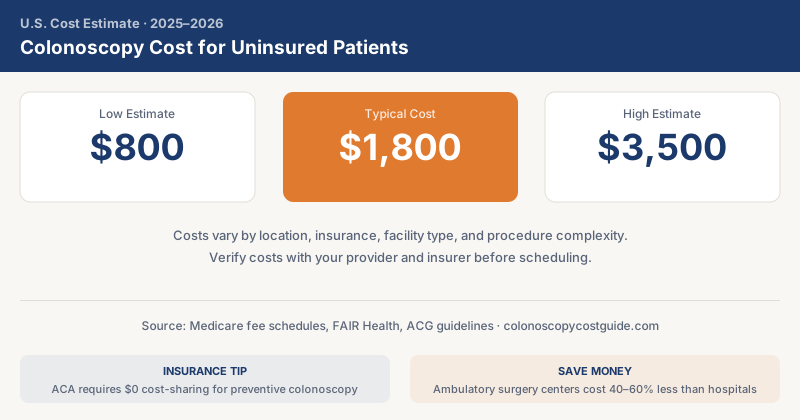
According to CMS data and FAIR Health benchmarks, here’s what uninsured patients actually pay at different facility types when they ask for a self-pay rate:
| Facility Type | Self-Pay Rate (All-In: Facility + Physician + Anesthesia) |
|---|---|
| Freestanding endoscopy center (negotiated) | $800 – $1,800 |
| Ambulatory surgery center (standard self-pay) | $1,000 – $2,200 |
| Hospital outpatient (self-pay rate) | $2,000 – $4,500 |
| Hospital outpatient (list price, no negotiation) | $3,500 – $7,000 |
| FQHC / community health center | $0 – $500 (sliding scale) |
Key point: The “self-pay rate” and the “list price” are not the same number. You must explicitly ask for the self-pay rate. If you don’t ask, you may be billed list price.
Step 1: Find a Freestanding Endoscopy Center
Don’t call the hospital first. Find freestanding GI endoscopy centers or ambulatory surgery centers in your area. These are the lowest-cost venue for colonoscopy.
How to find them:
- Google Maps search: “endoscopy center near me” or “GI ambulatory surgery center [city]”
- Ask your primary care doctor for a referral to a GI physician who practices at an ASC (not a hospital)
- CMS’s ASC Facility database (data.cms.gov) lists Medicare-certified ASCs
Step 2: Make the Phone Call
Call the scheduling and billing department of the ASC. Use this script:
“I’m an uninsured patient looking to schedule a diagnostic colonoscopy. Before I book, I want to know your self-pay rate, all-inclusive — facility fee, physician fee, and anesthesia. Can you tell me that number?”
If they give you a rate, follow up with:
“Thank you. If I pay in full at the time of service, is there any additional discount for same-day cash payment?”
Upfront payment is often worth an additional 5 to 15% discount. Many ASCs have a formal “prompt pay” policy for self-pay patients.
Reference Medicare as Your Negotiation Anchor
Medicare’s facility payment for a diagnostic colonoscopy (CPT 45378) at an ASC is approximately $280 to $340. The physician fee adds roughly $150 to $200. Total Medicare payment: about $430 to $540.
If an ASC quotes you $1,400 all-in, you can respond: “I understand Medicare pays approximately $530 for this procedure. As a self-pay patient willing to pay today, I was hoping to get closer to that range. Is there any flexibility?”
Most ASC billing staff have authority to discount to 100 to 130% of Medicare rates for self-pay patients — which means $530 to $700 for the facility + physician, not including anesthesia. Anesthesia is often billed separately by an independent group.
Step 3: Free and Low-Cost Options to Check First
Before spending even $800, check these programs:
Federally Qualified Health Centers (FQHCs)
FQHCs are federally funded community health centers that charge on a sliding-scale fee based on income. They serve patients regardless of ability to pay. Many FQHCs have gastroenterology services or referral relationships with local GI centers at reduced rates.
Find one at: findahealthcenter.hrsa.gov
Income at or below 100% of the federal poverty level ($15,060 for a single person in 2025): you may pay $0. Income between 100 to 200% FPL: you may pay $50 to $200 for a colonoscopy.
State Colorectal Cancer Screening Programs
Many states have dedicated colorectal cancer screening programs for uninsured adults. These are funded separately from Medicaid and provide free colonoscopies to income-eligible residents.
States with robust programs include:
- New York (CPEX Program)
- California (Every Woman Counts — expanded to include CRC)
- Texas (Cancer Prevention and Research Institute of Texas-funded programs)
- Florida (Department of Health cancer screening programs)
- Most states have some version; contact your state health department
The CDC’s Colorectal Cancer Control Program (CRCCP) funds programs at health departments and clinical sites in many states — they provide free CRC screening including colonoscopy to income-eligible uninsured adults.
Hospital Charity Care
Every nonprofit hospital must have a financial assistance program under the ACA. Most provide free or heavily discounted care to patients below 200 to 300% of the federal poverty level.
Apply before your procedure. Call the hospital’s Patient Financial Services department and ask:
“Do you have a financial assistance or charity care program? Can I apply before my colonoscopy?”
You’ll typically need to provide proof of income (pay stubs or tax return) and proof of uninsured status. Processing takes 1 to 4 weeks.
| Program | Income Threshold | What You Pay |
|---|---|---|
| FQHC (sliding scale) | All incomes; fees based on FPL | $0 – $300 |
| State CRC screening program | Varies (typically < 200% FPL) | $0 |
| Hospital charity care | Varies (typically < 250% FPL) | $0 – 50% of charges |
| ASC negotiated self-pay | No income requirement | $800 – $1,800 |
Step 4: If You’re in a Middle-Income Gap
If you earn too much for charity care programs but can’t comfortably pay $1,000 to $1,800 out of pocket:
Health insurance marketplace (ACA): Open enrollment runs November 1 to January 15. A marketplace plan with low or $0 premium may be available if your income qualifies for premium tax credits. A colonoscopy as a preventive screening on an ACA plan is $0.
Short-term health plans: Cover major medical procedures including colonoscopy in many cases, but read the policy carefully — some exclude preventive care or limit GI coverage.
Medical financing: CareCredit and similar programs spread the cost over 12 to 24 months. For a $1,200 colonoscopy, 12-month payments are $100/month at 0% (if paid within promotional period). See colonoscopy financing options for the full breakdown.
The Bottom Line
Uninsured patients don’t have to choose between paying $5,000 for a colonoscopy and skipping it entirely. With the right approach:
- ASC self-pay rate + upfront payment discount: $700 to $1,500
- FQHC or state program (income-eligible): $0 to $300
- Hospital charity care (income-eligible): $0 to $500
The most important thing you can do is call multiple providers, ask explicitly for self-pay rates, and check whether any income-based programs apply to you before scheduling. The CDC reported in 2024 that colorectal cancer screening rates among uninsured adults are 20 to 30 percentage points lower than insured adults — and cost is the primary barrier cited. It doesn’t have to be.
{ if eq .Lang "zh" }