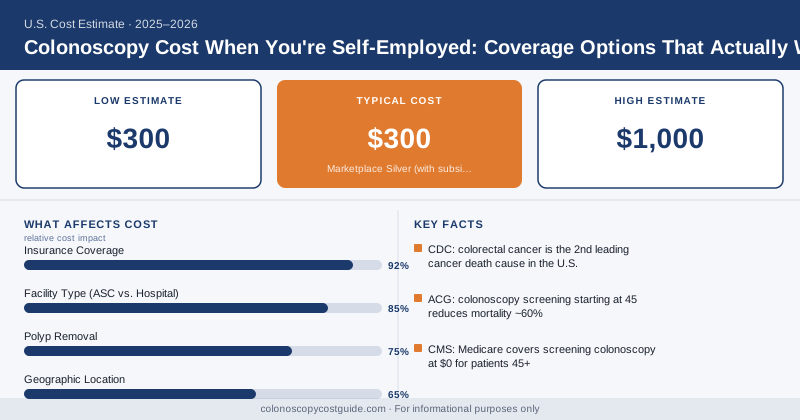
Colonoscopy Cost When You're Self-Employed: Coverage Options That Actually Work
{ if eq .Lang "zh" }{ else }{ end }Freelancers, contractors, gig workers, small-business owners: you’re on your own for health coverage, and a colonoscopy bill can look terrifying when there’s no HR department backing you up. Good news — the screening is still free, and the tax code actually works in your favor here. You just have to set it up right.
Roughly 16.5 million Americans were self-employed as of recent Bureau of Labor Statistics counts, and most of them buy coverage individually. Here’s how to make a colonoscopy affordable without an employer plan.
Your Screening Is Still Free
This is the part people don’t expect. Being self-employed doesn’t cost you the ACA preventive benefit. Any compliant individual plan — Marketplace or off-exchange — must cover a screening colonoscopy at $0 for people 45 and up. No employer required. Our ACA free preventive coverage guide spells out the rule.
Key Takeaway
Comparing Your Coverage Options
The self-employed have several paths, and the right one depends on your income and how much care you expect.
| Option | Premium Reality | Diagnostic Colonoscopy Cost |
|---|---|---|
| Marketplace Silver (with subsidy) | $0–$300/mo | $300–$1,000 |
| Marketplace Bronze + HSA | $250–$450/mo | Full rate until deductible ($1,500–$2,500), pre-tax |
| Spouse’s employer plan | Varies | Per that plan |
| Self-pay cash (no insurance) | $0 | $1,250–$3,000 |
If your income qualifies you for premium tax credits, a Marketplace plan is usually the clear winner. See our Marketplace plan colonoscopy cost discussion for how the metal tiers play out.
The Tax Advantages You Shouldn’t Skip
Here’s where self-employment actually helps. Two tax breaks make a colonoscopy cheaper in real dollars:
Self-employed health insurance deduction. You can deduct 100% of your health insurance premiums above the line — meaning you don’t even need to itemize. That lowers your taxable income directly.
HSA contributions. Pair a qualifying high-deductible plan with a Health Savings Account and you contribute pre-tax, grow tax-free, and withdraw tax-free for medical costs. For 2026, the HSA limit is $4,300 for an individual and $8,550 for a family. Paying an $800 diagnostic colonoscopy from an HSA in the 24% bracket means it really cost you about $608.
The HSA Strategy in Practice
For a healthy self-employed person, a Bronze high-deductible Marketplace plan plus an HSA is often the sweet spot. Your premium is lower and deductible, your screening is free, and any diagnostic colonoscopy gets paid with pre-tax HSA dollars. The downside is you pay the full negotiated rate until you hit the deductible — so understand the screening versus diagnostic distinction before you assume a procedure is covered.
If You’re Currently Uninsured
Maybe you’re between plans or skipped coverage. You can still get a colonoscopy, but a “free” screening becomes a paid one when you’re self-pay. Negotiate the cash rate hard — our colonoscopy cost without insurance and how to lower your colonoscopy bill guides cover the discounts and payment plans most facilities offer the uninsured.
Bottom Line
Being self-employed doesn’t make a colonoscopy expensive by default. Your screening is free on any ACA plan, your premiums are tax-deductible above the line, and an HSA lets you pay diagnostic costs with pre-tax dollars. The mistakes to avoid: buying a non-ACA plan that strips the free screening, or going uninsured and paying full cash. Set up the right plan and the colonoscopy is one of the easier bills to manage.
{ if eq .Lang "zh" }