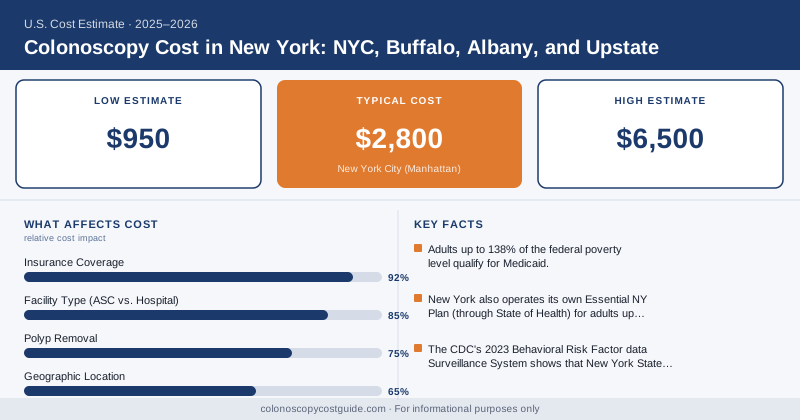
Colonoscopy Cost in New York: NYC, Buffalo, Albany, and Upstate
{ if eq .Lang "zh" }{ else }{ end }Mark, a 52-year-old in Buffalo, scheduled his first colonoscopy through a local freestanding surgery center. His Highmark BlueCross BlueShield plan covered it as preventive — $0 out of pocket, total billed charge around $1,800. His cousin in Manhattan, same age, same insurance carrier, had his colonoscopy at a major academic hospital. The facility fee alone came to $4,200. The cousin paid $840 in coinsurance before hitting his deductible.
Same procedure. Same national insurance carrier. Same state. Nearly $3,000 difference in billed charges — and $840 more out of pocket in New York City than in Buffalo. That gap isn’t a fluke. It reflects how dramatically colonoscopy costs vary across New York State based on market power, facility type, and geography.
New York State Colonoscopy Costs by Metro
| City | Hospital Outpatient (Billed) | ASC (Billed) | Self-Pay/Cash Rate (ASC) |
|---|---|---|---|
| New York City (Manhattan) | $3,200–$6,500 | $1,500–$2,800 | $950–$1,700 |
| NYC (Outer Boroughs) | $2,800–$5,500 | $1,300–$2,400 | $850–$1,500 |
| Buffalo | $2,200–$4,500 | $1,000–$1,800 | $650–$1,150 |
| Albany | $2,300–$4,600 | $1,100–$1,900 | $700–$1,200 |
| Rochester | $2,100–$4,300 | $1,050–$1,800 | $675–$1,150 |
| Syracuse | $2,000–$4,000 | $950–$1,650 | $625–$1,050 |
These are facility fees only. Physician billing ($300–$600) and anesthesia ($300–$800) are separate. For insured patients, out-of-pocket varies enormously based on plan design and whether the colonoscopy is classified as preventive or diagnostic.
New York’s Expanded Medicaid Coverage
New York State expanded Medicaid under the ACA and has one of the most comprehensive Medicaid programs in the country. Adults up to 138% of the federal poverty level qualify for Medicaid. New York also operates its own Essential Plan (through NY State of Health) for adults up to 200% FPL who are not Medicaid-eligible — the Essential Plan offers very low or $0 premiums with minimal cost-sharing.
For both Medicaid and Essential Plan enrollees, colonoscopy is covered when medically indicated or meeting USPSTF preventive screening guidelines. The out-of-pocket cost is typically $0–$20.
New York also extended Medicaid-like coverage to income-eligible immigrants who don’t qualify for federal Medicaid due to immigration status — one of the broadest state-level expansions in the country.
To apply, visit nystateofhealth.ny.gov or call 1-855-355-5777.
NYC Health + Hospitals: Free and Low-Cost Programs
NYC Health + Hospitals (H+H) is the largest municipal health system in the US, operating 11 acute care hospitals and dozens of neighborhood health centers. H+H offers colonoscopy services to uninsured and underinsured NYC residents through its MetroPlus health plan and its sliding-scale fee program for uninsured patients.
For uninsured patients, H+H applies sliding-scale fees based on income — many patients pay $0–$100 for GI procedures. Coverage is not limited to NYC residents, though H+H facilities are concentrated in the five boroughs. Learn more at nychealthandhospitals.org.
New York’s Balance Billing Protections
New York has some of the strongest surprise billing protections in the country — predating the federal No Surprises Act by several years. New York’s independent dispute resolution (IDR) process and consumer protections apply to both in-network and out-of-network situations in many cases.
Specifically for scheduled colonoscopies, New York law requires providers to give you a cost estimate before a procedure and prohibits certain types of balance billing from out-of-network providers at in-network facilities. If you receive a bill that seems inconsistent with your plan’s cost-sharing, New York’s Department of Financial Services has a complaint and mediation process.
What to Know About NYC Academic Medical Centers
Insured Patients: The In-Network Facility Trap
New York City has multiple competing hospital systems with overlapping but not identical insurance networks. A GI doctor may be in-network with your BCBS or UnitedHealthcare plan, but the hospital where they perform procedures might not be. This is common with academic medical centers that negotiate selectively with insurers.
Before scheduling:
- Confirm your GI doctor is in-network
- Separately confirm the specific facility (hospital OR ASC) is in-network
- Ask whether there will be a separate anesthesia provider — and confirm that provider is in-network
The anesthesiologist-out-of-network scenario is particularly common at NYC hospitals and can add $800–$2,000 in unexpected bills, though the No Surprises Act and New York’s own protections now limit out-of-network anesthesiologist balance billing at in-network facilities.
For more information on insurance-specific coverage, see colonoscopy cost with insurance and in-network vs. out-of-network colonoscopy cost.
{ if eq .Lang "zh" }