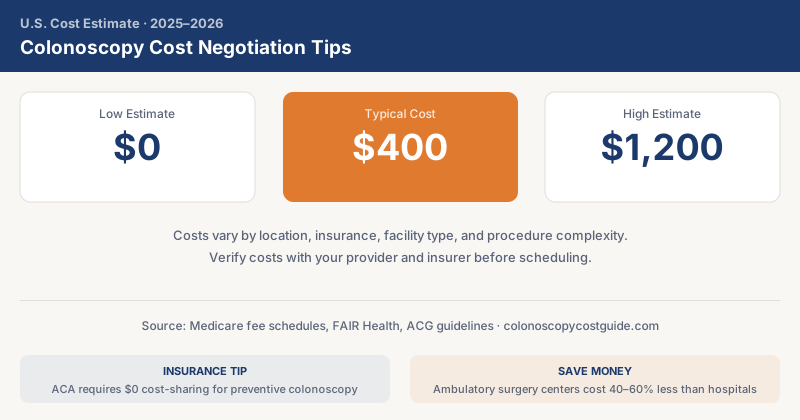
How to Negotiate Your Colonoscopy Bill: Scripts, Tactics, and Real Savings
{ if eq .Lang "zh" }{ else }{ end }“What’s the self-pay rate for a diagnostic colonoscopy?” Six words that can save you $1,000 to $3,000. Most patients never ask.
The billed price on a medical procedure is not a fixed number. It’s a starting point — and hospitals and GI centers know it. Insurers negotiate discounts of 40 to 70% off billed charges. Cash-pay patients who know how to ask can get similar rates. The patients who pay full price are usually the ones who never ask whether a lower price exists.
Here’s exactly how to negotiate your colonoscopy bill, whether you’re doing it before the procedure or after the bill arrives.
Before the Procedure: Where the Real Leverage Is
Negotiating before your procedure is almost always more effective than disputing after the fact. You have something valuable to offer: guaranteed payment, upfront.
Script 1: The Self-Pay Rate Ask
Call the GI center or hospital’s billing department and say:
“I’m scheduling a diagnostic colonoscopy and I’ll be paying out of pocket. Before I book, I want to confirm your self-pay rate. What is the all-in cash price for a colonoscopy — facility fee, physician fee, and anesthesia — at your center?”
Many centers have an official self-pay rate (sometimes called a “prompt-pay” or “cash-pay” rate) that’s 20 to 50% below their list price. This rate isn’t always advertised. You have to ask.
Script 2: The Medicare Rate Anchor
If the self-pay rate they quote seems high, use Medicare as your benchmark:
“I understand the Medicare facility payment for a diagnostic colonoscopy at an ASC is around $300 to $340 for the facility fee. As a cash-pay patient, I’m hoping to pay something in that range for the facility component. Is that something you can work with?”
This works because it’s factual. The Medicare Physician Fee Schedule and Ambulatory Payment Classification rates are public information. You’re not bluffing — you’re referencing real data. Most ASC billing staff are aware of Medicare rates and will negotiate toward them for serious cash-pay patients.
How to Find Medicare Rates
Disputing the Bill After the Fact
Already received the bill? It’s not too late. The following situations offer legitimate grounds to dispute:
Balance Billing After Out-of-Network Services
If you received services from an out-of-network provider at an in-network facility — such as an out-of-network anesthesiologist at an in-network ASC — you may be protected by the No Surprises Act (effective January 2022). This law limits what out-of-network providers can charge you for most emergency and scheduled outpatient services at in-network facilities.
If you received an unexpected bill from an anesthesia group, pathology lab, or assistant surgeon that wasn’t in-network, call your insurer. Reference the No Surprises Act. File a dispute through your insurer’s member portal. Many balance bills are reduced or eliminated through this process.
Requesting an Itemized Bill
Most patients receive a summary bill, not an itemized one. An itemized bill shows every single charge — every supply, every drug, every service, every CPT code. Billing errors are common.
Call the billing department and say:
“I’d like to request a complete itemized bill for my procedure on [date]. I want to see every line item charge before I pay.”
Review each charge against what actually happened during your procedure. Common billing errors to look for:
- Procedures billed that weren’t performed
- Duplicate line items
- Room charges billed at “inpatient” rates for outpatient procedures
- Incorrect CPT codes
| Negotiation / Dispute Tactic | Realistic Savings |
|---|---|
| Asking for self-pay rate (pre-procedure) | 20–50% off list price |
| Referencing Medicare rate as anchor | Additional 10–20% |
| Paying upfront / same-day | Additional 5–15% |
| Disputing out-of-network balance billing (No Surprises Act) | Often 100% of the excess charges |
| Requesting itemized bill and disputing errors | $100–$1,000 depending on errors |
| Appealing denied insurance claim | Often full claim amount |
| Applying for charity care (hospital) | 50–100% of remaining balance |
Using a Patient Advocate
If your bill is large and complicated — multiple providers, denied claims, balance billing disputes — consider hiring a medical billing advocate. These professionals work on your behalf to negotiate bills, appeal denials, and identify errors.
Patient advocates typically charge a contingency fee (25 to 35% of the savings they achieve) or a flat hourly rate. For a $10,000 hospital colonoscopy bill, a good advocate may negotiate it to $3,000 — meaning you pay $1,750 to $2,450 in fees but save $5,000 to $7,000 overall.
Find patient advocates through the Patient Advocate Foundation (patientadvocate.org) or the Alliance of Professional Health Advocates.
If Your Insurance Denied the Claim
Claim denials are common and frequently overturned on appeal. According to the Kaiser Family Foundation, about 18% of all in-network claims are denied in marketplace plans. Of those appealed, about 43% are overturned in the patient’s favor.
If your colonoscopy claim was denied:
- Get the denial letter and identify the specific reason code
- Call your GI physician’s office — they’ve seen your insurance’s denial patterns and often know how to resubmit
- Request a peer-to-peer review between your doctor and the insurance medical director
- If the peer-to-peer fails, file a formal appeal with supporting clinical documentation
- If the formal appeal fails, request an external independent review (required by law under the ACA)
The Phone Call That Saves You the Most Money
If you do only one thing on this list, do this: before your colonoscopy, call your insurer and ask:
“I’m scheduling a colonoscopy at [facility] with Dr. [name]. Will this be covered as a preventive screening or as a diagnostic procedure? What will my out-of-pocket cost be, and will it count toward my deductible?”
Get the name of the representative you spoke with and a confirmation number. Write it down. This one call prevents the most common billing surprise in GI medicine — being charged diagnostic rates for a procedure you expected to be covered at $0.
For complete pricing context on colonoscopy cost and uninsured pricing, see our full breakdown guides. For financing options after you know what you’ll owe, see CareCredit and colonoscopy financing.
{ if eq .Lang "zh" }