Colonoscopy Cost With Medicaid: State Coverage, Prior Auth, and What's Included
{ if eq .Lang "zh" }{ else }{ end }42% of colorectal cancers in the US are diagnosed at a late stage, according to the CDC — in part because screening rates remain lowest among low-income adults. Medicaid covers colonoscopy in every state, but the rules around cost-sharing, prior authorization, and eligible settings differ so much that a procedure costing nothing in California can require approval battles in Texas.
Here’s what Medicaid actually covers, state by state, and what you need to do to make sure your colonoscopy is covered before you schedule.
Federal Baseline: What All Medicaid Programs Must Cover
The Affordable Care Act requires Medicaid programs to cover preventive services recommended by the USPSTF with a grade of A or B at no cost to the patient. The USPSTF gives colorectal cancer screening a Grade A recommendation — which means Medicaid must cover colonoscopy screening with no cost-sharing for eligible adults.
But “must cover” doesn’t mean “automatically covered.” States have flexibility in:
- Which specific screening methods they prefer or require as first-line
- Prior authorization requirements before covering colonoscopy
- Which facilities are in the Medicaid network
- How they handle diagnostic (vs. screening) colonoscopy cost-sharing
- Age thresholds (some states still use age 50 as the start of coverage despite the USPSTF’s 2021 update to age 45)
| Coverage Type | Typical Medicaid Cost to Patient |
|---|---|
| Screening colonoscopy (average-risk) | $0 in most states |
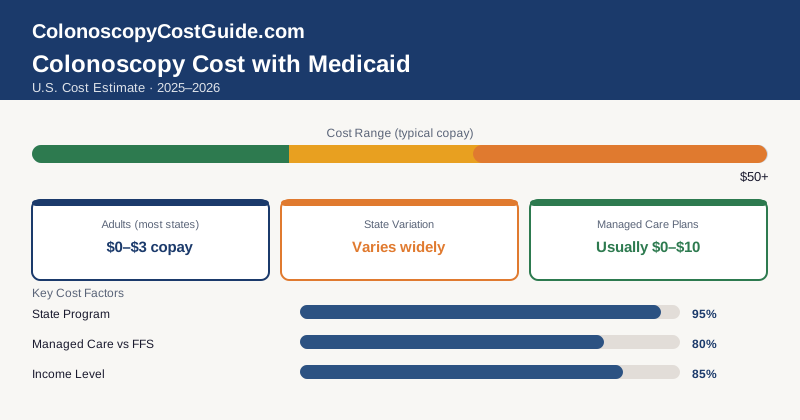
| Diagnostic colonoscopy (symptoms present) | $0 to $3 copay in most states |
| Colonoscopy with polypectomy | $0 to $5 in most states |
| Out-of-network facility | May require prior approval; may not be covered |
| Prep medication (Rx) | Usually covered under Medicaid pharmacy benefit |
Prior Authorization: The Most Common Barrier
Prior authorization (prior auth) is Medicaid’s biggest access hurdle for colonoscopy. Many states require Medicaid managed care organizations (MCOs) — the private insurers that administer Medicaid in most states — to pre-approve a colonoscopy before it’s performed.
Without prior auth, even a procedure that should be covered at $0 can become a denied claim, leaving you responsible for the full bill.
How to navigate prior auth:
- Ask your GI physician’s office to submit prior authorization before scheduling the procedure.
- Confirm the auth covers the specific facility you’ll use, not just the procedure type.
- If denied, ask for the specific denial reason in writing. “Not medically necessary” is the most common reason — and the most frequently overturned on appeal.
Some states have moved to “gold carding” — waiving prior auth requirements for established providers with clean approval records. Ask your GI office if they’ve been gold-carded with your Medicaid MCO.
State-by-State Coverage Highlights
| State | Screening Age | Prior Auth Required | Notable Limitations |
|---|---|---|---|
| California (Medi-Cal) | 45 | Often required through MCO | Must use network facility |
| Texas (Medicaid) | 50 (most MCOs) | Yes, typically | Limited network availability |
| New York (Medicaid) | 45 | Varies by MCO | Generally strong coverage |
| Florida (Medicaid) | 50 | Yes | Managed care network restrictions |
| Illinois (Medicaid) | 45 | Varies | Generally aligned with USPSTF |
| Ohio (Medicaid) | 45 | Yes, through MCO | Prep kits covered under Rx |
These are generalizations. Your specific Medicaid MCO within your state may have different rules. Always verify with your actual MCO — not just the state Medicaid agency.
The Stool Test First-Step Requirement
Some states and MCOs require patients to try a less expensive screening test — like a fecal immunochemical test (FIT) or Cologuard — before approving colonoscopy. This is called “step therapy” or a “fail first” requirement.
If you’re average-risk, your state’s Medicaid program may require:
- A stool test first (FIT, gFOBT, or Cologuard)
- Colonoscopy only if the stool test is positive or inconclusive
If you have risk factors (family history of colorectal cancer, prior polyps, symptoms), you can typically go directly to colonoscopy. Document your risk factors clearly in any prior auth request.
How to Request a Colonoscopy as First-Line Screening on Medicaid
If your Medicaid plan requires a stool test first but your doctor believes colonoscopy is appropriate for you, ask your physician to submit a Letter of Medical Necessity. The letter should specify:
- Your age and any personal or family risk factors
- Why colonoscopy is clinically preferable for you over stool-based testing
- The USPSTF Grade A recommendation as the basis for coverage
Most MCOs will approve colonoscopy as first-line screening when accompanied by a signed LMN from a GI specialist or primary care physician.
Medicaid and the Polyp Billing Issue
Unlike Medicare, Medicaid generally doesn’t have the same screening-to-diagnostic conversion billing problem. Most Medicaid programs don’t charge beneficiaries more when a polyp is found and removed during a screening colonoscopy. The procedure is still billed as preventive and cost-sharing (if any) remains at the screening level.
However, this depends on your specific MCO’s contract terms. If you receive a bill after a polypectomy, call your MCO and ask why the procedure was reclassified. If it was incorrectly billed as diagnostic, you have the right to request a billing correction.
Prep Medications on Medicaid
Colonoscopy prep prescriptions are generally covered under the Medicaid pharmacy benefit. Most states cover the generic PEG-based preparations (GoLYTELY, MoviPrep) on their formularies. Brand-only preparations like Clenpiq may require prior authorization or may not be covered — your GI office can request a formulary exception if needed.
If you’re eligible for the Miralax + Gatorade split-dose prep (ask your GI physician), those are available over the counter and likely cost less than your Medicaid copay for a prescription prep anyway. See colonoscopy prep cost for a full breakdown.
The Bottom Line on Medicaid Colonoscopy Costs
If everything lines up — you use an in-network facility, get prior authorization, and the procedure is coded as screening — your out-of-pocket cost is $0 or close to it in most states. The barriers are administrative, not financial. They’re prior auth delays, network restrictions, and age cutoffs that don’t always reflect the USPSTF’s 2021 guidance.
Work with your GI physician’s office to handle prior auth before scheduling. And if you’re denied, appeal — Medicaid denial overturns are common, especially for screening services with a USPSTF Grade A recommendation behind them.
{ if eq .Lang "zh" }