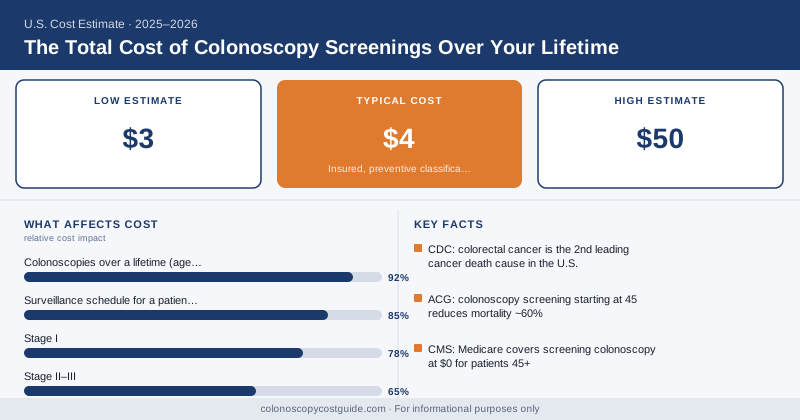
The Total Cost of Colonoscopy Screenings Over Your Lifetime
{ if eq .Lang "zh" }{ else }{ end }Lifetime colonoscopy costs for most insured Americans add up to roughly the price of two car tires. Colorectal cancer treatment, by comparison, runs $35,000–$250,000 and up. That contrast is worth sitting with for a moment.
The United States Preventive Services Task Force (USPSTF) lowered the recommended colonoscopy starting age from 50 to 45 in 2021, adding a full decade of potential screening to the average adult’s timeline. That means if you’re 45 today and live to 75, you’re looking at 3–4 routine screenings over your lifetime — assuming you stay average-risk. High-risk patients face a more intensive schedule and meaningfully higher cumulative costs.
Here’s what the numbers actually look like.
Average-Risk Patient: Lifetime Cost Model
An average-risk adult with no polyp history, no family history of colorectal cancer, and no symptoms follows the standard USPSTF schedule: colonoscopy every 10 years starting at 45.
Colonoscopies over a lifetime (ages 45–75):
- Age 45 (first scope)
- Age 55
- Age 65
- Age 75 (optional based on health status)
That’s 3–4 colonoscopies total.
| Patient Type | # of Colonoscopies | Cost Per Procedure | Lifetime Total |
|---|---|---|---|
| Insured, preventive classification | 3–4 | $0 (ACA-mandated coverage) | $0–$50* |
| Insured, deductible applies (diagnostic) | 3–4 | $200–$600 per scope | $600–$2,400 |
| Uninsured, ASC self-pay | 3–4 | $900–$1,400 all-in | $2,700–$5,600 |
| Uninsured, hospital self-pay | 3–4 | $2,000–$4,000 all-in | $6,000–$16,000 |
*The $50 is a realistic estimate for incidental costs like transportation and bowel prep prescription copays.
For insured patients whose colonoscopy is correctly classified as preventive, the ACA mandates $0 cost-sharing — no copay, no deductible, no coinsurance. This is the majority of average-risk commercially insured adults. Their lifetime colonoscopy screening cost is genuinely near zero.
High-Risk Patient: Lifetime Cost Model
“High-risk” in GI terminology means you’ve had adenomatous polyps found in a prior colonoscopy, or you have a first-degree relative with colorectal cancer or advanced adenomas. Surveillance colonoscopies after polyp removal are classified as diagnostic — not preventive — meaning standard deductible and coinsurance apply.
Surveillance schedule for a patient with adenoma history:
- First adenoma found at age 45 → follow-up at 48 (3 years)
- Clean scope at 48 → follow-up at 53 (5 years)
- Clean scope at 53 → follow-up at 58 (5 years)
- Clean scope at 58 → follow-up at 63 (5 years)
- And so on through age 75
That’s potentially 7–8 colonoscopies over a lifetime for a high-risk patient.
| High-Risk Patient Type | # of Colonoscopies | Cost Per Procedure | Lifetime Total |
|---|---|---|---|
| Insured, 20% coinsurance (met deductible) | 7–8 | $200–$500 | $1,400–$4,000 |
| Insured, high deductible plan | 7–8 | $500–$1,200 | $3,500–$9,600 |
| Uninsured, ASC self-pay | 7–8 | $900–$1,400 | $6,300–$11,200 |
High-risk patients on high-deductible health plans face the steepest cumulative burden — especially if their surveillance colonoscopies fall in early calendar year when their deductible hasn’t been met yet. Strategic scheduling (post-deductible when possible) can meaningfully reduce this.
Alternative Screening: FIT Test Lifetime Cost
The USPSTF recommends several colonoscopy alternatives for average-risk adults, including the fecal immunochemical test (FIT) done annually. At $20–$50 per test, FIT is inexpensive — but the lifetime math is more complex.
FIT must be done every year. From age 45 to 75 = 30 years = 30 tests.
- FIT test cost: $20–$50/test
- Lifetime FIT cost: $600–$1,500
But: any positive FIT requires a follow-up colonoscopy (which may be classified as diagnostic, not preventive). FIT has a positive rate of 5–15% per test depending on the population. Over 30 years, the cumulative probability of at least one positive test is high — meaning most patients will eventually need a colonoscopy anyway.
| Screening Method | Annual Cost | Lifetime Direct Cost | Follow-up Colonoscopy Needed? |
|---|---|---|---|
| Colonoscopy (every 10 years) | $0 insured | $0–$50 insured | No (unless positive) |
| FIT test (annual) | $20–$50 | $600–$1,500 | Yes if positive (adds $800–$2,000) |
| Cologuard (every 3 years) | $500–$700 | $5,000–$7,000 | Yes if positive (40% false-positive rate) |
For most insured patients with good access to GI care, colonoscopy every 10 years is both more cost-effective and more clinically powerful than annual FIT testing over a lifetime. The colonoscopy detects AND removes polyps in a single procedure — FIT only detects blood and requires a follow-up procedure for anything positive.
The Cost of NOT Screening
The National Cancer Institute estimated total colorectal cancer treatment costs in the U.S. at approximately $19.7 billion annually (2019 data, adjusted for recent trends). The average cost of colorectal cancer treatment per patient ranges enormously by stage:
- Stage I (caught early, localized): $30,000–$70,000
- Stage II–III (regional spread): $70,000–$150,000
- Stage IV (distant metastasis): $150,000–$250,000+
These are first-year treatment costs. Ongoing chemotherapy, immunotherapy, and surgical follow-up extend costs further. And colorectal cancer caught at Stage I has an 90% five-year survival rate; Stage IV is 14%.
Approximately 150,000 Americans are diagnosed with colorectal cancer each year, according to the American Cancer Society’s 2024 data. An estimated 30–40% of those diagnoses could have been prevented or caught at an earlier stage with timely screening colonoscopy.
The math isn’t subtle: a lifetime of $0 preventive colonoscopies (for insured patients) vs. a potential $150,000 treatment course isn’t a close decision.
The Real Lifetime Cost for Most Insured Americans
For the full picture on alternative screening options and their comparative costs, see colonoscopy vs. stool DNA test. For lifetime savings strategies if you’re a high-risk patient facing multiple surveillance scopes, how to schedule the cheapest colonoscopy applies to every procedure, not just your first one.
{ if eq .Lang "zh" }