Colonoscopy Costs for Immigrants and Undocumented Patients: Real Options
{ if eq .Lang "zh" }{ else }{ end }Your immigration status doesn’t change the medical reality — colorectal cancer screenings starting at 45 are recommended for everyone. The American Cancer Society doesn’t have a citizenship requirement. Colorectal cancer doesn’t check papers.
What does change based on immigration status is access to insurance programs, which affects how you pay for a colonoscopy. But it doesn’t eliminate your options — it just changes which ones apply. Here’s a practical guide to what’s actually available.
What Most Undocumented Adults Can’t Access
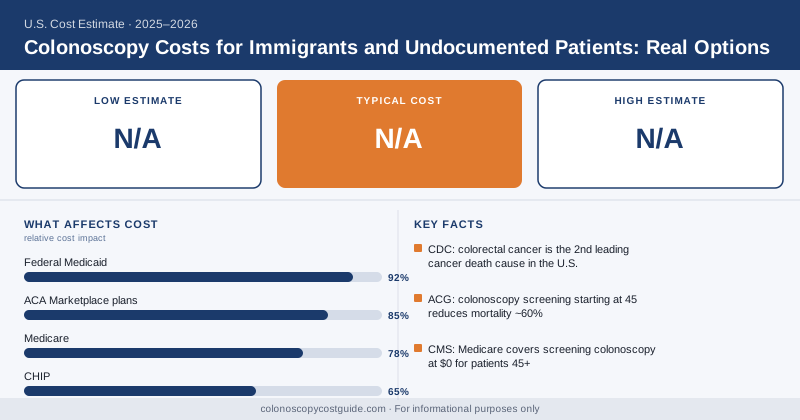
To understand your options, you need to know the baseline. In the U.S., undocumented immigrants generally do NOT qualify for:
- Federal Medicaid (standard): Most states require legal immigration status for full Medicaid benefits
- ACA Marketplace plans (standard): Federal law bars undocumented immigrants from purchasing plans through the Health.gov marketplace, with or without subsidies
- Medicare: Requires work authorization history
- CHIP: Requires qualifying immigration status for most states
Emergency Medicaid is the exception: available in most states for undocumented immigrants during medical emergencies (ER visits, emergency childbirth). A routine colonoscopy does not qualify as an emergency under this program.
Option 1: Federally Qualified Health Centers (FQHCs)
This is the most important option on this list. FQHCs are federally funded community health centers required by law to serve all patients regardless of immigration status, ability to pay, or insurance status. That requirement is explicit and non-negotiable — it’s in their federal funding conditions.
There are over 1,400 FQHC organizations with more than 15,000 service sites across the U.S. They use a sliding-scale fee structure based on your household income. At the lowest income levels, services may cost $0–$20. At moderate incomes, fees are scaled proportionally.
Do FQHCs offer colonoscopy directly? Some do, but many are primarily primary care clinics. The more important function for colonoscopy access: FQHCs can refer patients to GI specialists who accept FQHC-referred patients at sliding-scale rates. Some FQHC networks have established partnerships with local gastroenterologists or ASCs specifically to serve their uninsured patient population.
How to find your nearest FQHC: findahealthcenter.hrsa.gov — enter your zip code. This is the official government tool.
Estimated colonoscopy cost at or through an FQHC: $0–$300, depending on income and the FQHC’s specific GI referral partnerships.
Option 2: Free Clinics and Community Health Organizations
Beyond FQHCs, many communities have free clinics run by volunteer physicians, often affiliated with medical schools or hospital systems. These clinics don’t bill for services and operate on charitable funding.
Free clinics vary enormously in what services they can provide directly. Colonoscopy requires specialized equipment and a trained gastroenterologist — not every free clinic can perform one on-site. But many can:
- Order a fecal immunochemical test (FIT) as a first-step screening tool
- Refer to charitable GI programs or hospital charity care for follow-up colonoscopy
- Help with the navigation between services
Option 3: Colon Cancer Alliance Free Colonoscopy Program
The Colon Cancer Alliance (colorectal.org) operates a patient navigation and financial assistance program that connects uninsured and underinsured patients with free or low-cost colonoscopies. The program works through a network of participating providers who donate procedure time and facility access.
Availability varies by region and is subject to funding cycles. Not all areas have active program capacity at any given time. Contact the Alliance directly at 877-422-2030 to inquire about availability in your state.
Option 4: State-Funded Programs That Don’t Require Citizenship
A handful of states have expanded state-funded coverage programs to include immigrants regardless of documentation status. These are the most generous options if you live in one of these states:
California: Medi-Cal (California’s Medicaid program) covers all income-eligible adults regardless of immigration status. “Medi-Cal for All” expansion was fully implemented in 2024. If your income is at or below 138% of the federal poverty level (roughly $20,100/year for a single adult in 2025), you qualify for full Medi-Cal coverage — including colonoscopy at $0 or nominal cost-sharing.
New York: The Essential Plan covers adults with incomes up to 200% of the federal poverty level regardless of immigration status, with low premiums and minimal cost-sharing. The NY State of Health marketplace administers enrollment.
Washington, Oregon, Illinois, Colorado, Minnesota: Have expanded state-funded health programs to include various categories of immigrants not covered by federal Medicaid. Details vary — check your state’s Medicaid or health department website.
If You're in California
Option 5: Hospital Charity Care Programs
Every nonprofit hospital in the U.S. is required by the IRS (as a condition of their tax-exempt status) to provide charity care to low-income patients. Income thresholds vary, but most hospital charity care programs cover patients at 200–400% of the federal poverty level — and the best programs (like Grady in Atlanta or LAC+USC in Los Angeles) have programs specifically designed for undocumented patients.
To access hospital charity care:
- Go to the hospital’s patient financial services department
- Ask about charity care or financial assistance programs
- Bring documentation of income (pay stubs, employer letters, or a self-declaration form)
- Immigration status documentation is generally NOT required for charity care applications
Estimated cost through hospital charity care: $0–$200 for qualifying patients at participating hospitals.
Option 6: Third-Party Discount Platforms (No Insurance Required)
MDsave and ColonoscopyAssist connect patients directly to ASCs offering fixed-price packages. These platforms don’t require insurance — you pay a set rate directly. No immigration status check. No eligibility verification beyond payment.
Typical cost: $800–$1,300 for a diagnostic colonoscopy at a participating ASC. This is significantly cheaper than the self-pay “rack rate” at most hospitals.
Option 7: Medical Tourism to Mexico
For patients near the southern border — or those willing to travel — colonoscopy in Mexico is a real and cost-effective option. Major border cities with established medical tourism infrastructure:
- Tijuana: $300–$500 USD for a basic colonoscopy at accredited private hospitals
- Juarez / El Paso border region: $350–$500 USD at private clinics
- Monterrey: Higher quality private hospital options at $400–$700 USD
Quality varies significantly. For medical tourism colonoscopy, look for COFEPRIS-accredited private hospitals (COFEPRIS is Mexico’s federal health regulation authority) or Joint Commission International (JCI) accredited facilities. Hospitals like Hospital Ángeles and Hospital San José have JCI accreditation and attract medical tourism patients regularly.
Bring your pathology results back to your U.S. primary care provider for review.
The Stool Test Alternative
If colonoscopy access is genuinely out of reach, fecal immunochemical tests (FIT) are a meaningful first step. FIT tests are available at most pharmacies for $20–$50 without a prescription, and many FQHCs can provide them at low or no cost. A negative FIT test provides some reassurance; a positive result requires follow-up colonoscopy.
FIT testing annually is an approved USPSTF alternative to colonoscopy for average-risk adults. It doesn’t catch everything colonoscopy catches — particularly precancerous polyps — but it’s far better than no screening at all.
For a full comparison of colonoscopy alternatives, see colonoscopy vs. stool DNA test. For general cost-saving strategies once you’ve identified a provider, how to schedule the cheapest colonoscopy covers the steps that apply to self-pay patients of any background.
{ if eq .Lang "zh" }