Using HSA or FSA for a Colonoscopy: What's Covered and How to Maximize Your Benefit
{ if eq .Lang "zh" }{ else }{ end }Here’s the tax math most patients don’t run: if you’re in the 22% federal income tax bracket and you owe $1,500 on a colonoscopy after insurance, paying from your HSA instead of your checking account is the equivalent of getting a $330 discount — automatically, with no negotiating required. At the 24% bracket, that’s $360 off. At 32%, it’s $480.
That’s the power of pre-tax health spending accounts. Every dollar you pay for a colonoscopy from an HSA or FSA is a dollar that was never taxed — which means the government is effectively subsidizing a portion of your medical bills.
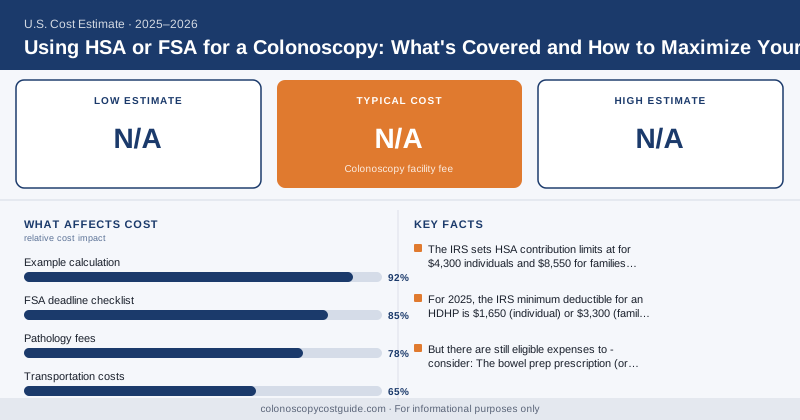
The IRS sets HSA contribution limits at $4,300 for individuals and $8,550 for families in 2025 (limits adjust annually for inflation). That’s a meaningful amount of pre-tax money available for health expenses — including everything associated with a colonoscopy.
What’s Covered: The Full Colonoscopy Bill
The IRS defines eligible medical expenses under Section 213(d) of the Internal Revenue Code. Every standard component of a colonoscopy encounter qualifies:
| Expense | HSA Eligible? | FSA Eligible? | Notes |
|---|---|---|---|
| Colonoscopy facility fee | Yes | Yes | ASC or hospital outpatient |
| Gastroenterologist physician fee | Yes | Yes | Billed separately from facility |
| Anesthesia fee | Yes | Yes | Billed by anesthesiology group |
| Pathology / biopsy lab fee | Yes | Yes | If polyp removed and analyzed |
| Bowel prep (prescription) | Yes | Yes | GoLYTELY, Sutab, Clenpiq, etc. |
| Bowel prep (OTC MiraLAX) | Yes | Yes | Post-CARES Act 2020, OTC drugs eligible |
| Clear liquid diet foods (Gatorade) | No | No | General nutrition, not IRS-eligible |
| Transportation to/from procedure | Yes | Yes | Mileage at IRS medical rate or actual cost |
| Post-procedure pain medication (Rx) | Yes | Yes | If prescribed |
The CARES Act (2020) expanded HSA/FSA eligibility to include over-the-counter drugs without a prescription — so your MiraLAX bowel prep is now eligible even without an Rx.
When HSA/FSA Pays Off Most: The HDHP Scenario
If you have a high-deductible health plan (HDHP) and haven’t met your deductible, colonoscopy costs hit you dollar-for-dollar until you do. For 2025, the IRS minimum deductible for an HDHP is $1,650 (individual) or $3,300 (family).
A diagnostic colonoscopy can run $1,000–$2,500 in an ambulatory surgery center at your plan’s negotiated rate. If that entire amount applies to your unmet deductible, you’re paying every cent out of pocket. Using HSA funds for that expense gives you the automatic tax discount — effectively reducing your real cost by 22–37% depending on your bracket.
Example calculation:
- HDHP deductible: $2,000 (individual)
- Colonoscopy bill after insurance: $1,400
- Your tax bracket: 24% federal + 5% state = 29% combined
- If you pay from checking: you’ve spent $1,400 in after-tax income
- If you pay from HSA: your real cost is $1,400 × (1 - 0.29) = $994
- Effective savings: $406
That’s money you’ve already set aside in your HSA — not new spending. Using it correctly just reduces the real-world cost.
FSA Strategy: The Use-It-or-Lose-It Timing Play
Unlike HSAs, Flexible Spending Accounts (FSAs) are use-it-or-lose-it. Funds must be spent by your plan year’s deadline — typically December 31, though some plans allow a grace period of up to 2.5 months or a rollover of up to $640 (2025 limit).
If you’re approaching year-end with unused FSA funds, a colonoscopy is one of the most cost-effective ways to spend them — it’s a procedure you’d need anyway, and the entire bill is eligible. Scheduling in October–December to use FSA funds before they expire is a legitimate and common strategy.
FSA deadline checklist:
- Confirm your plan year end date (usually December 31)
- Confirm whether your plan has a grace period or rollover option
- Check your remaining FSA balance in October
- If you have $500–$2,500 remaining and are due for a colonoscopy, schedule for Q4
- Pay all components — facility, physician, anesthesia, prep — with your FSA card
Pay Each Bill Separately With Your FSA/HSA Card
HSA vs. FSA: Which Is Better for Colonoscopy Costs?
| Feature | HSA | FSA |
|---|---|---|
| Requires HDHP? | Yes | No (most employer plans) |
| Funds roll over? | Yes — indefinitely | No (use-it-or-lose-it, limited rollover) |
| Can invest funds? | Yes — like a 401k | No |
| Contribution limits (2025) | $4,300 individual / $8,550 family | $3,300 individual |
| Can pay for past expenses? | No — must incur after account opening | No |
| Best for colonoscopy? | Ideal for HDHP patients | Ideal for timing FSA before year-end |
HSAs have a significant long-term advantage: unused funds roll over and can be invested tax-free, similar to a retirement account. If you’re lucky enough to have a screening colonoscopy covered at $0 under ACA preventive rules, your HSA contributions accumulate for future healthcare expenses — including if costs arise from a polyp follow-up or diagnostic colonoscopy down the road.
What If Your Screening Colonoscopy Is $0?
If your colonoscopy is covered at $0 under ACA preventive care rules, you won’t have an out-of-pocket bill to pay from your HSA or FSA. But there are still eligible expenses to consider:
- The bowel prep prescription (or OTC MiraLAX + Gatorade) is still eligible and out-of-pocket
- Pathology fees if a polyp is removed may still apply even under the 2022 ACA polypectomy rule
- Transportation costs (mileage at $0.21/mile for medical travel as of 2025 IRS rate) are eligible
- Any deductible amounts on a diagnostic colonoscopy are eligible
Even for patients with good insurance, there’s usually something to run through an HSA or FSA — it just takes knowing to look for those secondary charges.