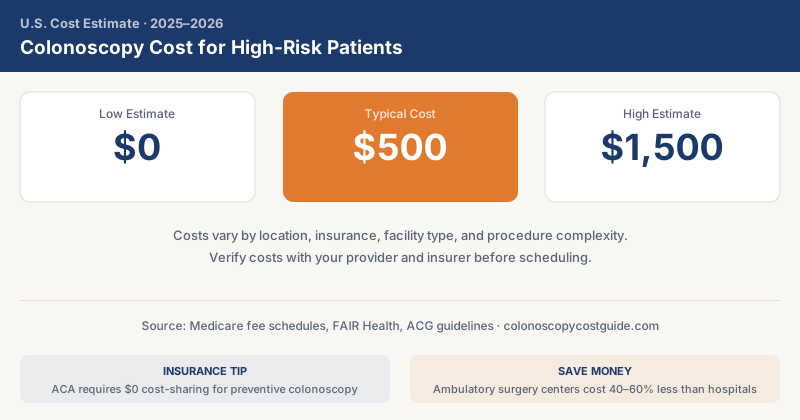
Colonoscopy Cost for High-Risk Patients: Lynch Syndrome, Family History, and Insurance
What does a colonoscopy actually cost when you need one every year or every other year for your entire adult life? If you have Lynch syndrome, that’s not a hypothetical — it’s your reality.
Lynch syndrome is the most common hereditary colorectal cancer syndrome in the US, affecting approximately 1 in 279 people. According to the National Cancer Institute, Lynch syndrome carriers face a 52 to 82% lifetime risk of colorectal cancer, depending on the specific gene mutation involved. The standard surveillance recommendation is colonoscopy every 1 to 2 years starting at age 20 to 25, or 2 to 5 years before the youngest affected family member’s diagnosis age.
That’s potentially 45 to 50 colonoscopies over a lifetime. The cumulative cost — financial and otherwise — is substantial.
Colonoscopy Schedule by Risk Category
| Risk Category | Surveillance Start Age | Interval | Colonoscopies Est. (Age 25–75) |
|---|---|---|---|
| Lynch syndrome / HNPCC | 20–25 | Every 1–2 years | 25–50 procedures |
| FAP (familial adenomatous polyposis) | 10–15 | Annually until colectomy | Varies; often leads to colectomy |
| Strong family history (1 first-degree relative CRC < 60) | 40 or 10 years before relative’s age | Every 5 years | 6–7 procedures |
| Family history (1 FDR CRC ≥ 60 or 2 FDR any age) | 45 | Every 5 years | 5–6 procedures |
| Average risk | 45 | Every 10 years | 3 procedures |
Cumulative Lifetime Cost for Lynch Syndrome Carriers
For a Lynch syndrome patient starting surveillance at age 25 with annual colonoscopy:
| Scenario | Procedures Over Lifetime | Cost Per Procedure (Insured) | Lifetime Estimate |
|---|---|---|---|
| Lynch, insured, ACA-compliant plan | 40–50 | $500 – $1,500 (diagnostic billing) | $20,000 – $75,000 |
| Lynch, Medicare + Medigap Plan G | 40–50 | $50 – $257 (mostly deductible) | $2,000 – $13,000 |
| Lynch, uninsured (ASC cash rate) | 40–50 | $800 – $1,800 | $32,000 – $90,000 |
| Family history patient, every 5 years | 6–7 | $0 (preventive, average-risk billing) | $0 – $2,000 |
The insurance classification makes an enormous difference. Lynch syndrome patients billed at diagnostic rates face tens of thousands of dollars in lifetime colonoscopy costs. Those with Medigap face a fraction of that.
How Insurance Handles High-Risk Surveillance Colonoscopies
Commercial insurance (employer or ACA marketplace plans): Most plans cover colonoscopy as medically necessary when Lynch syndrome is documented with genetic testing. Coverage is as a diagnostic procedure — deductible and coinsurance apply. Prior authorization is often required but generally granted with genetic testing documentation.
Medicare: Medicare covers colonoscopy every 24 months for beneficiaries at high risk for colorectal cancer. The ACG defines high-risk criteria in CMS guidelines to include Lynch syndrome carriers, those with adenomatous polyposis, and those with a personal or family history meeting certain criteria. High-risk colonoscopy under Medicare has reduced cost-sharing compared to diagnostic billing.
Genetic testing: Before surveillance begins, Lynch syndrome must typically be confirmed by germline genetic testing. Most commercial insurers and Medicare cover Lynch syndrome genetic testing (MLH1, MSH2, MSH6, PMS2 mutation analysis) when clinical criteria are met. Testing costs $300 to $1,000 out of pocket if not covered.
Getting Insurance to Recognize Lynch Syndrome
Family History Without Genetic Diagnosis
Many patients have a strong family history of colorectal cancer but no known hereditary syndrome. Their colonoscopy schedule and insurance handling depends on their specific risk level:
One first-degree relative with CRC under age 60: ACG recommends colonoscopy starting at age 40 (or 10 years before the relative’s diagnosis age, whichever is earlier) and every 5 years thereafter. Insurance typically covers this as a preventive benefit, though some plans require documentation of family history.
Two first-degree relatives with CRC at any age: Similar recommendation. Some plans cover at preventive rates; others treat it as diagnostic. Verify with your insurer before scheduling.
One first-degree relative with CRC at age 60 or older: ACG recommends screening starting at age 45, every 10 years — same as average risk. Standard preventive coverage applies.
| Risk Level | Insurance Billing Category | Typical Patient Cost |
|---|---|---|
| Lynch syndrome / HNPCC confirmed | Diagnostic (medically necessary) | $500–$2,000 per procedure |
| Strong family history (documented) | Varies by plan (preventive or diagnostic) | $0–$1,500 per procedure |
| Standard family history (FDR ≥ 60) | Preventive | $0 (ACA-compliant plans) |
| Average risk | Preventive | $0 (ACA-compliant plans) |
Managing the Financial Burden of Lifelong Surveillance
For Lynch syndrome carriers facing decades of annual colonoscopies, here are practical strategies:
Maximize HSA contributions: High-deductible plans with HSA accounts let you save pre-tax dollars specifically for medical expenses. Every colonoscopy, pathology bill, and prep medication is HSA-eligible. At the 22% federal tax bracket, maximizing your HSA saves you roughly $880 to $1,650 per year (2025 HSA limits: $4,300 individual / $8,550 family).
Schedule after deductible is met: Many Lynch patients have other medical care (specialist visits, genetic counseling, other screenings) that helps them meet their deductible early in the year. Scheduling colonoscopy after the deductible is met means you pay only coinsurance — typically 20 to 30% — rather than the full procedure cost.
Use freestanding endoscopy centers: Even as a non-preventive procedure, ASC pricing is $1,000 to $2,000 less per procedure than hospital outpatient rates. Over 40 procedures, that’s $40,000 to $80,000 in lifetime savings.
For more context on colonoscopy costs more broadly, see our colonoscopy cost overview and the colonoscopy follow-up cost breakdown by risk category.