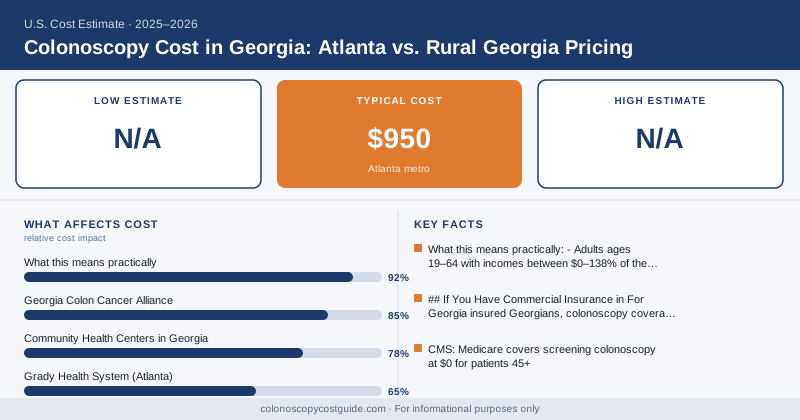
Colonoscopy Cost in Georgia: Atlanta vs. Rural Georgia Pricing
{ if eq .Lang "zh" }{ else }{ end }Georgia has some of the highest colorectal cancer mortality rates in the South, yet large coverage gaps make screening unaffordable for many of the residents who need it most. That’s not a small irony — it’s a genuine public health problem, and it shapes the colonoscopy cost landscape here in a way that’s different from most states.
The American Cancer Society’s 2023 data shows Georgia’s colorectal cancer mortality rate at 17.2 per 100,000 people, above the national average of 14.5. Yet Georgia is one of a handful of states that has not fully expanded Medicaid, leaving an estimated 300,000–400,000 low-income adults in a coverage gap — ineligible for Medicaid but also too poor to qualify for ACA marketplace subsidies.
Georgia City-by-City Pricing
| Area | Hospital Outpatient | ASC / Freestanding | Self-Pay ASC (All-In Est.) |
|---|---|---|---|
| Atlanta metro | $2,200–$4,600 | $1,000–$1,900 | $950–$1,600 |
| Savannah | $1,900–$4,000 | $900–$1,600 | $850–$1,400 |
| Augusta | $1,800–$3,900 | $850–$1,500 | $800–$1,350 |
| Macon | $1,700–$3,700 | $800–$1,400 | $750–$1,250 |
| Columbus, GA | $1,700–$3,600 | $800–$1,400 | $750–$1,250 |
| Rural Georgia | $1,600–$3,500 | $800–$1,400* | $700–$1,200* |
*ASC availability is significantly lower in rural Georgia. Many rural residents must travel to a metro area or larger city for freestanding ASC access, which eliminates the convenience advantage even when the price is lower.
Anesthesia adds $300–$700 at most facilities. Pathology for removed polyps adds $200–$600 separately from the procedure price.
Atlanta Metro: Biggest Market, Biggest Variation
Atlanta has a highly competitive GI market with major health systems (Emory Healthcare, Piedmont Healthcare, Northside Hospital, WellStar) operating at hospital outpatient pricing, and a dense network of independent GI practices and ASCs offering meaningfully lower rates.
Emory University Hospital and Grady Memorial Hospital are the largest referral centers. Grady is particularly important for uninsured and underinsured Atlantans — it operates on a sliding-scale fee structure and has a GI department that sees patients regardless of ability to pay. If you’re in the Atlanta area without insurance, Grady should be your first call.
Independent GI practices in suburban Atlanta — particularly in Sandy Springs, Dunwoody, Marietta, and Alpharetta — often operate their own ASC suites and offer competitive direct-pay pricing in the $1,000–$1,500 range for a bundled colonoscopy.
The Georgia Medicaid Gap
Georgia chose not to fully expand Medicaid under the ACA. Instead, it implemented a limited program called “Georgia Pathways to Coverage” in 2023, which requires qualifying adults (ages 19–64) to complete at least 80 hours per month of work, training, education, or community engagement — and submit monthly documentation to maintain coverage.
As of 2025, Georgia Pathways enrollment remains extremely low — well under 10,000 people — and does not come close to covering the 300,000+ adults in the coverage gap.
What this means practically:
- Adults ages 19–64 with incomes between $0–138% of the federal poverty level who don’t qualify for Georgia Pathways have no Medicaid option and likely no ACA subsidy
- These adults must rely on FQHCs, free clinics, or self-pay at reduced rates
- This is a structural problem that affects colonoscopy access significantly
Georgia-Specific Resources for Uninsured and Underinsured Patients
Georgia Colon Cancer Alliance: Offers education, navigation services, and connections to low-cost or free colonoscopy programs across Georgia, particularly for those in screening deserts.
Community Health Centers in Georgia: Georgia has 40+ FQHC locations. Key systems include: Community Health Care Systems (Middle Georgia), Ninth District Opportunity (Northeast Georgia), and Coastal Community Health Services (Savannah area). FQHC services are income-based, and some have GI referral partnerships.
Grady Health System (Atlanta): One of the largest public hospital systems in the Southeast. Grady’s charity care program and sliding-scale fee structure make it the best option for Atlanta-area uninsured patients with limited income.
The Colon Cancer Coalition’s “Get Your Rear in Gear”: National nonprofit that funds community screening programs. Has partnered with Georgia providers in past years for free/reduced-cost screening events.
Savannah and Coastal Georgia
Savannah’s market is smaller but has a mix of hospital outpatient (Candler Hospital, Memorial Health University Medical Center) and a modest ASC presence. Memorial Health’s financial counseling program offers income-based discounts for uninsured patients. For coastal rural residents in Bryan, Effingham, or Liberty counties, Savannah is typically the nearest practical option for a GI procedure.
Traveling for a Colonoscopy in Georgia
If You Have Commercial Insurance in Georgia
For insured Georgians, colonoscopy coverage works the same as everywhere else: preventive screening at age 45+ is covered at $0 cost-sharing under ACA-compliant plans (the ACA requires coverage of USPSTF Grade B recommendations with no cost-sharing). The exception is if your procedure gets reclassified as diagnostic — for example, if you have symptoms or a prior polyp history. In that case, your deductible and coinsurance apply.
Major Georgia insurers include Anthem Blue Cross Blue Shield, United Healthcare, Aetna, and Cigna. Blue Cross Blue Shield of Georgia has particularly broad GI provider networks across the state.
For strategies on minimizing cost before you book, see how to schedule the cheapest colonoscopy. And if you got a bill after a procedure you thought was free, the bill after a free screening colonoscopy explains what happened and what to do.
{ if eq .Lang "zh" }