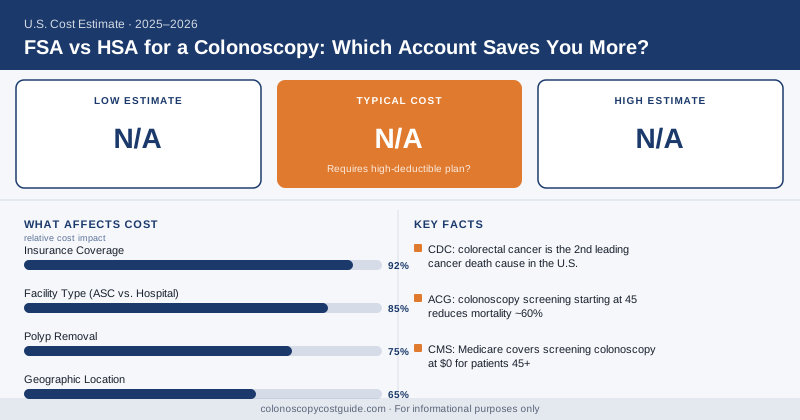
FSA vs HSA for a Colonoscopy: Which Account Saves You More?
{ if eq .Lang "zh" }{ else }{ end }A $900 diagnostic colonoscopy isn’t really $900 if you pay it from the right account. Run it through an FSA or HSA and that bill shrinks by your tax rate — $200, maybe $300, off the top. The catch is these two accounts work in opposite ways, and picking the wrong one for your situation costs you the savings.
So which wins for a colonoscopy? Let’s settle it.
Both Save You Taxes — Differently
An FSA (Flexible Spending Account) and HSA (Health Savings Account) both let you pay medical costs with pre-tax dollars. The savings equal your marginal tax rate. But the structure, eligibility, and rules diverge sharply.
| Feature | FSA | HSA |
|---|---|---|
| Requires high-deductible plan? | No | Yes |
| 2026 contribution limit | $3,300 | $4,300 individual / $8,550 family |
| Funds roll over? | Mostly use-it-or-lose-it | Yes, indefinitely |
| Full amount available day one? | Yes | Only what you’ve contributed |
| Portable if you leave job? | No | Yes |
| Can invest funds? | No | Yes |
Key Takeaway
The $900 Colonoscopy, Run Through Each
Say you owe $900 for a diagnostic colonoscopy and you’re in the 24% federal bracket. Add roughly 7.65% FICA savings on an FSA (since FSA contributions are payroll-deducted pre-FICA) and the math gets interesting.
- FSA: You contribute pre-tax via payroll, dodging income tax and FICA. On $900, that’s roughly $216 income-tax savings plus about $69 FICA — close to $285 total. Real cost: about $615.
- HSA: You dodge income tax (and FICA too if contributed via payroll). Similar savings, but the bigger win is what you don’t spend — leftover funds roll over and grow. Real cost on the $900: about $615 to $684 depending on contribution method.
Both beat paying with after-tax dollars by a wide margin. The difference is what happens to the money you don’t use.
When the FSA Wins
The FSA has one killer feature: the entire annual election is available on January 1, even though you fund it gradually through payroll. So if you need a colonoscopy in February and elected $3,000 for the year, you can spend the full amount immediately and repay it through the rest of the year’s deductions. An HSA only has what you’ve actually contributed so far.
When the HSA Wins
The HSA is the long-game champion. Funds roll over forever, grow tax-free if invested, and follow you when you change jobs. If you have a high-deductible health plan, an HSA lets you pay this year’s colonoscopy and keep building a tax-free medical nest egg for the future. The 2026 limits — $4,300 individual, $8,550 family, plus a $1,000 catch-up at 55+ — let you stash real money.
The one constraint: you can’t have a standard FSA and an HSA at the same time, because the HSA requires that high-deductible plan and a general FSA disqualifies you. You can pair an HSA with a limited-purpose FSA (dental and vision only), but your colonoscopy comes out of the HSA.
Don’t Forget the Screening Is Free
Worth repeating: if your colonoscopy is a routine screening, it should be $0 under the ACA — no FSA or HSA needed. These accounts matter for diagnostic procedures, anesthesia, prep, and pathology. Our ACA free preventive coverage guide confirms what’s free. If you got billed for a screening that should’ve been free, that’s an error — see how to lower your colonoscopy bill.
Bottom Line
Both accounts turn a colonoscopy bill into a tax discount worth 22% to 37%. Choose the FSA if you need the full amount available early in the year and you’ll spend it before year end. Choose the HSA if you have a high-deductible plan and want funds that roll over, grow, and follow you. You generally can’t run both for the same procedure, so match the account to your timing and your plan — and remember that a true screening shouldn’t cost you anything at all.
{ if eq .Lang "zh" }