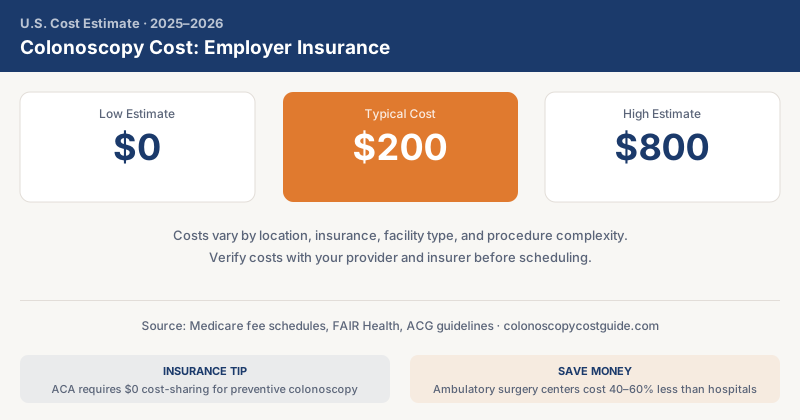
Colonoscopy Cost With Employer Insurance: What to Verify Before You Schedule
{ if eq .Lang "zh" }{ else }{ end }Sarah, 46, scheduled her first colonoscopy on her employer health plan. She assumed it was free — she’d heard the ACA covers it at $0. Six weeks later she received a $1,400 bill. Her employer’s plan was grandfathered. Her gastroenterologist was out-of-network. And the polypectomy changed her billing code.
Three different mistakes. One $1,400 surprise. Here’s how to avoid all three.
The 5 Things to Verify With Your Employer Plan Before Scheduling
1. Is Your Plan ACA-Compliant or Grandfathered?
The ACA’s preventive care mandate — which requires coverage of USPSTF-recommended screenings at $0 — applies to non-grandfathered, non-grandfathered plans. Grandfathered plans are exempt.
A grandfathered plan is one that existed before March 23, 2010 and has not made significant benefit changes since. The Department of Labor’s 2023 survey estimated approximately 16% of employer-sponsored plan enrollees are in grandfathered plans.
If your plan is grandfathered:
- Your preventive screening colonoscopy may be subject to your deductible and coinsurance
- The ACA’s $0 preventive benefit mandate does not apply
- You could owe $500 to $2,500 for a “free” screening
How to find out: Call your HR department or the member services number on your insurance card and ask: “Is my health plan grandfathered under the ACA?” They’re legally required to tell you. Your Summary of Benefits and Coverage (SBC) document also states grandfathered status.
2. Is Your GI Physician In-Network?
Your primary care doctor gave you a referral to a gastroenterologist. That doesn’t mean the GI doctor is in your plan’s network.
The financial consequence of an out-of-network GI physician:
- Out-of-pocket cost for an OON gastroenterologist can be 2 to 4x higher than in-network
- The No Surprises Act limits balance billing for certain situations, but its protections for scheduled outpatient services are more limited than for emergency care
- Out-of-network physician fees typically don’t apply toward your in-network deductible
How to verify: Call your insurance plan’s member services before your appointment. Say: “I need to verify that Dr. [Name], NPI [number], is in-network for my plan.” Your GI doctor’s office can provide their NPI.
The Facility AND Provider Both Matter
An in-network facility does not guarantee all providers at that facility are in-network. Your gastroenterologist may be in-network, but the anesthesiologist assigned to your procedure may not be. Always verify:
- The GI facility is in-network
- Your gastroenterologist is in-network
- The anesthesia group that serves that facility is in-network (harder to check, but call and ask)
The No Surprises Act provides some protection against unexpected anesthesia bills at in-network facilities, but the most reliable protection is verification in advance.
3. How Does Your Plan Handle Preventive vs. Diagnostic Billing?
Here’s the billing issue that catches the most patients off guard. ACA-compliant plans are required to cover preventive colonoscopies at $0. But when polyps are found and removed, many insurers reclassify the procedure as therapeutic — and apply cost-sharing.
The ACA was amended in 2022 to clarify that a colonoscopy beginning as preventive screening should remain classified as preventive even when polyps are removed. But compliance has been uneven.
Before your colonoscopy, call your insurer and ask:
"If polyps are found and removed during my screening colonoscopy, will the procedure still be billed as preventive with $0 cost-sharing, or will cost-sharing apply to the polypectomy?"
Get the representative’s name and the date of the call. If they say cost-sharing applies to the polypectomy, ask for this policy in writing — and note that you may have grounds to appeal if you receive a bill after a preventive scope with polypectomy.
4. Does the Facility Follow Preventive Billing Rules?
Even if your insurer says it will cover the colonoscopy as preventive, the facility needs to submit the claim correctly. Two scenarios where billing goes wrong:
- The GI practice uses a “diagnostic” indication code even for average-risk patients, which triggers cost-sharing at your plan
- The procedure starts with a diagnostic indication (your doctor noted a “change in bowel habits” along with the screening order), converting the insurance category from preventive to diagnostic
When you call to schedule your colonoscopy, tell the scheduling staff: “This is a routine preventive screening colonoscopy. I need it coded as preventive, not diagnostic. Can you confirm that’s how it will be submitted?”
5. What Is Your Deductible Status — and Is This a Good Year to Schedule?
If your employer plan has a high deductible, the timing of your colonoscopy within your plan year matters significantly.
| When You Schedule | Typical Patient Cost (Average-Risk Screening) |
|---|---|
| ACA-compliant plan, preventive | $0 regardless of deductible timing |
| Grandfathered plan, early in year | $1,000 – $2,500 (deductible + coinsurance) |
| Grandfathered plan, after deductible met | 20–30% coinsurance only |
| ACA plan, polyps found (polypectomy portion) | $0 – $800 depending on how insurer bills |
Open Enrollment: The HSA Angle
If you’re currently on a high-deductible health plan (HDHP) — or thinking about switching to one during open enrollment — understand the HSA opportunity:
HDHPs in 2025: Minimum deductible $1,650 (individual) / $3,300 (family). Maximum out-of-pocket $8,300 / $16,600.
HSA contribution limits 2025: $4,300 (individual) / $8,550 (family).
If your employer contributes $500 to $1,500 to your HSA and you max your own contribution, you can fund colonoscopy costs with pre-tax dollars. At a 22% federal tax bracket, the tax savings on $4,300 in HSA contributions is approximately $946 — essentially a $946 discount on every dollar of colonoscopy cost you run through the HSA.
An HDHP may actually be the better choice for someone who anticipates a colonoscopy year, especially if they’re high-risk or in a surveillance year.
| Plan Type | Annual Premium | Colonoscopy Cost | Total with Premium | Best For |
|---|---|---|---|---|
| Low-deductible PPO | $3,600 (employee share) | $0 – $300 | $3,600 – $3,900 | Frequent medical users |
| HDHP + HSA (employer contributes $1,000) | $1,800 (employee share) | $800 – $1,600 | $2,600 – $3,400 | Healthy patients; tax savers |
What to Say When You Call HR
Before open enrollment and before scheduling, ask your HR department:
- “Is our health plan grandfathered under the ACA for preventive benefits?”
- “Does our plan cover preventive colonoscopy at $0, including when polyps are found and removed?”
- “What is the in-network GI specialist cost-sharing for diagnostic colonoscopy?”
- “Does our plan have a deductible that applies before colonoscopy coverage kicks in for diagnostic procedures?”
- “Is there an HSA option, and does the employer contribute?”
For the full picture of colonoscopy costs by procedure type, see the colonoscopy cost overview. For cash-price alternatives if your employer plan coverage disappoints, see colonoscopy cost for uninsured patients.
{ if eq .Lang "zh" }