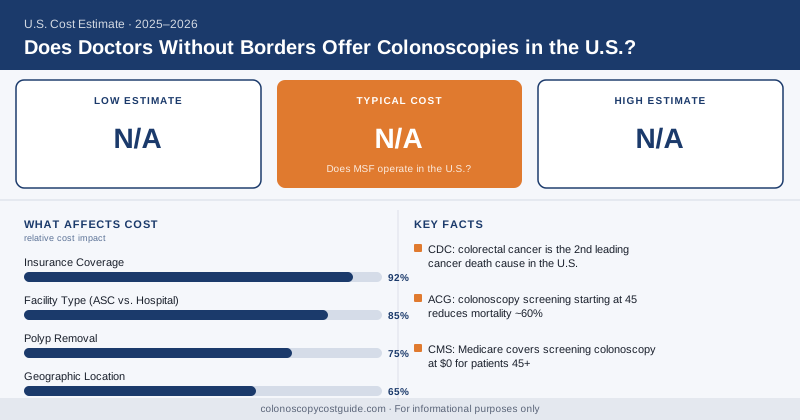
Does Doctors Without Borders Offer Colonoscopies in the U.S.?
{ if eq .Lang "zh" }{ else }{ end }Where does the idea that Doctors Without Borders offers free colonoscopies in America even come from? It’s an understandable mix-up — MSF (Médecins Sans Frontières) is one of the most recognized names in low-cost global medical care, so it’s a natural search when someone’s worried about affording a screening.
But it’s not what MSF does. Here’s the actual answer, and where to look instead.
What Doctors Without Borders Actually Does
| Question | Answer |
|---|---|
| Does MSF operate in the U.S.? | Rarely — only for specific disaster/emergency response |
| Do they offer routine colonoscopies anywhere? | No — their model is emergency/crisis medical care |
| Primary regions served | Conflict zones, disease outbreaks, disaster areas globally |
| Funding model | Donor-funded, focused on humanitarian emergencies |
MSF’s entire operating model is built around acute humanitarian crises: war zones, epidemics, refugee camps, natural disaster response. A routine, elective colorectal cancer screening simply isn’t the kind of care their mission is designed around, in the U.S. or anywhere else with a functioning healthcare system.
The Real U.S. Equivalents
| Program Type | Colonoscopy Available? | Cost Model |
|---|---|---|
| Federally qualified community health center | Yes | Income-based sliding scale |
| Nonprofit hospital charity care program | Yes | Free or reduced based on income (IRS-mandated) |
| State colorectal cancer screening grant program | Yes (varies by state) | Free or very low-cost for qualifying residents |
| Independent cash-pay surgery center | Yes | Discounted flat rate, no income requirement |
Key Takeaway
How Nonprofit Hospital Charity Care Actually Works
Every nonprofit hospital in the U.S. is required by IRS regulations to maintain a financial assistance policy and publish it publicly. Depending on your income relative to the federal poverty level, you may qualify for a substantial discount or a fully free colonoscopy through this program — ask the hospital’s billing office specifically for their “financial assistance” or “charity care” application.
State-Level Screening Grant Programs
Many states run their own colorectal cancer screening programs funded partly through CDC grants, specifically targeting uninsured and underinsured residents. The CDC’s Colorectal Cancer Control Program has funded state and tribal programs providing screening services to eligible low-income adults for years — a genuinely comparable resource to what people are picturing when they think of MSF-style free care.
Bottom Line
Doctors Without Borders is a vital organization, but it isn’t a source of domestic, routine colonoscopy care. The real path to a low- or no-cost colonoscopy in the U.S. runs through community health centers, nonprofit hospital charity care, and CDC-funded state screening programs — all worth calling before assuming you have no affordable option.
{ if eq .Lang "zh" }