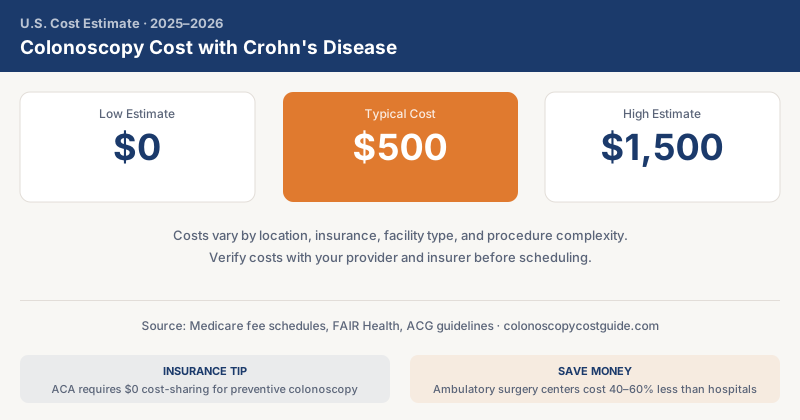
Colonoscopy Cost With Crohn's Disease: Surveillance Frequency and Insurance Coverage
If you’ve had Crohn’s disease for more than 8 years, the colonoscopy math changes completely. You’re no longer looking at one screening every 10 years. You’re looking at annual or biennial procedures — potentially for the rest of your life — and every one of them will be billed as diagnostic, not preventive.
That difference matters enormously for your wallet.
Crohn’s disease increases colorectal cancer risk significantly, particularly for patients with colonic involvement. According to a 2022 meta-analysis in The Lancet, patients with Crohn’s colitis have approximately a 2.5-fold increased risk of colorectal cancer compared to the general population. That risk drives the intensive surveillance schedule that the ACG and ASGE recommend — and it means Crohn’s patients face far higher lifetime colonoscopy costs than average-risk adults.
How Crohn’s Changes Your Colonoscopy Schedule
Average-risk adult: Screening colonoscopy every 10 years starting at age 45. One procedure per decade.
Crohn’s disease (colonic involvement): Surveillance colonoscopy starting 8 years after disease onset, then every 1 to 2 years depending on disease activity, extent, and prior findings.
That’s potentially 5 to 10 or more colonoscopies over a 10-year period vs. one for an average-risk adult.
| Patient Profile | Colonoscopies Over 10 Years | Estimated Total Out-of-Pocket (Insured) |
|---|---|---|
| Average-risk adult | 1 | $0 (preventive) |
| Crohn’s, quiescent, no dysplasia | 5–7 | $2,500 – $8,400 |
| Crohn’s, active disease or prior dysplasia | 8–10 | $4,000 – $12,000 |
| Crohn’s with multiple biopsies per procedure | 8–10 | $5,000 – $15,000+ |
These estimates assume diagnostic billing with typical commercial insurance (deductible applies), not $0 preventive billing.
Why Surveillance Colonoscopies Are Billed as Diagnostic, Not Preventive
This is the critical financial distinction. When your gastroenterologist orders a colonoscopy because you have Crohn’s disease and need surveillance, the procedure is billed as a diagnostic procedure — not as preventive colorectal cancer screening.
Preventive screening billing ($0 cost-sharing under ACA) applies when a procedure is performed for cancer screening in an asymptomatic, average-risk adult. Surveillance in Crohn’s patients is performed because of an established disease that elevates cancer risk. Different clinical indication = different billing category.
Your health plan may cover surveillance colonoscopies as a “medically necessary” diagnostic procedure, but your normal cost-sharing applies: you pay toward your deductible and then coinsurance. Depending on your plan and how much of your deductible you’ve already met, each colonoscopy can cost you $500 to $2,000 out of pocket.
Check Your Plan's IBD-Specific Coverage
Biopsies Multiply the Cost
Crohn’s surveillance colonoscopy protocols typically involve extensive tissue sampling. The ACG’s surveillance protocol for IBD-related colorectal cancer risk recommends:
- Two to four biopsies every 10 cm throughout the colon (the “Seattle Protocol” adapted for IBD)
- Targeted biopsies of any visible lesions
- Chromoendoscopy (dye spray) may be used in high-risk patients, which is billed under an additional code
A thorough Crohn’s surveillance colonoscopy may involve 10 to 20 tissue specimens. At $60 to $90 per specimen under Medicare rates (or $150 to $300 at list price), the pathology bill alone can run $600 to $4,000 per procedure.
For insured patients whose deductible is already met, the pathology portion triggers coinsurance. For those early in a plan year, it all applies toward the deductible first.
| Colonoscopy Component | Typical Range (Crohn’s Surveillance) |
|---|---|
| Facility fee (ASC) | $700 – $1,800 |
| Gastroenterologist fee | $300 – $700 |
| Anesthesia | $400 – $1,000 |
| Pathology (10–20 specimens) | $600 – $4,000 |
| Total per procedure | $1,500 – $7,500 |
Biologics, Steroids, and Procedure Timing
For Crohn’s patients on biologic therapy (infliximab, adalimumab, vedolizumab, ustekinumab), disease activity changes over time. Surveillance recommendations may shift based on disease extent and mucosal healing status.
Patients with deep remission confirmed by colonoscopy may be able to extend their surveillance interval from 1 year to 2 years in consultation with their gastroenterologist. That single additional year between scopes saves one procedure’s worth of cost — potentially $1,500 to $3,000.
Conversely, patients with active inflammation, pseudopolyps, or prior low-grade dysplasia need more frequent surveillance, and some dysplasia findings may require chromoendoscopy protocols or accelerated follow-up.
Strategies to Manage Crohn’s Colonoscopy Costs
Time procedures after your deductible resets: If you have multiple medical expenses in a year, try to schedule your colonoscopy after you’ve already met your deductible from other care. The colonoscopy cost then only triggers coinsurance (typically 20–30%), not the full deductible.
Use an HSA for tax savings: If you have a high-deductible health plan, contribute the maximum to your HSA annually. Your colonoscopy and all related pathology costs are HSA-eligible, saving you the tax equivalent of your marginal rate on every dollar spent.
Request combined procedures when clinically appropriate: If your GI doctor is also managing upper GI symptoms or wants to check your small bowel, a combined colonoscopy and upper endoscopy in one session is generally cheaper than two separate procedures.
Negotiate the pathology lab: If you’re paying significant out-of-pocket for pathology, ask your gastroenterologist whether the specimens can be sent to a lab with lower contracted rates or one that’s in your network.
For context on how your Crohn’s-related costs compare to the general colonoscopy pricing picture, see the colonoscopy cost overview.