Colonoscopy Cost at a Community Health Center: Sliding Scale Prices Explained
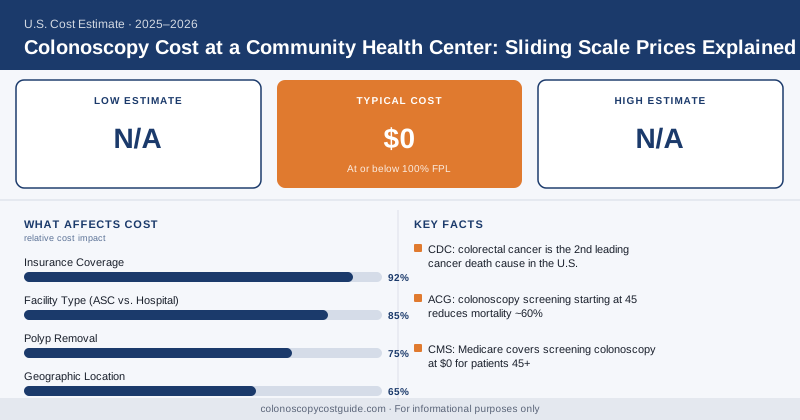
{ if eq .Lang "zh" }{ else }{ end }$0. That’s what a colonoscopy costs at a federally qualified community health center if your household income falls at or below the federal poverty level. It’s not a rumor or a rare exception — it’s federal policy, and over 31 million Americans used these centers in 2022 according to HRSA data.
Here’s exactly how the pricing works.
The Sliding Fee Scale, in Real Numbers
| Income Relative to Federal Poverty Level | Typical Colonoscopy Cost |
|---|---|
| At or below 100% FPL | $0 |
| 100% – 150% FPL | $20 – $75 |
| 150% – 200% FPL | $75 – $200 |
| Above 200% FPL | $200 – $400 (still discounted) |
| Insured patients | Billed to insurance; sliding scale covers remaining balance |
Notice that even patients above 200% of the federal poverty level, which covers a lot of working households, still receive a meaningful discount compared to standard cash-pay rates elsewhere.
Why This Exists
Federally qualified health centers (FQHCs) receive federal grant funding specifically in exchange for agreeing to serve all patients regardless of insurance status or ability to pay, using this legally mandated sliding scale. It’s not charity in the informal sense — it’s a structured, federally overseen program with consistent rules nationwide.
Key Takeaway
How to Actually Qualify
You’ll typically need to bring proof of income — a recent pay stub, tax return, or a simple self-declaration form depending on the center’s policy — along with proof of household size. The application process is usually quick, often completed the same day as your first visit, and doesn’t require immigration status documentation at most centers.
Finding One Near You
HRSA (the Health Resources and Services Administration) maintains an official, searchable directory of every federally qualified health center in the country. Search “HRSA Find a Health Center” and enter your zip code — most metro areas and many rural counties have at least one location.
What If They Don’t Do Colonoscopies On-Site?
Many community health centers focus on primary care and refer out for specialty procedures like colonoscopies. When that happens, ask specifically whether their referral partnership extends the sliding scale to the procedure itself, or whether you’ll need to separately negotiate with the referral facility using the cash-pay strategies that apply elsewhere.
Bottom Line
A federally qualified community health center is one of the most reliable ways to get a low-cost or free colonoscopy in the U.S., with pricing legally tied to your income rather than a fixed rate. If you’re uninsured or underinsured, this should be one of your first calls, not a last resort.
{ if eq .Lang "zh" }