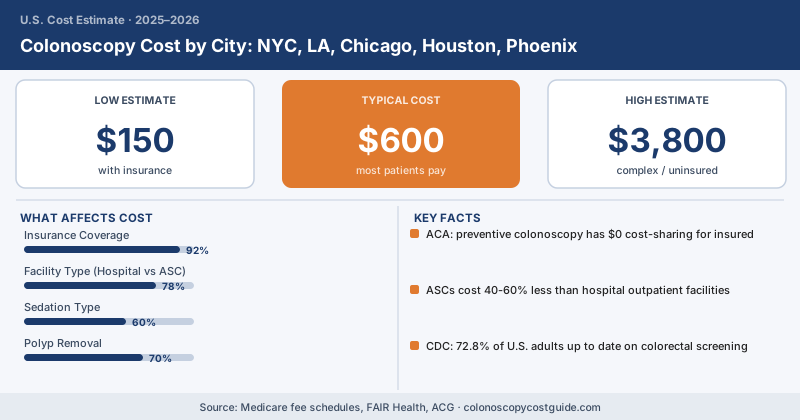
Colonoscopy Cost by City: NYC, LA, Chicago, Houston, and Phoenix Compared
The same 45-year-old, healthy, no-symptoms colonoscopy costs $950 in Phoenix and $3,800 in Manhattan. Same procedure. Same CPT code. A 4x price gap — just because of your zip code.
FAIR Health data consistently shows that colonoscopy prices in major metro areas vary enormously, driven by facility costs, local wage rates, regional insurance negotiations, and market concentration. If you’re uninsured or paying out-of-pocket, your city can matter more than your health status.
Price Comparison Across Five Major Cities
These figures represent typical total charges (facility + physician + anesthesia) for a routine screening colonoscopy without polyp removal, based on FAIR Health consumer cost data and CMS geographic payment adjustments.
| City | Uninsured / Self-Pay | Typical Insured (Cost-Sharing) | ASC vs. Hospital Gap |
|---|---|---|---|
| New York City | $2,800–$5,500 | $400–$1,200 | Large — ASC saves ~50% |
| Los Angeles | $2,200–$4,500 | $300–$1,000 | Moderate — ASC saves ~40% |
| Chicago | $1,800–$3,800 | $250–$900 | Moderate |
| Houston | $1,400–$3,200 | $200–$750 | Smaller — hospital prices more competitive |
| Phoenix | $900–$2,200 | $150–$600 | Smallest — market is ASC-heavy |
Why does Phoenix come out cheapest? The metro has a high density of ambulatory surgery centers (ASCs), which creates competition and drives down prices. New York City, by contrast, has many procedures still performed at hospital outpatient departments — which charge facility fees 2 to 3 times higher than ASCs, even for identical procedures.
New York City: The Most Expensive Market
NYC is an outlier. The city’s high cost of living, unionized hospital workforces, and significant volume of procedures done at major academic medical centers (Weill Cornell, NYU Langone, Columbia) all push prices up.
A colonoscopy at a Manhattan hospital outpatient department without insurance can easily hit $4,000 to $5,500 in billed charges. Even with insurance, if you’re early in a calendar year and haven’t met your deductible, you could owe $800 to $1,500.
The workaround: freestanding endoscopy centers in the outer boroughs or in New Jersey suburbs charge significantly less. A colonoscopy at a Queens or Brooklyn ASC typically runs $1,200 to $2,200 in billed charges — roughly half the Manhattan hospital rate.
Los Angeles: Wide Variation Within the Metro
LA’s price dispersion is wide. A procedure at Cedars-Sinai or UCLA Medical Center will cost significantly more than one at a Beverly Hills freestanding endoscopy suite or a San Fernando Valley ASC. The LA market also has strong HMO penetration (Kaiser Permanente covers roughly 20% of insured Angelenos), and Kaiser members typically pay low fixed copays for colonoscopies regardless of facility.
If you’re on a PPO in LA and shopping for a lower-cost option, the San Gabriel Valley and South Bay areas tend to have more price-competitive endoscopy centers than the Westside.
Chicago: Mid-Range Costs, Strong Academic Center Presence
Chicago falls in the middle of the national range. The presence of large academic systems (Northwestern, Rush, University of Chicago) anchors the upper end of pricing, while the city also has a competitive independent endoscopy center market on the North Side and in the suburbs.
Cook County Health’s public hospital system provides colonoscopies at sliding-scale prices for uninsured patients — a meaningful option for lower-income residents. The free and low-cost colonoscopy programs article has more on income-based options.
Houston: Competitive Hospital Market Keeps Prices Moderate
Houston’s health care market is unusual — it has a large number of hospitals competing for patients, and that competition has historically kept prices more moderate than comparably sized cities. The Texas Medical Center offers many options, but community hospitals and standalone ASCs in the suburbs (Katy, Sugar Land, The Woodlands) are often cheaper.
Texas also has no state income tax and a lower regulatory burden on ASC operations, which contributes to lower facility overhead compared to states like New York or California.
Phoenix: The Benchmark for Low-Cost Colonoscopy
Phoenix consistently appears as one of the most affordable large U.S. cities for colonoscopy. A 2023 FAIR Health analysis ranked Phoenix and several other Sun Belt metros among the lowest-cost markets for outpatient GI procedures. The market has:
- A high concentration of freestanding ASCs (Arizona is a certificate-of-need-free state, making it easy to open new ASCs)
- Several large multispecialty GI practices that own their own procedure suites
- Strong managed care competition keeping negotiated rates low
Uninsured patients in Phoenix can often find a colonoscopy in the $950 to $1,500 range through direct-pay pricing at ASCs, compared to $2,500 to $5,000 in NYC for the same procedure.
How to Find the Best Price in Your City
What Drives the City-to-City Price Gap
The core drivers come down to a few factors:
Facility type: Hospital outpatient departments charge facility fees that ASCs can’t touch. In NYC, more colonoscopies happen in hospital settings. In Phoenix, the opposite.
Local wage rates: Anesthesia technician wages, nursing salaries, and administrative costs are higher in high-cost-of-living cities, and those costs get passed through to facility fees.
Insurance market concentration: Cities dominated by a few large insurers tend to have less negotiating leverage for patients. Cities with more insurer competition often have lower negotiated rates.
State regulation: Certificate-of-need laws (which restrict opening new ASCs) exist in states like New York and effectively reduce ASC competition, keeping hospital prices higher.
For the full national picture of what colonoscopies cost, see the colonoscopy cost by state breakdown.