Blue Cross Blue Shield Colonoscopy Coverage: What BCBS Members Actually Pay
{ if eq .Lang "zh" }{ else }{ end }Blue Cross Blue Shield is the largest private health insurer in the US by enrollment, covering more than 100 million Americans — but “BCBS” isn’t one company. It’s 33 independent local and regional plans that share a brand. What Anthem BCBS (now Elevance Health) covers in California may differ from what BCBS of Florida covers or BCBS of Michigan covers.
That’s the most important thing to know about checking your BCBS colonoscopy coverage: the answer isn’t universal. You have to check your plan.
The BCBS Baseline on Preventive Colonoscopy
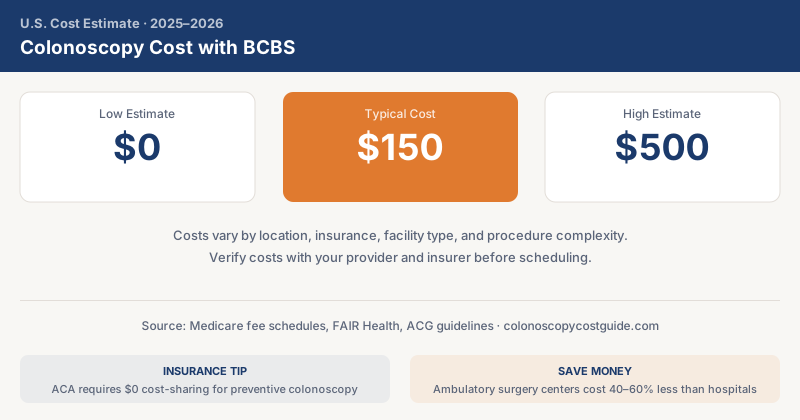
All ACA-compliant BCBS plans must cover preventive colonoscopy with zero cost-sharing for average-risk adults 45 and older, under ACA Section 2713. The USPSTF’s 2021 update (lowering the recommendation to age 45) is reflected in most BCBS plans’ benefit structures as of 2023–2024.
In practice, this means:
- Screening colonoscopy (CPT 45378 with Z-code diagnosis) — $0 for most BCBS members on ACA-compliant plans
- No deductible, no copay, no coinsurance — as long as you use in-network providers
But the specifics vary by affiliate and plan design.
BCBS Affiliates and Coverage Differences
| BCBS Affiliate | Screening Colonoscopy | Diagnostic Colonoscopy | Polyp Removal During Screening |
|---|---|---|---|
| Anthem BCBS (CA, CO, CT, GA, IN, KY, ME, MO, NH, NV, NY, OH, VA, WI) | $0 | Deductible + 20% coinsurance | Generally $0 (varies by plan year) |
| BCBS of Florida (Florida Blue) | $0 | Deductible + coinsurance | Generally $0 (2024 policy) |
| BCBS of Michigan | $0 | Deductible + coinsurance | $0 for polypectomy during screening |
| BCBS of Illinois | $0 | Deductible + coinsurance | $0 (state law protection) |
| BCBS of Texas | $0 | Deductible + coinsurance | Varies by plan; check specific benefits |
| HCSC (IL, MT, NM, OK, TX) | $0 | Plan-specific | Varies |
These are generalizations based on publicly available BCBS benefit documents as of 2025–2026. Your specific plan year and employer contract may differ. Always verify with your actual plan documents.
How BCBS Handles the Screening-to-Diagnostic Conversion
The polyp billing problem — where a screening colonoscopy becomes diagnostic when a polyp is removed — is handled differently by different BCBS affiliates.
Most major BCBS affiliates updated their policies between 2022 and 2024 to align with the Consolidated Appropriations Act of 2023, which reduced cost-sharing for polyp removal during screening colonoscopy. Many now apply $0 cost-sharing for the entire encounter, including polypectomy, on ACA-compliant plans.
To verify for your specific plan:
- Log into your BCBS member portal and check the “preventive care” or “diagnostic procedures” section of your plan benefits
- Call the member services number on your BCBS card and ask: “If my doctor removes a polyp during my screening colonoscopy, will you cover the entire procedure at $0 or will cost-sharing apply?”
- Ask for the written benefit document citation — not just a verbal answer
Prior Authorization Requirements
Most BCBS plans don’t require prior authorization for routine screening colonoscopy. But diagnostic colonoscopies — and colonoscopies following positive stool tests — may require prior auth under some BCBS plans.
If your colonoscopy is being scheduled as diagnostic (due to symptoms, family history, or a positive Cologuard test), ask your GI physician’s office to check prior authorization requirements before scheduling. A denied claim due to missing prior auth can leave you with the full bill.
Verifying In-Network Status
“BCBS” network status depends on which BCBS affiliate you have and which network tier your plan uses. BCBS plans often have multiple network tiers:
- BlueChoice / Blue Select (Narrow Network): Lower premium, fewer in-network providers
- Blue PPO / Preferred Blue (Broad Network): Higher premium, wider access
- Blue HMO: Requires PCP referral; out-of-network not covered except emergencies
A provider listed as in-network for “Blue PPO” may be out-of-network for your “BlueChoice” plan. Search the provider directory specifically for your plan product — not just “BCBS” generically — at the provider search on your BCBS member portal.
The Fastest Way to Verify Your Specific BCBS Colonoscopy Cost
Before scheduling, call the number on the back of your BCBS card and prepare these three questions:
- “Is CPT 45378 covered as a preventive service at $0 cost-sharing for a [your age]-year-old average-risk patient on my plan?”
- “Is [specific facility name] in-network under my plan product?” (Give the facility NPI)
- “If a polyp is removed, does my plan apply cost-sharing to the polypectomy, or is the entire encounter still covered at $0?”
Document the call: date, representative name, call reference number. This is your protection if the claim is processed differently from what you were told.
BCBS Medicare Advantage Colonoscopy Coverage
BCBS Medicare Advantage plans are separate from commercial BCBS plans and operate under Medicare rules. Coverage for screening colonoscopy typically mirrors Original Medicare — $0 for screening — but the polyp billing rules may be more favorable than Original Medicare in some BCBS Medicare Advantage plans.
Check your BCBS Medicare Advantage Evidence of Coverage document, available on your plan’s website or by calling the plan’s member services.
For comparison, see coverage breakdowns for Aetna colonoscopy coverage, UnitedHealthcare colonoscopy coverage, and Cigna colonoscopy coverage.
{ if eq .Lang "zh" }