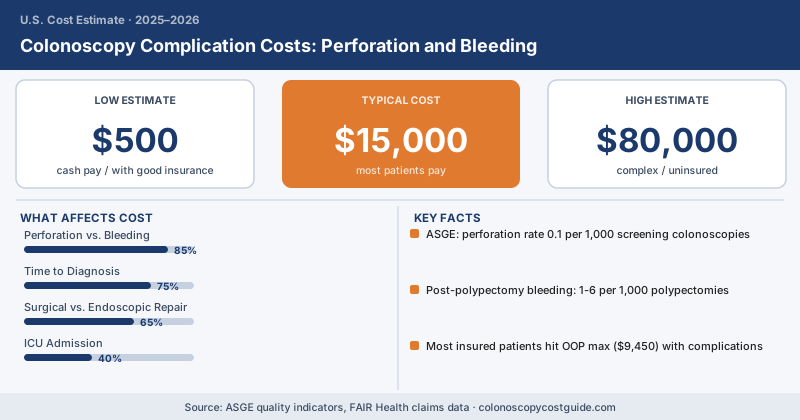
Colonoscopy Complication Costs: Perforation, Bleeding & Emergency Treatment Prices
Most colonoscopies go off without a problem. But “most” isn’t “all” — and if you’re in the unlucky 0.3%, the financial hit can be as severe as the medical one.
A serious colonoscopy complication isn’t just a bad experience. It can mean emergency surgery, a multi-day ICU stay, and a bill that dwarfs the original procedure cost by 10 to 20 times. Here’s an honest breakdown of what each type of complication costs and what you’ll actually pay.
The Real Complication Rates
The American Society for Gastrointestinal Endoscopy (ASGE) reports serious adverse event rates for colonoscopy as follows:
- Perforation: 0.1 per 1,000 screening colonoscopies; 1–2 per 1,000 therapeutic procedures
- Post-polypectomy bleeding: 1–6 per 1,000 polypectomies
- Cardiopulmonary events (sedation-related): 0.5–1.0 per 1,000 procedures
- Infection/sepsis: rare, under 0.1 per 1,000
These numbers sound small. For context, over 15 million colonoscopies are performed in the US annually — meaning roughly 4,500 to 45,000 patients per year experience a complication serious enough to require medical attention.
Perforation: The Most Expensive Complication
Colon perforation — a tear in the bowel wall — is the complication most likely to generate catastrophic costs. Treatment depends on where the perforation is and how quickly it’s caught.
| Perforation Treatment Path | Estimated Total Cost |
|---|---|
| Endoscopic clip closure (caught immediately, same session) | $5,000 – $15,000 |
| Laparoscopic surgical repair (next-day or within 24 hrs) | $20,000 – $45,000 |
| Open abdominal surgery (delayed diagnosis, peritonitis) | $40,000 – $80,000+ |
| ICU stay (per day, hospital charges) | $3,000 – $8,000/day |
| Temporary colostomy bag (if needed) | $8,000 – $25,000 additional |
| Colostomy reversal surgery | $15,000 – $30,000 |
The cost driver is the delay between perforation and diagnosis. A perforation caught during the procedure — while the endoscope is still in place — can sometimes be closed with clips right then, converting a potential surgical emergency into a brief observation admission. A perforation that isn’t recognized until 12–24 hours later, when the patient develops fever, severe abdominal pain, and CT evidence of free air, is a different situation entirely.
Post-Polypectomy Bleeding
Bleeding after polyp removal is more common than perforation and usually less catastrophic. Minor bleeding stops on its own. The cases that generate bills are the ones where bleeding is heavy enough to require intervention.
| Bleeding Treatment | Estimated Cost |
|---|---|
| Minor delayed bleeding (monitored, self-resolving) | $500 – $2,000 (ER evaluation) |
| Repeat colonoscopy to clip or cauterize bleeding site | $3,000 – $8,000 |
| Hospital admission for observation (1–2 nights) | $5,000 – $15,000 |
| Blood transfusion (if significant blood loss) | $1,500 – $5,000 |
| Interventional radiology embolization (if scope fails) | $10,000 – $25,000 |
Patients on blood thinners — warfarin, Eliquis, Xarelto — have significantly higher rates of post-polypectomy bleeding. If you’re on anticoagulants, your GI doctor should discuss the protocol for stopping them before the procedure. Don’t stop them on your own without guidance.
Your Insurance Out-of-Pocket Maximum Is Your Protection
Sedation and Anesthesia Complications
Most colonoscopy sedation is uneventful. But propofol — used in the majority of US colonoscopies — does carry real cardiovascular and respiratory risk, particularly in older patients or those with sleep apnea, heart disease, or obesity.
- Oxygen desaturation requiring supplemental oxygen: managed in the procedure room, no added cost in most cases.
- Aspiration pneumonia: requires hospitalization of 3–7 days. Total cost: $8,000–$25,000.
- Cardiac event (rare): depending on severity, $15,000–$100,000+.
- Allergic reaction to medications: ER treatment for anaphylaxis runs $2,000–$10,000.
Splenic Injury (Rare But Real)
It sounds unlikely, but splenic rupture has been documented as a colonoscopy complication — typically from traction on the splenocolic ligament during scope manipulation. It’s very rare (estimated 1 in 100,000 procedures), but costs are substantial:
- Splenic laceration treated conservatively: $10,000–$25,000 (hospitalization)
- Splenectomy: $30,000–$60,000
Infection After Colonoscopy
Serious infections following colonoscopy are uncommon but can include bacterial peritonitis (if perforation occurred) and, rarely, bacteremia. Post-procedure infection treatment:
- Outpatient antibiotic course: $50–$200
- Hospitalization for IV antibiotics (3–5 days): $8,000–$20,000
- Surgical drainage of abscess: $15,000–$35,000
What You’ll Actually Pay Out of Pocket
Most insured patients dealing with a complication will hit their annual out-of-pocket maximum. Here’s how that works in practice:
- Your deductible applies first (typically $1,000–$3,000)
- Then you pay coinsurance (20–30%) until you hit your OOP max
- OOP maximum for ACA-compliant plans caps at $9,450 for individuals in 2025
- After that, the insurer pays 100%
Uninsured patients face the full chargemaster rate — but hospitals are legally required to offer financial assistance programs, and most large health systems will negotiate significantly if you ask. A perforation surgery billed at $60,000 might settle for $15,000–$20,000 through the hospital’s charity care program.
For Medicare beneficiaries without Medigap, the 20% coinsurance has no cap — which is why supplemental coverage matters more when facing serious complications.