How to Ask for the Cash Price on a Colonoscopy (Script + Tips)
{ if eq .Lang "zh" }{ else }{ end }The $4,200 line item on your Explanation of Benefits is NOT what you have to pay. It’s the chargemaster rate — a starting price that almost nobody actually pays in full, including uninsured patients. The cash (self-pay) price is a separate, lower rate that exists at nearly every hospital and surgery center in the country. You just have to know to ask for it.
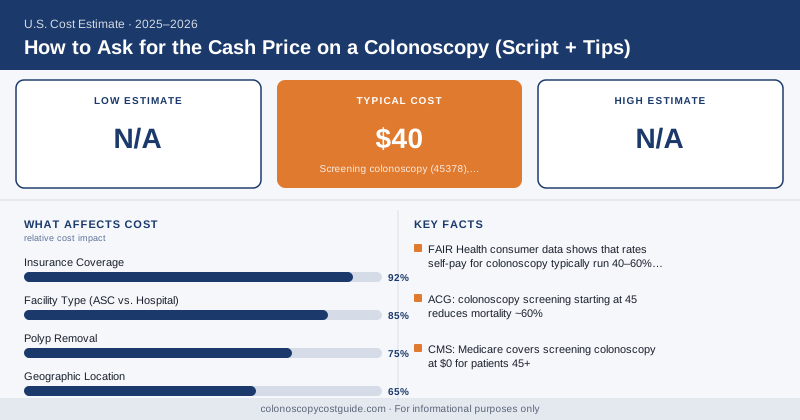
FAIR Health consumer data shows that self-pay rates for colonoscopy typically run 40–60% below chargemaster prices. On a $4,000 procedure, that’s a $1,600–$2,400 difference — real money that goes unclaimed every day simply because patients don’t know the rate exists or how to request it.
Here’s the exact process, including what to say.
Step 1: Know Who to Call — and Who NOT to Call
Call the billing department of the ambulatory surgery center or endoscopy facility where the procedure will be performed — not the GI doctor’s office.
The physician fee (gastroenterologist) is billed separately from the facility fee, and the cash rate negotiation happens at each entity independently. But the facility fee is the largest portion of the total bill, so start there.
ASC vs. Hospital: Start With the Right Facility
Step 2: Know the CPT Codes Before You Call
Knowing the billing codes signals to the person on the phone that you’re an informed patient — which moves the conversation faster and signals you won’t simply accept the first number offered.
For a routine screening colonoscopy: CPT 45378 For colonoscopy with polyp removal (biopsy): CPT 45380 or CPT 45385 For anesthesia: CPT 00810
You don’t need to memorize the codes — just have them written down.
Step 3: The Phone Script
Call the ASC or endoscopy center’s billing department and say:
“Hi, I’m scheduling a colonoscopy and I’ll be paying out of pocket. I’d like to ask about your self-pay rate for CPT 45378 — the routine screening colonoscopy without polypectomy. Can you tell me what your cash pay rate is for the facility fee?”
If they quote a rate, respond:
“Thank you. Does that rate include everything billed by the facility, or are there additional facility charges? And is that separate from the physician and anesthesia fees?”
If they quote only the chargemaster price or say “we don’t have a self-pay rate,” ask:
“I understand — under the Hospital Price Transparency Rule, you’re required to publish your standard charges including discounted cash prices. I’d like to understand what discount is available for a patient paying upfront in full. Can I speak with someone in your financial counseling department?”
| Procedure | Chargemaster (List Price) | Typical Self-Pay Cash Rate | Typical Savings |
|---|---|---|---|
| Screening colonoscopy (45378), ASC | $1,800–$3,500 | $800–$1,600 | 40–55% |
| Screening colonoscopy (45378), Hospital Outpatient | $3,000–$6,000 | $1,400–$3,000 | 40–50% |
| Colonoscopy with biopsy (45380), ASC | $2,200–$4,000 | $1,000–$2,000 | 40–55% |
| GI physician fee (separate) | $400–$700 | $250–$450 | 30–40% |
| Anesthesia (00810), ASC | $600–$1,200 | $300–$700 | 35–45% |
Step 4: Negotiate the Physician and Anesthesia Fees Separately
Once you have the facility’s cash rate, call the gastroenterologist’s billing office separately (not the ASC) and request their self-pay rate for 45378. Many GI practices have a standing cash rate — typically $200–$400 for a screening colonoscopy.
For anesthesia: ask the ASC which anesthesia group they use. Call that group’s billing department and request their self-pay rate for CPT 00810. Alternatively, ask the ASC whether they can quote you an all-in price that includes anesthesia — some facilities do this.
Step 5: Get It in Writing
Before scheduling, ask for written confirmation of the quoted price. An email is fine — even a reference number from the call works. This protects you from being billed the chargemaster rate later.
Say: “Can you email that rate to me? Or give me a reference number I can cite when I check in?”
The No Surprises Act and Price Transparency — Your Legal Tools
The federal Hospital Price Transparency Rule (effective January 1, 2021, enforced more strictly since 2024) requires hospitals to publicly post their standard charges, including discounted cash prices, in a machine-readable file online. Freestanding ASCs aren’t hospitals, so they’re not subject to the same rule — but many have adopted similar practices voluntarily or in response to competitive pressure.
The No Surprises Act (effective January 2022) requires facilities to provide a good-faith cost estimate upon request before a scheduled procedure. If you ask for an estimate, they must provide one. You can use that estimate as leverage in your negotiation.
If the First Quote Is Too High: Counter
Quoting a lower price from a competitor (like an MDsave voucher price or a neighboring ASC’s self-pay rate) is fair game. Try: “I’ve found a pre-negotiated rate at another accredited center for $1,100 all-in. Can you match or beat that for a cash patient?” Not every facility will budge, but some will — especially smaller independent ASCs that value volume.
After the Procedure: Audit Your Bill
Even after negotiating upfront, review your itemized bill carefully. Common errors include duplicate charges, charges for services not rendered, and billing at chargemaster rates despite a confirmed cash agreement. If you see a discrepancy, reference the confirmation you received before the procedure and request a corrected bill.
Getting the cash price isn’t confrontational — it’s standard practice. Providers expect these conversations from self-pay patients. The only reason most people don’t have them is that nobody told them to ask.
{ if eq .Lang "zh" }