Why You Can Get a $900 Anesthesia Surprise Bill From a 'Free' Colonoscopy (And How to Prevent It)
{ if eq .Lang "zh" }{ else }{ end }Jason scheduled his colonoscopy at an accredited ambulatory surgery center that was fully in-network with his Blue Cross plan. He confirmed the GI doctor was in-network. He called the ASC’s billing department and confirmed the facility was in-network. He paid his $0 copay at check-in and went home feeling like he’d handled everything correctly.
Six weeks later, a $947 bill arrived. It was from an anesthesiology group he’d never heard of — a company contracted to staff the ASC’s anesthesia services. That company was out-of-network with his plan. He’d been under their care for the entire procedure without ever knowing they weren’t covered.
This scenario plays out thousands of times each year. It’s one of the most common colonoscopy billing surprises, and it’s entirely preventable if you know to ask the right question before scheduling.
Why Anesthesiologists Are Often Out of Network
The facility (ASC or hospital) and the gastroenterologist choose their own in-network contracts independently. Anesthesia at most endoscopy centers is provided by a separate anesthesiology group — often a physician-owned practice or a large national staffing company like NAPA (National Anesthesia Partners) or TeamHealth — that has its own distinct insurance contracts.
That anesthesia group may not be in-network with your insurance plan even if the facility and GI doctor both are. The patient often has no idea, because nobody at the facility mentions it unless asked.
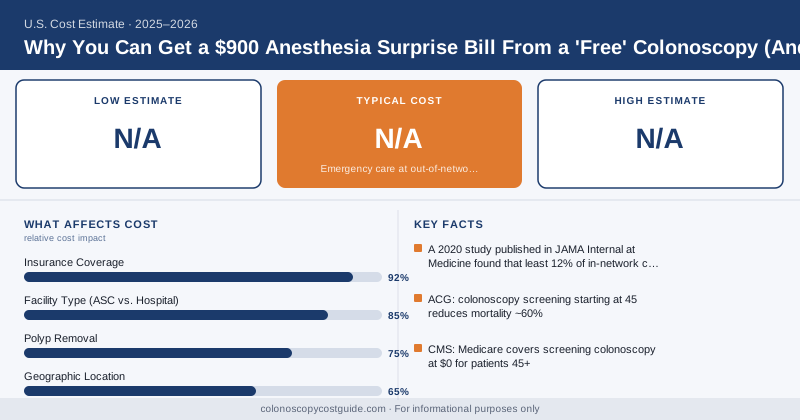
A 2020 study published in JAMA Internal Medicine found that at least 12% of in-network colonoscopies involved an out-of-network anesthesia provider — making this one of the most common out-of-network billing situations in all of outpatient medicine.
What the No Surprises Act Does (and Doesn’t Do)
The No Surprises Act, effective January 1, 2022, provides significant protections against surprise medical bills — but it has limitations you need to understand.
| Situation | No Surprises Act Protection | Patient Liability |
|---|---|---|
| Emergency care at out-of-network facility | Full protection — can only bill in-network rate | In-network cost-sharing only |
| Non-emergency care at in-network facility, OON provider | Protection IF patient wasn’t properly notified | In-network cost-sharing only |
| Non-emergency care, patient signed OON consent form | NOT protected — patient accepted the OON terms | Full OON balance bill possible |
| Self-pay patient (no insurance) | Not applicable — different rules | Negotiate cash rate directly |
For scheduled (non-emergency) procedures like a colonoscopy, the No Surprises Act does protect you — but only if you weren’t given proper notice and didn’t consent to out-of-network care in writing. Some providers use this consent form as a loophole: if you signed a paper at check-in without reading it carefully, you may have unknowingly consented to out-of-network anesthesia charges.
The best protection is prevention — confirming everyone who will treat you is in-network before your procedure date.
The Exact Questions to Ask Before Scheduling
When you call the ASC or endoscopy center to schedule your colonoscopy, ask these questions specifically:
Question 1: “Is [facility name] an in-network provider with [my insurance plan and plan ID]?”
Question 2: “Who provides anesthesia services at your facility? Is that anesthesia provider in-network with [my plan]?”
Question 3: “Are there any other providers — nurses, assistants, pathology — who will bill separately and who may not be in-network with my plan?”
If they can’t confirm anesthesia network status over the phone, ask for the name of the anesthesiology group and call your insurer directly to verify.
Get Written Confirmation
What to Do If You Already Got the Bill
If you received an out-of-network anesthesia bill after a colonoscopy at an in-network facility, don’t pay it without investigation. Here’s the process:
Step 1: Check what you signed at check-in. Pull out any paperwork you received and signed at the facility. Look for a document titled “Consent for Out-of-Network Care,” “Balance Billing Disclosure,” or similar. If you signed something like this without realizing it was a consent to OON charges, that complicates — but doesn’t necessarily end — your dispute.
Step 2: Request your EOB from your insurer. Confirm how the anesthesia claim was processed and what the insurer paid versus what the provider is billing you for.
Step 3: File a No Surprises Act complaint with CMS. If you weren’t properly notified in advance that the anesthesiologist was out of network and you didn’t knowingly consent, you can file a complaint at cms.gov/nosurprises. CMS can investigate and order the provider to reprocess the bill at in-network rates.
Step 4: Contact your insurer’s member services. Ask them to conduct a “surprise billing review” and apply No Surprises Act protections if applicable. Many insurers now have dedicated surprise billing teams.
Step 5: Request a reduction directly. Even if the No Surprises Act doesn’t apply (e.g., you signed a consent form), anesthesia groups often reduce out-of-network bills significantly for patients who appeal. Call the anesthesia group’s billing department and explain the situation. Offers of $200–$400 in place of $800–$1,200 are common.
The Specific Language That Protects You
Under the No Surprises Act, providers must give you an “advance explanation of benefits” upon request for scheduled procedures. You’re entitled to ask:
“Under the No Surprises Act, I’d like a good-faith cost estimate and confirmation that all providers involved in my procedure are in-network with my plan. Please include the anesthesia provider.”
Facilities are required to respond to these requests. A facility that refuses or is unable to provide this information is a red flag — consider scheduling at a different center where you can get a clear answer.
One Practical Shortcut
If this level of pre-procedure verification feels overwhelming, there’s a simpler option: buy a colonoscopy voucher through a platform like MDsave or ColonoscopyAssist. These bundles pre-negotiate all fees — facility, GI physician, and anesthesia — into a single price. By definition, there’s no separate out-of-network anesthesia bill. For uninsured or high-deductible patients, this is often the cleanest way to eliminate anesthesia surprise billing entirely.
Anesthesia surprise bills from colonoscopies are common enough to have a name in patient advocacy circles: “facility loop billing.” It’s legal in some forms, preventable in all forms. A five-minute phone call before scheduling is all it takes.
{ if eq .Lang "zh" }