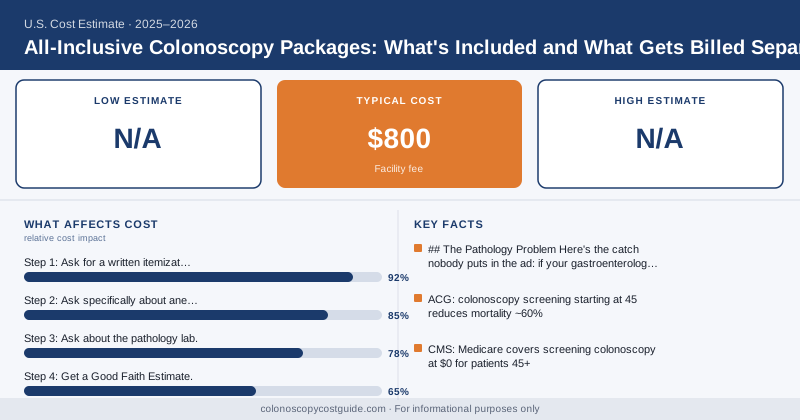
All-Inclusive Colonoscopy Packages: What's Included and What Gets Billed Separately
{ if eq .Lang "zh" }{ else }{ end }The “$995 all-inclusive colonoscopy” ad sounds like a deal — until the pathology bill arrives six weeks later. It’s one of the most common billing surprises in GI care, and it happens to thousands of patients every year who thought they’d paid in full.
All-inclusive colonoscopy packages are real, and they’re often genuinely cheaper than going through a hospital with insurance. But “all-inclusive” means different things to different facilities. Understanding what’s bundled — and what’s always billed separately — can save you a few hundred dollars and a lot of frustration.
What “All-Inclusive” Usually Covers
At most ambulatory surgery centers (ASCs) and GI clinics that advertise bundled pricing, the package typically includes:
| Component | Included in Most Packages? | Typical Standalone Cost |
|---|---|---|
| Facility fee | Yes | $800–$2,500 |
| GI physician fee | Yes | $300–$600 |
| Anesthesia/sedation fee | Yes | $300–$900 |
| Bowel prep prescription | Sometimes | $20–$80 |
| Pathology (if polyps removed) | Almost never | $200–$800 |
| Follow-up pathology visit | No | $150–$300 |
The three big fees — facility, physician, and anesthesia — are what most bundles cover. These alone represent the bulk of colonoscopy billing, so a true all-in package that covers all three typically runs $900–$1,500 at a freestanding ASC.
The Pathology Problem
Here’s the catch nobody puts in the ad: if your gastroenterologist finds and removes a polyp during your colonoscopy (which happens in roughly 40% of screening procedures, according to a 2023 report from the American Cancer Society), the tissue gets sent to an outside pathology laboratory. That lab bill is almost always separate.
Pathology charges vary based on the number of polyps, the type of tissue analysis required, and the lab’s contracts:
- Simple polyp analysis: $200–$400
- Multiple polyps or complex histology: $400–$800
- Out-of-network lab (common even when facility is in-network): up to $1,000+
The facility has no control over pathology billing — the lab is typically an independent entity. Even if you paid $1,200 all-in for your colonoscopy, the lab can and will bill you separately.
Real-World: Advertised vs. Actual Cost
CDC data from 2022 showed that colonoscopy is performed in over 19 million Americans annually. A significant portion of those patients encounter pathology bills they didn’t anticipate. Here’s how the numbers typically play out:
| Scenario | Advertised Package Price | Pathology Added | Total Actual Cost |
|---|---|---|---|
| No polyps found | $995 | $0 | $995 |
| 1 polyp removed | $995 | $200–$350 | $1,195–$1,345 |
| 2–3 polyps removed | $995 | $350–$600 | $1,345–$1,595 |
| Multiple polyps, out-of-network lab | $995 | $500–$800 | $1,495–$1,795 |
| Comprehensive package (path included) | $1,400–$1,800 | $0 | $1,400–$1,800 |
Some facilities — particularly those marketing specifically to self-pay patients — do include pathology in their bundled price, or partner with a specific in-network lab and negotiate pathology into the quote. These are worth paying a premium for if pathology inclusion is verified in writing.
How to Verify What’s Actually Included
Don’t rely on the ad. Do this before you book:
Step 1: Ask for a written itemization. Request a breakdown of every CPT code the package covers. A real all-inclusive package will list CPT 45378 (diagnostic colonoscopy), CPT 45380 or 45385 (polypectomy, if applicable), and the anesthesia code (typically 00810). If pathology is included, ask for the CPT 88305 (tissue exam by pathologist) in writing.
Step 2: Ask specifically about anesthesia. Some cheaper packages substitute “moderate sedation” (administered by the GI nurse or physician) instead of monitored anesthesia care (MAC) with an anesthesiologist. Both are acceptable for most patients, but make sure you know which you’re getting — and that the anesthesia provider isn’t billing separately.
Step 3: Ask about the pathology lab. Even if the package doesn’t cover pathology, ask which lab they use. If it’s an in-network lab with your insurance, you’ll have more predictable costs.
Step 4: Get a Good Faith Estimate. Under the No Surprises Act, uninsured and self-pay patients are entitled to a Good Faith Estimate of expected charges before any scheduled service. Ask for one — it’s your legal right.
The Best All-Inclusive Packages to Look For
When All-Inclusive Pricing Makes Sense
All-in packages are most useful for:
- Uninsured patients: When you’re paying 100% out of pocket, a bundled price beats negotiating individual line items with three separate billers.
- Patients with high deductibles: If your deductible is $3,000–$7,000 and your colonoscopy is diagnostic, an all-in package at $1,200 may cost less than your insurance’s “negotiated rate” once you do the math.
- Healthy average-risk adults with no polyp history: Lower polyp probability = lower pathology risk.
They’re less useful if you have a known polyp history, inflammatory bowel disease, or other factors that make additional biopsy work more likely.
Even with the best all-inclusive package, build in a $200–$500 buffer. Polyps show up when you least expect them — and a thorough doctor who removes one is doing exactly the right thing.
For more on how billing works at each type of facility, see ambulatory surgery center vs. hospital colonoscopy cost. And if you already received a surprise bill after a free screening, the bill after a free screening colonoscopy explains your options.
{ if eq .Lang "zh" }