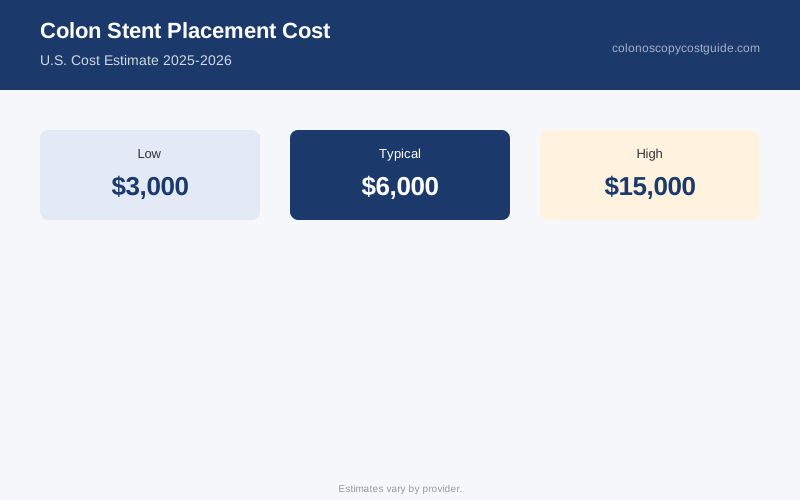
Colon Stent Placement Cost: Colorectal Obstruction Treatment Prices
A colorectal obstruction is a medical emergency — and colon stent placement is often the fastest, least invasive way to relieve it. Whether you’re facing a malignant obstruction from colorectal cancer or a benign stricture from Crohn’s disease or prior surgery, understanding what this procedure costs can help you navigate a stressful situation with more clarity.
What Is Colon Stent Placement?
A colonic self-expanding metallic stent (SEMS) is a mesh tube deployed through a colonoscope directly across a narrowed or blocked segment of the large intestine. Once released, it expands to hold the bowel open. The procedure typically takes 30–60 minutes and doesn’t require open surgery.
There are two main clinical settings:
Bridge to surgery (curative intent): For patients with malignant left-sided colorectal obstruction who need emergency surgery but aren’t immediately operable (due to bowel dilation, medical instability, or poor bowel prep conditions). Stenting decompresses the colon acutely, allows the patient to stabilize, and permits elective resection under better conditions — typically 2–4 weeks later.
Palliative stenting: For patients with incurable metastatic colorectal cancer where surgery isn’t appropriate. The stent maintains luminal patency and quality of life without major surgery.
The Cost of Colon Stent Placement
Costs depend on setting (hospital emergency vs. scheduled procedure), stent type, and whether fluoroscopic guidance is used alongside colonoscopy.
| Cost Component | Typical Range (Uninsured) |
|---|---|
| Hospital facility fee (emergency/inpatient) | $8,000 – $18,000 |
| Hospital facility fee (outpatient scheduled) | $4,000 – $10,000 |
| Gastroenterologist / colorectal surgeon fee | $800 – $2,500 |
| Anesthesia (propofol sedation) | $500 – $1,500 |
| SEMS device cost (to facility) | $800 – $2,500 per stent |
| Fluoroscopy / radiology interpretation | $200 – $600 |
| Total (outpatient, scheduled) | $6,000 – $15,000 |
| Total (emergency, inpatient) | $10,000 – $25,000+ |
Stent costs to the facility range widely. Through-the-scope (TTS) SEMS devices from companies like Boston Scientific (WallFlex), Cook Medical (Evolution), and Taewoong Medical (Niti-S) retail to hospitals at $800–$2,500 per stent. Some obstructions require two overlapping stents to span the stricture — doubling that cost.
Emergency vs. Elective Setting
Emergency colon stenting — done at 2 AM for an acute obstruction presenting to the ER — carries facility and overhead costs far higher than the same procedure scheduled a week in advance. If your situation permits even a brief delay, an outpatient or next-day scheduled stenting at an endoscopy center (rather than inpatient emergency) can significantly reduce total costs.
That said, acute large bowel obstruction is a genuine emergency — cecal dilation beyond 10–12 cm risks perforation and carries significant mortality. Don’t delay solely to reduce cost if your GI or surgical team recommends urgent intervention.
Benign vs. Malignant Obstruction
Malignant colorectal obstruction: The primary indication for colon stenting. Most insurers cover SEMS placement for malignant obstruction under oncologic surgical benefit — prior auth typically not needed in emergencies.
Benign colorectal strictures: SEMS for benign indications (anastomotic stricture after prior surgery, Crohn’s disease stricture, radiation-induced stricture) is more controversial and coverage is less consistent. Biodegradable stents and endoscopic balloon dilation are often tried first for benign disease. If your surgeon recommends a permanent metal stent for a benign stricture, it’s worth asking whether alternative options have been exhausted.
Insurance Coverage
Insurance Coverage for Colon Stent Placement
Medicare: Covered under Part A (inpatient) or Part B (outpatient hospital or ASC) depending on setting. CPT codes: 45327 (colonoscopy with stent placement) or 45389. Expect 20% Part B coinsurance after deductible for outpatient procedures.
Commercial insurance: All major payers — Aetna, BCBS, Cigna, UnitedHealthcare — cover SEMS for malignant colorectal obstruction. Documentation of obstruction (CT imaging report) and cancer diagnosis typically required.
Pre-authorization: Not typically required for acute/emergent placement, but your physician or facility should notify the insurer within 24–48 hours for inpatient emergencies. Planned outpatient procedures usually require standard pre-auth.
With insurance (met deductible): patient out-of-pocket for colon stent placement is typically $1,500 – $5,000 at an outpatient setting, or up to the out-of-pocket maximum ($4,000 – $10,000 for most commercial plans) for inpatient emergency stenting.
After the Stent: What Comes Next?
For bridge-to-surgery patients, the stent is typically removed at the time of colorectal resection 2–4 weeks later. That surgery represents a separate major cost — see our guide on colon cancer surgery cost for full details.
For palliative patients, the stent remains in place. Stent-related complications can require re-intervention:
- Stent migration: Stent moves out of position. Requires repeat colonoscopy for repositioning or replacement. Cost: $2,000 – $6,000.
- Tumor ingrowth / overgrowth: Cancer grows through or over the stent mesh, causing re-obstruction. Managed with laser ablation, APC, or second stent. Cost: $3,000 – $8,000 per intervention.
- Perforation (rare): Serious complication requiring surgical intervention.
Per-session complication management rates: stent migration occurs in 10–12% of cases; tumor ingrowth in approximately 8–10% within 6 months, based on pooled data from the European Society of Gastrointestinal Endoscopy.
Who Performs Colon Stent Placement?
Not every endoscopist has this skill set. Colon stenting requires advanced endoscopic training — it’s typically performed by interventional gastroenterologists or colorectal surgeons with specific SEMS experience. Academic medical centers and high-volume cancer centers have the most experienced operators. If emergency stenting is being considered at a community hospital without a high-volume GI team, and your condition allows even a short transfer window, it may be worth requesting transfer to a center with more experience.
The procedure, when performed by an experienced team, has technical success rates exceeding 90% for malignant obstruction. That’s a meaningful alternative to emergency surgery in a dilated, unprepared colon — both clinically and financially.