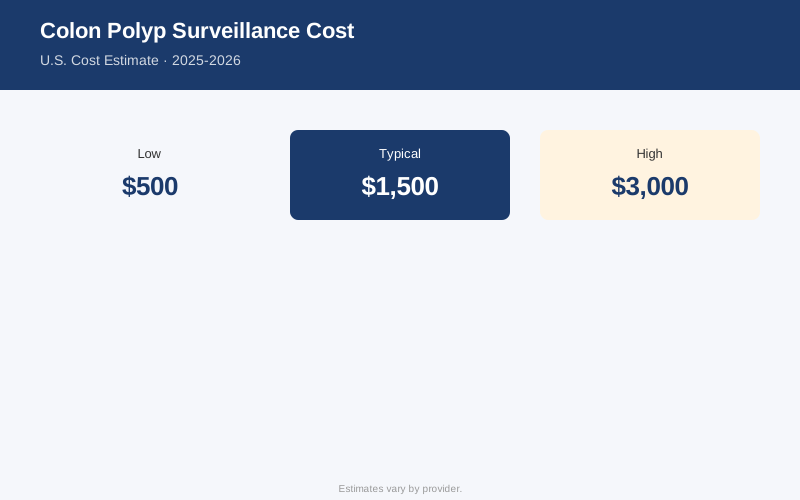
Colon Polyp Surveillance Cost: How Much Do Follow-Up Colonoscopies Cost?
Your first colonoscopy was covered as a free preventive screening. Then they found a polyp. Now your doctor is scheduling a follow-up in 3 years — and it’s not going to be free. That’s the financial reality most polyp patients discover after their first procedure.
Surveillance colonoscopies after polyps are billed as diagnostic, not preventive. That means insurance cost-sharing rules apply. And given that roughly 40% of colonoscopy patients have at least one polyp found, according to the American Society for Gastrointestinal Endoscopy (ASGE), this affects a lot of people.
Here’s what surveillance colonoscopies cost and how to manage those costs over time.
Surveillance Intervals by Polyp Type
Your follow-up schedule depends entirely on what the pathology report shows — not just how many polyps were found, but what type they were.
| Finding | Recommended Surveillance Interval | Notes |
|---|---|---|
| No polyps (normal) | 10 years | Back to standard screening interval |
| 1–2 small tubular adenomas (<10mm) | 7–10 years | 2021 ACG guidelines updated this from 5 years |
| 3–4 tubular adenomas, or 1–2 up to 20mm | 3–5 years | Higher-risk category |
| 5–10 adenomas, or any adenoma ≥20mm | 3 years | High risk; closer surveillance warranted |
| Villous adenoma or high-grade dysplasia | 3 years | Regardless of size |
| Serrated polyps (sessile serrated lesion <10mm) | 5 years | Updated guidance from ACG |
| Sessile serrated lesion ≥10mm or with dysplasia | 3 years | Increased risk |
| 10+ adenomas | 1–3 years | Consider genetic evaluation |
| Incomplete polyp removal (large polyp, piecemeal) | 3–6 months at same facility | Must confirm complete removal |
What Surveillance Colonoscopy Costs
Since surveillance is diagnostic rather than preventive, your cost depends on your insurance plan and deductible status.
| Payer/Situation | Estimated Cost |
|---|---|
| Commercial insurance, deductible met | $150 – $600 (coinsurance only) |
| Commercial insurance, deductible NOT met | $500 – $2,500 (until deductible satisfied) |
| Medicare Part B, colonoscopy for high risk | $0 (covered at 100% every 2 years) |
| Medicare, diagnostic (post-polyp surveillance) | 20% of approved amount after deductible; typically $100 – $350 |
| Uninsured, hospital outpatient | $1,500 – $4,500 cash |
| Uninsured, ambulatory surgery center (ASC) | $800 – $2,500 cash |
How Medicare Handles Post-Polyp Surveillance
Medicare’s colonoscopy coverage has two categories:
Screening (preventive): If you’ve never had a polyp, Medicare covers colonoscopy every 10 years at no cost-sharing (age 45+ beginning in 2023).
High-risk surveillance: If you have a personal or family history of colon cancer, polyps, or IBD, Medicare covers colonoscopy every 2 years at no cost-sharing. This is the category most post-polyp patients fall into.
After polyp removal becomes “diagnostic”: If polyps were removed at your last colonoscopy, your next one may be billed as diagnostic, and Medicare applies Part B coinsurance (20% after the annual deductible). Whether you’re classified as “high risk” vs. “diagnostic” can significantly affect your cost — and it’s worth clarifying with your GI office and Medicare which code your procedure will be submitted under before the appointment.
The Key Question to Ask Your GI Doctor Before Surveillance
Before scheduling your surveillance colonoscopy, ask your GI doctor’s office:
“How will this colonoscopy be billed — as screening for high-risk patients, or as diagnostic?”
The answer matters financially:
- High-risk screening: often no cost-sharing (Medicare, many commercial plans)
- Diagnostic: deductible and coinsurance apply
You can’t control which CPT code is used — that’s clinically determined by your diagnosis. But knowing in advance allows you to plan financially, use HSA/FSA funds, and schedule around your deductible reset date if helpful.
The Long-Term Cost of a Polyp History
If your polyp history places you on a 3-year surveillance schedule, you’re looking at a long-term recurring cost. Over 20 years, that’s roughly 6–7 colonoscopies. At $500–$1,000 per procedure after insurance, the lifetime cost of surveillance for moderate-risk adenoma history is $3,000–$7,000 — a meaningful financial commitment.
Strategies to manage this:
- Schedule surveillance in your high-deductible year strategically. If you have other medical expenses planned, bunching them in the same calendar year maximizes your deductible value.
- Use your HSA. Surveillance colonoscopy is fully HSA/FSA-eligible. If you’re on a high-deductible health plan, contribute aggressively to your HSA in years you expect GI procedures.
- Ask about self-pay discounts. Even with insurance, you can ask for the self-pay rate if it’s lower than your plan’s negotiated rate (this is more common with high-deductible plans where the negotiated rate and self-pay rate are close).
- Compare facility pricing. An ASC-based colonoscopy is consistently cheaper than a hospital outpatient department for the same procedure — often by 40–60%. Ask your GI doctor which facilities they have privileges at.
- Don’t skip surveillance to save money. Colon polyps are the precursors to colorectal cancer. The entire point of surveillance is catching advanced adenomas before they become malignant. Skipping a 3-year follow-up to avoid the cost is a false economy.
What If Polyps Are Found at Surveillance, Too?
Finding additional polyps at a surveillance colonoscopy restarts the clock — your next interval is set based on the new findings, not the original ones. If you’re found to have 5+ adenomas or a large serrated lesion at your 3-year surveillance, you may need to return in 1–3 years rather than 5.
Pathology fees apply to each specimen sent for biopsy: typically $100–$400 per polyp specimen depending on the laboratory. If multiple polyps are removed and sent separately, pathology can add $300–$800 to the total bill.
The cost of surveillance adds up, but so does the alternative. Colorectal cancer is the third leading cause of cancer death in the US, per the ACS — and the majority of cases develop from polyps that could have been caught and removed during surveillance.