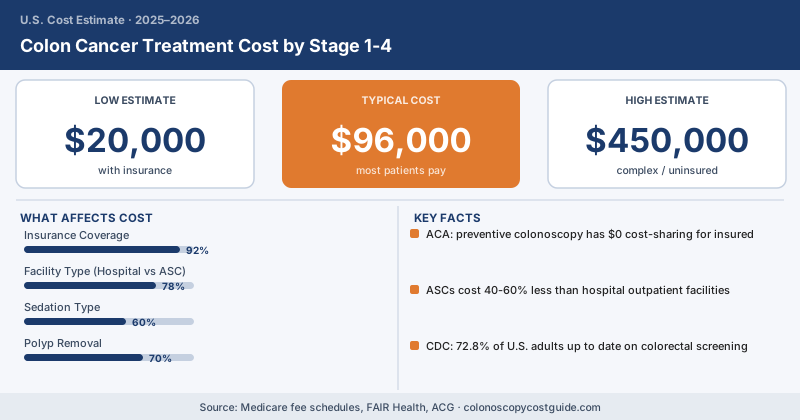
Colon Cancer Treatment Cost by Stage: Stage 1 Through Stage 4 Breakdown
Stage I colon cancer caught during a routine colonoscopy: surgery, a few days in the hospital, done. Total treatment cost around $20,000 to $40,000. Stage IV with liver metastases: 18 to 24 months of chemotherapy, targeted therapy, potentially liver surgery, immunotherapy — easily $250,000 to $500,000. That’s the stark math behind why a $0 preventive colonoscopy is one of the most financially meaningful health decisions you can make.
The American Cancer Society estimated 154,270 new colorectal cancer cases and 52,180 deaths in the U.S. in 2023. Early detection doesn’t just save lives — it saves the healthcare system (and patients) hundreds of thousands of dollars per case.
Stage I Colon Cancer Treatment Costs
Stage I means the cancer is confined to the inner layers of the colon wall and hasn’t reached lymph nodes or distant organs. Treatment is usually surgery alone.
Typical treatment: Surgical resection (colectomy)
- Laparoscopic partial colectomy: $18,000–$35,000 (facility + surgeon + anesthesia)
- Open colectomy: $22,000–$45,000
- Hospitalization (3–5 days): $8,000–$18,000
- Post-op follow-up colonoscopies (surveillance): $1,500–$4,000 over 5 years
Total Stage I estimated cost: $20,000–$55,000
With commercial insurance, your out-of-pocket is typically your deductible + coinsurance, hitting your annual out-of-pocket maximum. Most plans cap this at $4,000–$9,000 per year. With Medicare, coinsurance applies to hospital stays (inpatient Part A) and physician fees (Part B).
| Stage I Component | Estimated Cost |
|---|---|
| Laparoscopic colectomy (facility + surgeon) | $18,000–$35,000 |
| Inpatient hospital stay (3–5 days) | $8,000–$18,000 |
| Pathology and staging workup | $1,500–$3,500 |
| 5-year surveillance colonoscopies (2–3 total) | $3,000–$6,000 |
| Total (before insurance adjustments) | $30,000–$62,500 |
Stage II Colon Cancer Treatment Costs
Stage II cancer has grown through the colon wall and possibly into nearby tissues, but lymph nodes are clear. Surgery remains the primary treatment. Adjuvant chemotherapy is recommended for high-risk Stage II patients (T4 lesions, perforation, lymphovascular invasion).
Typical treatment: Surgery + possibly chemotherapy (FOLFOX or CAPOX regimen)
- Surgery: same as Stage I range
- Adjuvant chemo (if high-risk), 6 months of FOLFOX or CAPOX:
- Drug costs: $8,000–$20,000
- Infusion center administration: $15,000–$40,000
- Lab monitoring and oncology visits: $5,000–$10,000
Total Stage II estimated cost: $35,000–$120,000 (higher end if chemo is added)
Stage III Colon Cancer Treatment Costs
Stage III means cancer has spread to nearby lymph nodes. Standard treatment is surgery followed by 6 months of adjuvant chemotherapy — typically FOLFOX (fluorouracil, leucovorin, oxaliplatin) or CAPOX (capecitabine + oxaliplatin).
According to a 2022 analysis published in JNCI (Journal of the National Cancer Institute), the mean total first-year treatment cost for Stage III colon cancer in the U.S. was approximately $96,000 to $115,000.
| Stage III Component | Estimated Cost |
|---|---|
| Colectomy surgery | $20,000–$45,000 |
| Pre-op staging (CT, PET, MRI scans) | $3,000–$8,000 |
| 6-month FOLFOX chemotherapy (drugs + administration) | $30,000–$65,000 |
| Oncology visits and monitoring labs | $8,000–$15,000 |
| Port placement for IV access | $3,000–$6,000 |
| Nausea, neuropathy management | $2,000–$5,000 |
| Surveillance colonoscopies (years 1–5) | $4,000–$8,000 |
| Total first year | $65,000–$150,000 |
Stage IV Colon Cancer Treatment Costs
Stage IV is metastatic — cancer has spread to distant organs, most commonly the liver, lungs, or peritoneum. Treatment is no longer curative for most patients, but modern regimens can achieve meaningful remission and significantly extended survival.
Stage IV treatment is also where costs become genuinely enormous. The NCI estimated average lifetime treatment costs for metastatic colorectal cancer at $200,000 to $500,000+, depending on treatment duration and drug regimens used.
Typical Stage IV treatment components:
- First-line chemotherapy (FOLFOX, FOLFIRI, or FOLFOXIRI) plus a biologic agent (bevacizumab/Avastin or cetuximab/Erbitux): $180,000–$300,000 per year in drug costs alone
- Immunotherapy (pembrolizumab/Keytruda or nivolumab/Opdivo) for MSI-high tumors: $150,000–$200,000 per year
- Liver resection surgery (if liver-limited disease): $35,000–$80,000
- Ablation procedures (radiofrequency ablation of liver mets): $10,000–$25,000 per session
- Ongoing imaging (CT scans every 3 months): $1,200–$2,800 per scan; $5,000–$11,000 per year
- Supportive care (antiemetics, growth factors, wound care): $10,000–$30,000 per year
Total Stage IV estimated annual cost: $200,000–$450,000+
Financial Assistance for Stage IV Patients
Biologic drugs like Avastin, Erbitux, and immunotherapy agents all have manufacturer patient assistance programs. The Colorectal Cancer Alliance (colorectalcancer.org) has a financial navigation service that helps Stage IV patients access:
- Free drug programs (for uninsured or underinsured)
- Co-pay assistance foundations (PAN Foundation, HealthWell Foundation)
- Social Security Disability fast-track (Blue Book listing for metastatic colon cancer) Medicare and Medicaid eligibility often changes after a Stage IV diagnosis — a hospital social worker or patient navigator can help you reassess your options.
Out-of-Pocket Maximums Are Your Key Protection
For patients with commercial insurance, the ACA out-of-pocket maximum ($9,450 single / $18,900 family in 2025) is the most important number in your policy. Once you hit it, your insurer covers 100% of remaining in-network costs for the plan year. Most colon cancer patients will hit this maximum — the question is how fast and how many times across multiple plan years.
For Medicare patients, there’s no out-of-pocket maximum for Part A and B combined. Many colon cancer patients end up spending $3,000 to $10,000+ per year in Medicare cost-sharing, which is why Medigap policies or Medicare Advantage plans are financially critical for cancer patients.
This is exactly why the colon cancer surgery cost and screening investment deserve to be understood together — catching cancer at Stage I vs. Stage IV is a difference of hundreds of thousands of dollars and, more importantly, years of life.