Colon Cancer Screening Cost Comparison: Every Option Side by Side
3 things to know before you pick a colorectal cancer screening method: what each test actually finds, how often you’ll repeat it, and what it’ll cost over a decade when you include follow-ups.
Most patients pick their screening method based on what their doctor orders. That’s fine — but understanding the cost math helps you ask smarter questions, especially if you’re paying out of pocket or managing a high deductible. The USPSTF endorses seven different colorectal cancer screening strategies as acceptable for average-risk adults starting at age 45. Each has a different price tag per test, a different testing interval, and a different likelihood of triggering a follow-up colonoscopy.
Here’s the honest breakdown.
The Six Main Options
1. Colonoscopy
The gold standard. A gastroenterologist examines your entire colon with a flexible scope and removes polyps on the spot. If normal, you don’t repeat it for 10 years.
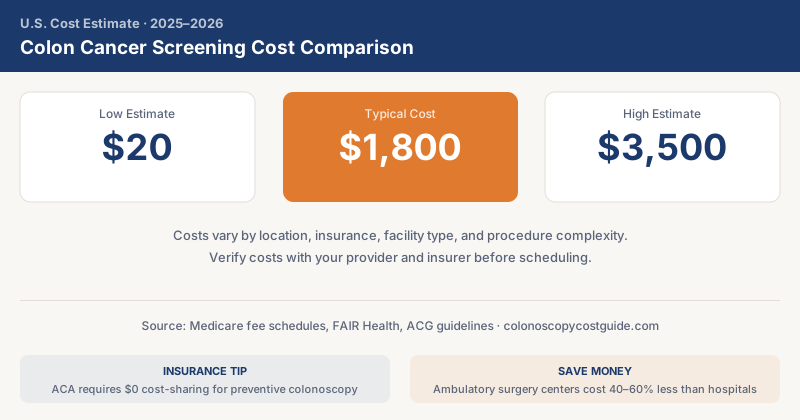
Average cost per procedure: $1,500 – $3,500 (with insurance, most average-risk patients owe $0 to $300 as screening; uninsured cash prices range $800–$2,500 at an ASC).
2. Cologuard (Stool DNA Test)
A take-home kit that analyzes stool DNA for cancer markers plus blood. More sensitive for polyps than FIT, but also more expensive and generates more false positives. Repeat every 3 years if normal.
Average cost: $600 – $800 per test. Medicare pays 100% as a preventive benefit; private insurance coverage varies significantly.
3. CT Colonography (Virtual Colonoscopy)
Low-dose CT scan of the colon. No sedation, but you still need bowel prep. If a polyp 6mm or larger is found, you need a follow-up optical colonoscopy — and that second procedure often comes with separate cost-sharing. Repeat every 5 years if normal.
Average cost: $400 – $1,500 per scan. Medicare currently does not cover it as a preventive screening (though this is under ongoing review). See virtual colonoscopy cost for details.
4. FIT (Fecal Immunochemical Test)
Annual take-home stool test. Detects blood in stool using antibodies. No dietary restrictions needed. Must be repeated every year.
Average cost: $20 – $60 per test. Covered 100% under Medicare and most ACA-compliant plans.
5. Guaiac FOBT (High-Sensitivity)
Annual take-home stool test using a chemical reaction. Requires 3-day dietary restrictions. Slightly less convenient than FIT. Annual testing required.
Average cost: $5 – $25 per test. Covered 100% under Medicare and ACA-compliant plans. See FOBT cost for specifics.
6. Flexible Sigmoidoscopy
A shorter scope that examines the lower third of the colon. Done every 5 years, or every year with annual FIT. Doesn’t require sedation at most practices.
Average cost: $200 – $800. Medicare covers it every 48 months (every 4 years) for average-risk patients.
10-Year Total Cost Comparison
This table assumes an average-risk adult, average-risk screening schedule, covered under insurance (most plans cover initial screening at $0). Follow-up colonoscopy triggered by any abnormal result is estimated at $1,800 (typical insured patient out-of-pocket after deductible and coinsurance at an ASC).
| Screening Method | Tests Over 10 Years | Cost Per Test | Follow-Up Risk | Estimated 10-Year Cost |
|---|---|---|---|---|
| Colonoscopy | 1 | $0–$300 | Low (polyps removed during test) | $0–$600 |
| Cologuard (stool DNA) | 3–4 | $0 (Medicare) / $300–$600 (private) | ~13% false positive rate | $900–$2,400 + possible colonoscopy |
| CT Colonography | 2 | $400–$1,500 | ~8% need follow-up colonoscopy | $800–$3,000 + possible $1,800 |
| FIT (annual) | 10 | $0 (insured) | ~5% annual positive rate | $0–$600 + possible colonoscopies |
| Guaiac FOBT (annual) | 10 | $0 (insured) | ~3–6% annual positive rate | $0–$250 + possible colonoscopies |
| Flexible sigmoidoscopy | 2 | $0 (Medicare) / $200–$800 | ~5% need full colonoscopy | $0–$1,600 + possible colonoscopy |
The Hidden Cost of False Positives
The Follow-Up Colonoscopy Problem
Every non-colonoscopy screening method has the same Achilles heel: when it finds something, you still need a colonoscopy. And that colonoscopy is almost always billed as diagnostic, not preventive screening.
The financial consequence:
- Preventive colonoscopy: $0 cost-sharing under ACA-compliant plans
- Diagnostic colonoscopy triggered by positive FOBT/FIT/CT: Counts toward your deductible; you pay your full cost-sharing
The ACG estimated in a 2022 analysis that this “rescreening effect” adds $200 to $1,800 to the real-world 10-year cost of FIT-based screening for patients with commercial insurance.
Which Option Is Cheapest Over Time?
If you’re covered by insurance and average-risk: A single preventive colonoscopy at age 45 with no polyps found costs you nothing and doesn’t repeat until age 55. That’s genuinely the lowest lifetime cost in most scenarios.
If you’re uninsured: FIT or guaiac FOBT is the cheapest entry point — $20 to $60 per year — with colonoscopy reserved for a positive result. See colonoscopy cost without insurance if you eventually need the follow-up scope.
If you’re on Medicare: Colonoscopy is covered at $0 for preventive screening every 10 years. FIT and guaiac FOBT are covered annually at $0. Cologuard is covered every 3 years at $0. CT colonography is currently not a covered preventive benefit.
Making the Decision
Cost is a real factor — but it’s one of several. Here’s a quick decision tree:
Choose colonoscopy if: you’re average-risk, have good insurance, can tolerate sedation, want the longest interval between tests.
Choose FIT or FOBT if: you’re uninsured or on a tight budget, willing to test every single year, and want to defer the colonoscopy unless something flags positive.
Choose Cologuard if: you prefer a non-invasive test, have Medicare, and understand you may need a colonoscopy anyway if it comes back positive.
Choose CT colonography if: you can’t tolerate sedation, no one in your area offers colonoscopy at an acceptable cost, and you understand Medicare won’t cover it preventively.
Talk through these tradeoffs with your gastroenterologist. The best screening test, as the old gastroenterology saying goes, is the one you actually do.